

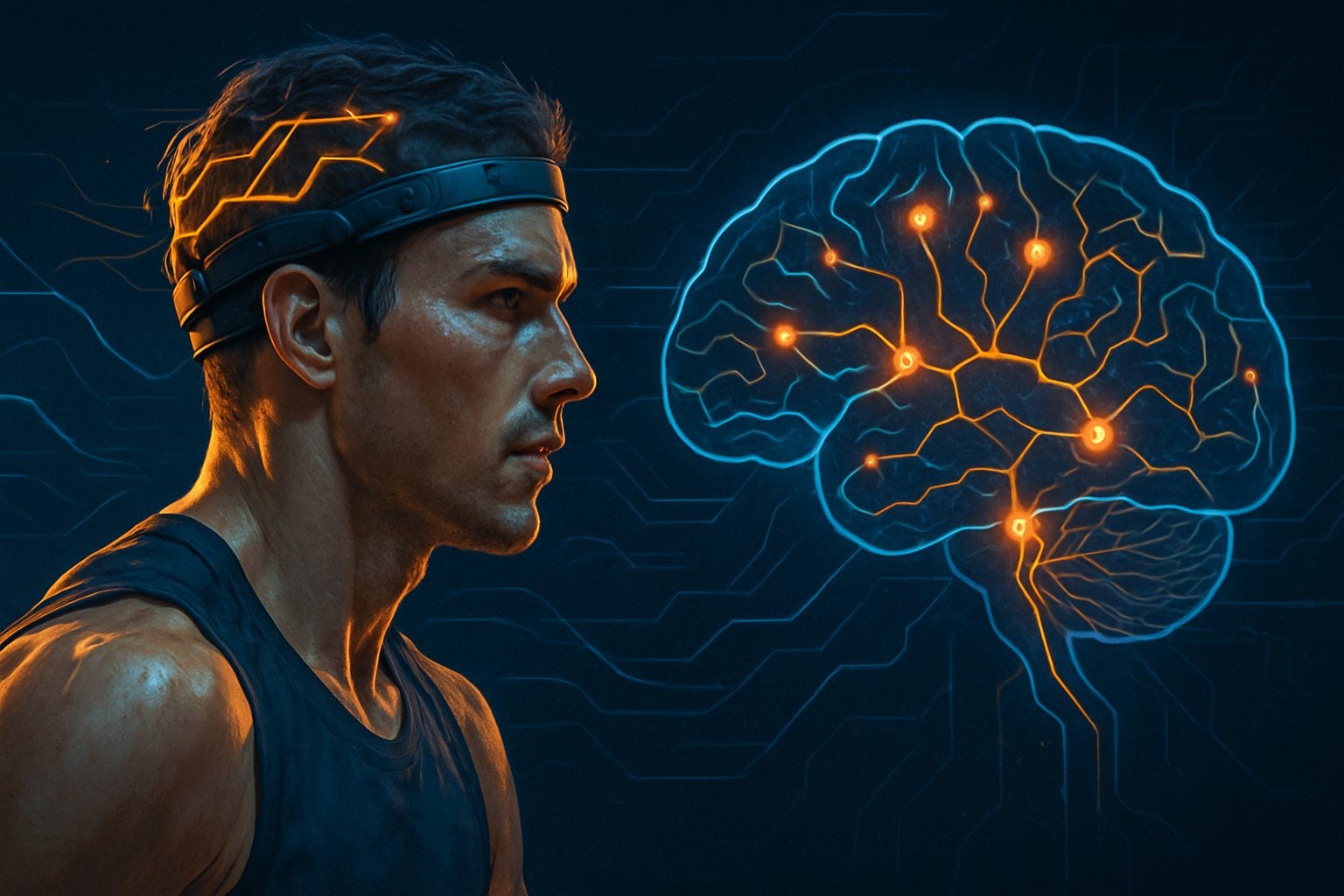
In the modern world of elite sports, the edge isn’t just muscular. It’s neural. Athletes today are no longer sculpting only their biceps and calves — they’re training their brains — and the results are staggering. Welcome to the era where neurotechnology meets the athlete’s playbook, transforming raw talent into razor-sharp precision. Think less sweat alone, and more wired circuits, real-time feedback loops, and cognitive drills that make a champion both mentally agile and physically fluid 🔄.
From brain sensing headsets to immersive cognitive drills, neurotech is quietly reshaping athletic performance by fortifying the brain-body connection — the intimate communication between neural impulses and physical movement that decides split-second outcomes on the field. If you’re curious how the pros are bending biology in their favor, buckle up. This is where silicon meets sweat. 💪🧠
1. Real-Time Cognitive Monitoring with Wearable EEG 🎧
Wearable EEG devices were once the stuff of labs — bulky, finicky, and fragile. Not anymore. Today’s lightweight EEG headsets can track an athlete’s mental states — attention, fatigue, stress — in real-time, even during training sessions or competition simulations. Coaches can see when focus peaks or dips, and blend that insight into session planning or in-game decisions. This isn’t sci-fi anymore; it’s performance analytics with brain data.
💡 Impact: Faster decision timing, better fatigue management, and sharper concentration when it matters most.
2. Neurofeedback Training to Optimize Brain States 🧠📊
Neurofeedback is like a gym for your brainwaves: sensors track your neural activity while software provides real-time feedback, helping athletes learn how to self-regulate brain patterns. With repetition, they can dial up focus or dial down anxiety. It’s reward-based learning for neural states.
Think of it as bio-hacking your calm. Top performers report improved reaction times, faster focus recovery, and mood resilience — all built through repeated neurofeedback loops.
3. Cognitive Simulation Training (Serious Gaming) 🎮
Not all brain training happens in silence. Tools like IntelliGym bring cognitive demands into game-like environments — challenging spatial awareness, pattern prediction, anticipation, and decision-making. These aren’t just video games — they’re serious cognitive simulators molded to sport psychology.
🏒 Example: Hockey players using IntelliGym show reduced injury rates because better awareness helps them avoid risky collisions on ice.
4. Sensory & Visual Tracking Systems 👀
Platforms like NeuroTracker and Senaptec sharpen perceptual tracking, visual focus, and depth perception — sensory skills at the core of elite performance. These systems make athletes better at juggling multiple moving objects, interpreting dynamic field info, and reacting to subtle visual cues.
🎯 Why it matters: Better vision processing means smarter movement — you see the play sooner, and your body follows suit.
5. Brain-Computer Interfaces (BCIs) for Neural Insight 🤖
BCIs create a direct communication channel between neural signals and computing systems, offering real-time feedback that reveals hidden patterns in mental effort, stress responses, and decision loops. For athletes, this means tailoring training at a neural level rather than guessing from physical markers alone.
🧪 What it does: Reveals your brain’s optimal cognitive window — the zone where neural and physical performance are aligned.
6. Motor Visualization & Neuromuscular Training 👣
Some neurotech platforms let athletes rehearse physical skills without moving a muscle — training the brain’s motor networks to produce stronger, more accurate movement once the body follows suit. This is especially powerful for injury recovery and skill refinement.
🎯 The idea: Your brain learns the motion pattern in vivid detail, then commands the body more effectively in actual play.
7. Non-Invasive Brain Stimulation (tDCS & TMS) ⚡
Cutting-edge research suggests that techniques like transcranial direct current stimulation can enhance motor performance and coordination by priming neural circuits in the motor cortex. While still emerging, early evidence shows promise in improving movement execution and responsiveness.
⚠️ Note: This area is controversial and still under ethical debate — especially regarding “neuro-doping.”
8. Brain Endurance Training 🧠🏃
Just like muscles fatigue, brains do too. Neuro training sessions that combine physical and cognitive challenges strengthen the brain’s stamina — meaning less mental fade during grueling competition moments. It’s endurance for your internal command center.
💪 Result: Better decision clarity and fewer mental slip-ups late in the game or race.
9. Virtual Reality (VR) Neurotraining 🥽
Immersive VR environments let athletes practice under simulated pressure — replicating game scenarios that trigger stress responses, all while collecting neural and physiological data. This lets them train for mental control the way they train physical plays.
🎮 Bonus: It’s fun — and the brain learns better when training feels like play.
10. Personalized Cognitive Profiling & Data-Driven Plans 📈
Leading teams and performance centers now create neural profiles of their athletes — detailed maps of cognitive strengths and weaknesses. These profiles inform personalized training regimens, blending traditional physical drills with brain-specific exercises tailored to each athlete’s neural makeup.
📊 Impact: More targeted, efficient training — fewer wasted reps, more meaningful improvements.
Why This Matters
The brain-body connection isn’t just jargon. It’s the core architecture of performance. Whether it’s shaving milliseconds off reaction times or staying calm under championship pressure, neurotech gives athletes a data-backed advantage that can separate contenders from champions. 🏆
Also read: 8 NeuroTech Tools That Can Improve Focus & Mental Clarity
🏁 Final Thought
Are you curious how your favorite athlete might be training their mind? Or want to boost your own neural fitness? Start with a wearable EEG or a cognitive simulation — that’s where the revolution begins.
Ready to think like a champion? ⚡