

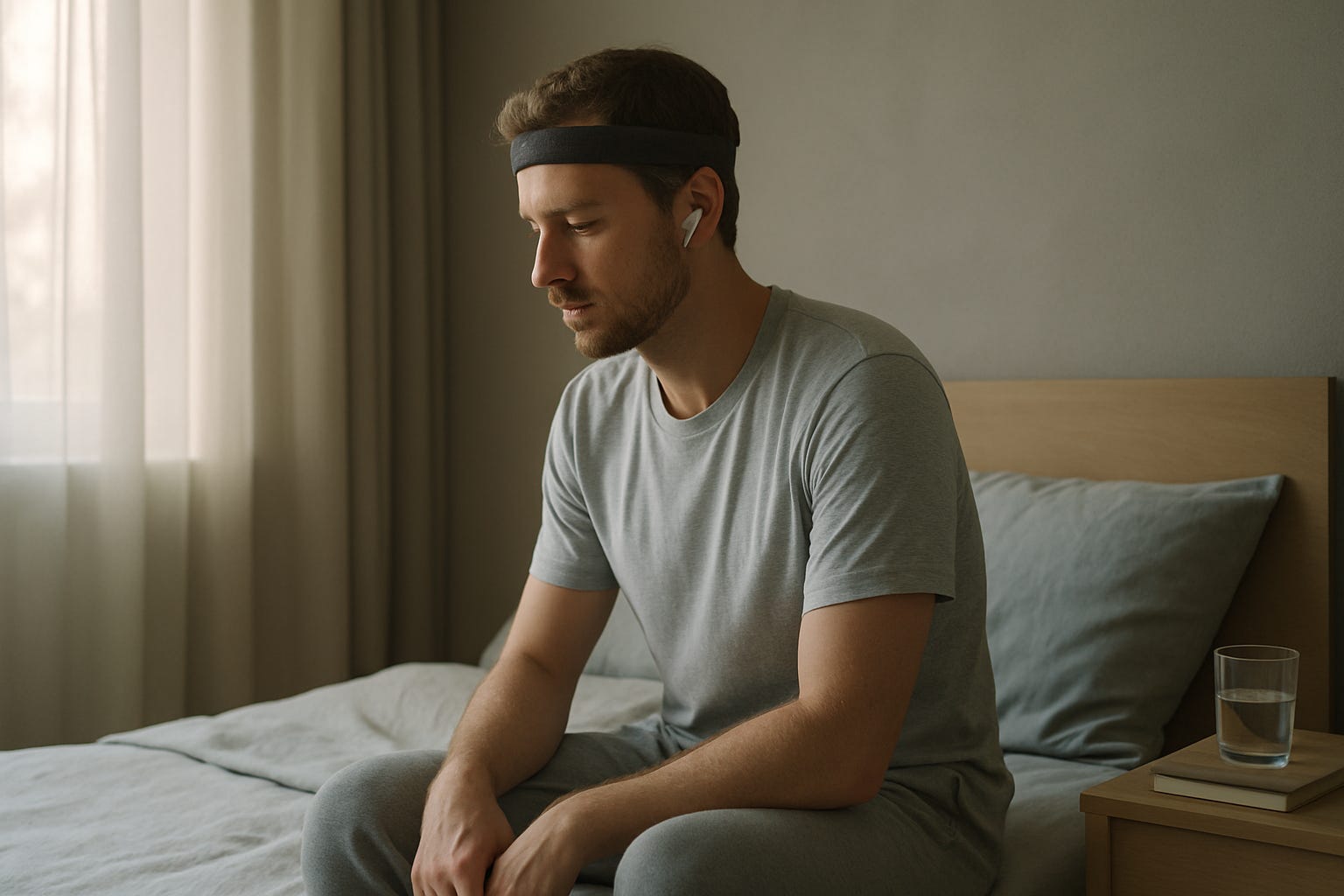
Sleep is the most studied, most poorly understood, and most universally ignored pillar of human health. The CDC reports that about one in three adults in the United States does not get enough sleep. Not occasionally. Routinely. And seven of the fifteen leading causes of death in the country link to poor sleep quality, according to data compiled by SingleCare from multiple national health surveys. We know this. We’ve known it for decades. And yet the average American still goes to bed with a racing mind, wakes up groggy, and calls it fine.
What’s changed recently isn’t the problem — it’s the toolkit. A small but genuinely interesting category of wearable neurotechnology has moved from sleep research labs into consumer bedrooms, bringing electroencephalography (EEG) with it. These aren’t rings or wristbands inferring your sleep stages from heart rate and wrist movement. They read brainwave patterns directly, the same signal that clinical sleep studies have used since Hans Berger first recorded human EEG in 1924. That fundamental advantage matters when you’re trying to know not just that you slept eight hours, but what your brain was actually doing during those hours.
Three devices are worth serious attention in 2026. They use different sensor combinations, different intervention strategies, and sit at very different price points. None of them are magic. But the data behind each one is more substantive than the usual wellness gadget promises — and the research explaining why brain-based sleep tracking is genuinely superior to accelerometry is worth understanding before you buy anything.
What EEG actually changes about sleep tracking 🧠
Before getting into specific devices, it’s worth being clear about what makes EEG-based sleep tracking different in principle, because the marketing noise around this category is significant.
Sleep stages — light sleep, deep slow-wave sleep, and REM — are defined by brainwave patterns. The American Academy of Sleep Medicine’s standard for scoring sleep requires EEG. A Polysomnography (PSG) lab test, which is clinical gold standard, uses 16 to 25 electrodes on the scalp to capture those patterns across the night. Consumer EEG wearables use far fewer channels, which reduces spatial resolution. But they’re still reading the fundamental signal that defines sleep architecture, which is something a ring or a wrist tracker simply cannot do.
Devices that rely on photoplethysmography (PPG) and accelerometry — meaning optical heart rate sensors and motion detection — can reach around 75% accuracy in sleep staging, according to comparison data cited across multiple 2025 and 2026 reviews. That’s useful for trend tracking, but it means roughly one in four sleep stage calls is wrong, particularly during REM and light-to-deep transitions. EEG-based systems consistently outperform this, which is why the research community still mandates PSG for clinical sleep diagnosis.
The three devices below each take a different approach to solving the core challenge of applying clinical-grade EEG to someone’s actual bedroom:
Muse S Athena adds fNIRS alongside EEG to track both electrical brain activity and blood oxygenation in the prefrontal cortex simultaneously
NextSense Smartbuds move EEG sensors into the ear canal, solving the comfort problem that has killed previous forehead-based sleep headbands
FRENZ Brainband pairs EEG with eye movement tracking (EOG) and facial muscle tracking (EMG) for the most comprehensive brain-and-body signal picture currently available in a consumer device
Which approach is best depends entirely on what you’re trying to do — and what you’re willing to tolerate on your head at 2 a.m.
Muse S Athena — the EEG + fNIRS benchmark ($474.99) 💡
The Muse S Athena launched in March 2025 as the first consumer wearable to combine EEG and fNIRS in a single headband. InteraXon, the Canadian company behind Muse, has been building consumer EEG devices since 2014, which in this category is a long run. The Athena is the third generation of their sleep-focused product, and the generational jump is real.
The hardware includes seven EEG sensors, a five-optode fNIRS array targeting bilateral prefrontal cortex hemodynamics, an upgraded PPG sensor for heart rate and SpO2, an accelerometer, and a gyroscope. That sensor combination lets the device do something no previous Muse could: it tracks both what state your brain is in (via EEG) and how hard it is working (via fNIRS, which measures oxygenated blood flow). Nathaly Arraiz Matute, Hardware Engineering Manager at Muse, told IEEE Pulse that this dual-signal approach unlocks “a deeper, more accurate picture of how your brain is functioning, focusing, and recovering.”
What does the data show? A few numbers worth holding carefully:
A 2021 study led by Western University, Cambridge Brain Science, Hatch, and InteraXon found 20% improvement in the Pittsburgh Sleep Quality Index among Muse S users relative to controls
InteraXon’s internal validation data shows 86% accuracy in sleep stage identification compared to PSG, with more recent claims of 88–96% accuracy using the Foundational Brain Model AI layer
A study published in Frontiers in Neuroscience found moderate-to-high correlations between Muse S sleep staging and PSG for REM and deep sleep phases
Those numbers come with a necessary asterisk. The 86% figure is from InteraXon’s own research team, not an independent large-sample peer-reviewed trial. That’s not disqualifying — the methodology is sound and the company has published in credible journals — but independent replication at scale hasn’t happened yet. The IEEE Pulse piece from August 2025 described Muse as part of a broader category that is “more than hype,” while noting that clinical claims require stronger evidence before these devices replace medical sleep studies.
The Digital Sleep Pill feature is Athena’s most practically interesting capability: a guided audio program that fades out in response to real-time EEG data as you fall asleep, then modulates throughout the night based on your actual brain state. Think of it less as a white noise machine and more as a responsive sleep co-pilot that adjusts its behavior based on your neural signals. The 55% improvement in sleep onset speed that Muse cites is from internal testing, not an external trial — but the mechanism is real and the behavioral principle is sound. 🔬
The main friction points are price and subscription:
Hardware: $474.99
Subscription: required for full feature access; approximately $100–$130/year
Comfort: a fabric headband with a sensor pod works fine for meditation; wearing it all night is a different experience, and some users abandon it within weeks
The honest question about Athena is whether you’re buying a sleep tracker or a sleep trainer. The neurofeedback and guided content suggest the latter intent, which is a meaningful difference. Passive tracking tells you what happened; active neurofeedback attempts to change what happens going forward. If you’re willing to engage with the app consistently, Athena’s EEG + fNIRS combination is the most technologically sophisticated consumer sleep device currently available.
NextSense Smartbuds — in-ear EEG for sleep ($249–$399.99) 🎧
The NextSense Smartbuds are the most interesting product in this space for a simple reason: they solve the form factor problem that has defeated every previous consumer sleep EEG device. Nobody sleeps well in a forehead band. People already sleep in earbuds — or at least tolerate them for hours. NextSense, which spun out of Alphabet’s X division in 2020, built their device around that behavioral reality.
The earbuds carry six clinical-grade EEG sensors embedded in conductive silicone ear tips, sampling at 1,000 Hz across two high-resolution channels. The electrode positions cover the ear canal, concha cavum, and antitragus — locations that give reasonable access to temporal brain regions involved in sleep processing. The sensor layer uses a material called Tecticoat that maintains stable dry-contact signal without gel. At just 5 grams per bud, they’re physically designed for side sleepers, which is the majority of the adult population and historically the population most likely to throw a headband across the room by 3 a.m.
The scientific mechanism is closed-loop auditory stimulation (CLAS), which is genuinely well-studied and not unique to NextSense. A 2024 pilot study published in the Journal of Sleep Research by researchers at Charles University in Prague demonstrated that CLAS can promote sleep slow oscillations and improve memory consolidation in chronic insomnia patients, compared to sham stimulation. A 2025 study in the same journal from the University of Wisconsin-Madison showed enhanced slow-wave activity in home settings using a wearable CLAS device. The basic science has been accumulating for over a decade. NextSense is commercializing a mechanism that clinical researchers have validated in controlled environments. ⚡
What NextSense’s own data shows:
Over a controlled beta period of 106 nights, Smartbuds increased slow-wave activity in participants
Nearly 50% of beta users reported better or much better sleep and improved morning recovery
The company has collected over 1,000 nights of real-world in-ear EEG data, making it one of the larger consumer-facing datasets of its kind
NextSense’s in-ear EEG technology has been peer-reviewed in Bioelectronic Medicine in both 2024 and 2026, with independent validation showing the system detected approximately 86.4% of focal seizures in multi-site clinical recordings
That last statistic comes from a different application context, but it matters for establishing that the underlying EEG signal quality is real, not marketing fluff. The Smartbuds’ published validation goes considerably further than most consumer wellness devices bother to reach.
The cost structure requires some thought before purchasing:
Hardware: $249 early-bird (limited time), $399.99 standard retail
Fit Kit subscription: $14.99/month after the first three months, for fresh ear tips and wings that maintain sensor contact quality
Platform: requires iPhone 12 or newer running iOS 17+; no Android support as of mid-2026
Current availability: on backorder due to demand at time of writing
The subscription is a real ongoing cost and one worth scrutinizing. The ear tips need replacement to maintain EEG contact integrity — that’s a genuine technical requirement, not just a revenue mechanism — but it means a $249 purchase becomes closer to $430 in year one of standard use. That changes the value calculation compared to the upfront price.
Have you tried sleeping with earbuds before, and does the idea of wearing them all night seem feasible to you? That question probably determines whether Smartbuds are right for you more than any spec comparison. As NextSense’s Head of Product Caitlin Shure, PhD, told MD+DI at the February 2026 launch: “One of the barriers to mass adoption has been the form factor.” The ear is their answer to that problem, and it’s the most compelling answer the category has produced.
FRENZ Brainband — triple-sensor sleep science ($680) 🔬
The FRENZ Brainband by Earable Neuroscience is the most sensor-dense consumer sleep device available, and the most expensive. At $680, it’s the kind of thing that separates casual sleep optimizers from people who actually want to know what their brain is doing at 3 a.m. with serious precision.
The hardware combines three distinct neural sensing modalities that no other consumer device has brought together: EEG for brainwave patterns, EOG (electrooculography) for eye movements, and EMG (electromyography) for facial micro-muscle activity. This matters because clinical polysomnography uses exactly these three signal types to stage sleep accurately, in addition to leg movement sensors and respiratory belts. Consumer devices typically settle for EEG alone, or EEG plus heart rate. FRENZ is trying to replicate the clinical sensing stack in a forehead headband with bone-conduction speakers. 🧬
The data from Earable’s research partnerships is striking, though it comes from the company and its collaborative institutions rather than fully independent trials. In tests conducted in collaboration with the University of Colorado and the University of Oxford:
Participants fell asleep 70% faster on FRENZ than control
Deep sleep quality improved by 40%, with associated improvements in cognitive performance
Sleep staging accuracy reached 88% compared to PSG
FRENZ’s approach uses bone-conduction audio to deliver personalized CBT (cognitive behavioral therapy) content and frequency-based sound through the inner ear, driven by an AI engine that reads your real-time brain and body state. The “FRENZ Smart Alarm” feature wakes you at the lightest moment of your final sleep cycle, using actual EEG data rather than a time window estimate. That’s the same principle as other sleep-aware alarm functions, but executed with direct brain measurement rather than heart rate inference.
Tom’s Guide awarded FRENZ a CES 2025 Innovation Award slot, noting that the bone-conduction audio is “based on your biometrics and cognitive state to help induce a calm mind for restorative sleep.” The company holds 15 core patents, has published in Nature Scientific Reports, and has research collaborations with MIT, University of Massachusetts, and others. This is not a startup with a slick website — it’s a product backed by serious neuroscience work.
The trade-offs:
Price: $680 is a significant barrier; substantially more than Muse Athena and NextSense
Form factor: a forehead headband is still a forehead headband; some sleepers simply cannot habituate to it
Focus features: the Focus Flow app won CES Innovation Award at CES 2025, expanding FRENZ’s use case beyond just sleep
Newer independent review coverage is still limited relative to Muse, which has been on the market much longer
As NeurotechMag’s recent coverage noted, this broader shift from passive monitoring to active brain-based intervention is one of the defining transitions in consumer neurotech right now. FRENZ sits at the front of that wave.
So what does the data actually show — and what should you buy? 📈
Let me be direct about what the evidence supports and where it gets fuzzy.
What’s clearly established:
EEG-based sleep staging is more accurate than accelerometry or PPG-based inference
Closed-loop auditory stimulation can enhance slow-wave activity — the peer-reviewed literature on this is substantial and growing
Consumer EEG devices have improved enough to produce data that clinical researchers use in real studies; Muse hardware appears in multiple peer-reviewed papers
What’s less certain:
Whether long-term use of any of these devices produces durable sleep improvements versus short-term novelty effects
Whether the specific accuracy claims (88%, 86%, 95%) hold up in large independent trials; most validation comes from the companies themselves or their research partners
Whether subjective sleep improvement metrics from beta testing translate to the general population, which includes worse sleepers, more varied environments, and less motivated users
The pattern across all three devices is the same: the underlying science is real, the technology is ahead of the independent validation, and the marketing runs ahead of both. That’s not unique to brain wearables — it’s the nature of most consumer health tech. The right frame is not “does this work” but “what’s the mechanism, what does the evidence actually support, and what am I genuinely willing to do every night.”
As NeurotechMag’s tracking of the sector has shown, the broader neurotech industry is reaching a genuine tipping point — and sleep is where that transition is most tangible for ordinary consumers right now, because the problem is universal and the baseline alternatives (melatonin, blackout curtains, sleep hygiene YouTube videos) are clearly insufficient for a meaningful portion of the population.
If you want the most technically capable device and are willing to pay for it, the FRENZ Brainband at $680 leads on sensor depth. If you want the best-established brand with the most research behind the hardware, Muse S Athena at $474.99 is the safer bet. If comfort and form factor matter most — and for many people they’re the deciding factor — NextSense Smartbuds at $249 early-bird make the strongest case.
The harder question is what any of this tells us about ourselves. If a device that reads your sleeping brain can show you in data what poor sleep looks like — not as a vague concept but as a graph of truncated deep sleep phases and fragmented REM — does that information change behavior? The sleep researchers would say: sometimes. The device companies would say: yes. The more accurate answer is probably that brain data is a better motivator than abstract statistics for some people, and for those people, these devices represent something genuinely new. What kind of sleeper are you — the kind who changes behavior when confronted with data, or the kind who optimizes the tracker and then ignores it?