

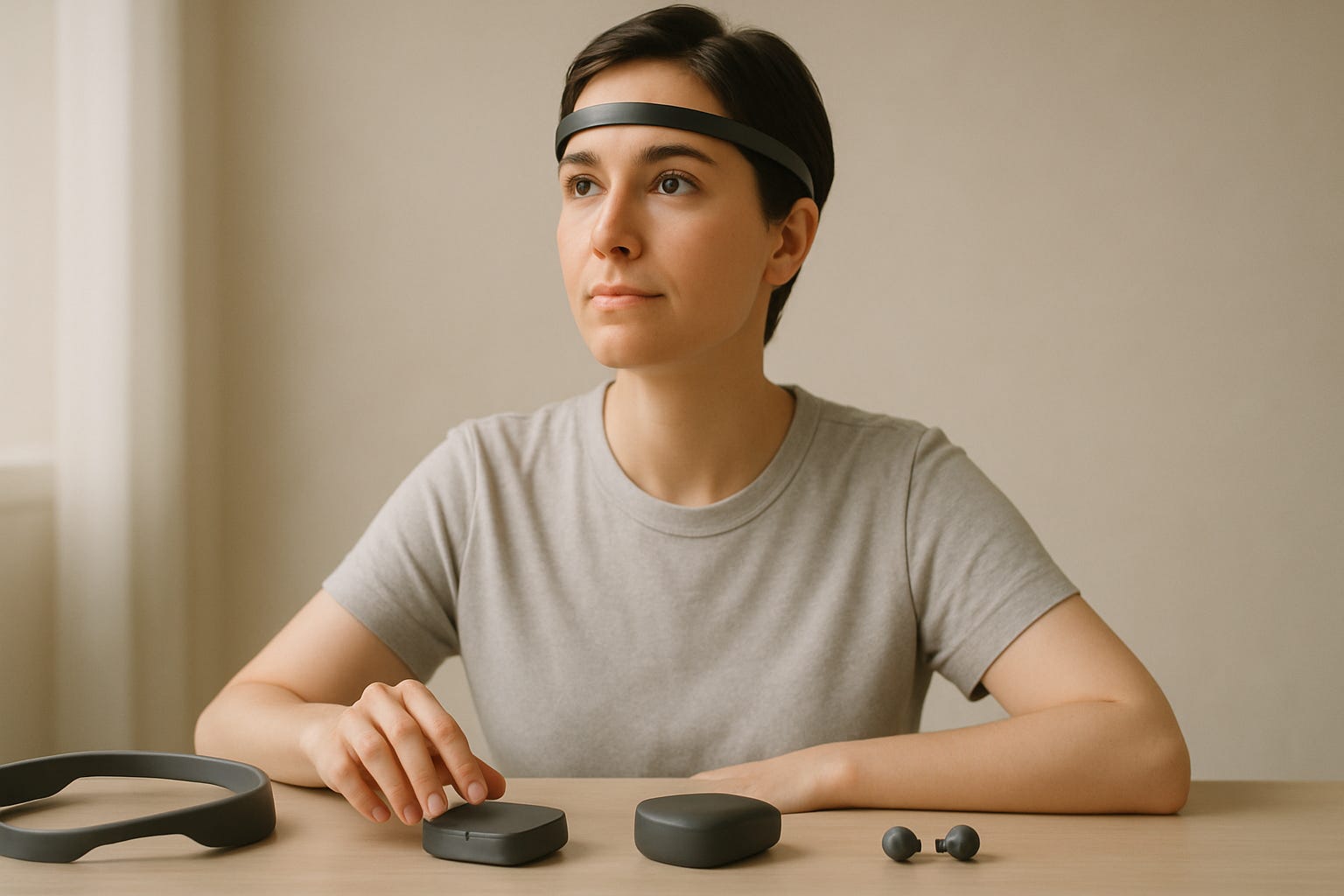
The year Neuralink put a chip in someone’s skull, most of us were still deciding whether to spring for an air fryer. That gap between sci-fi headlines and practical reality has defined neurotechnology’s awkward adolescence. But something is shifting. You no longer need a neuroscience lab, a clinical trial enrollment, or a surgeon to put a brain-sensing device to work. A decent number of them cost less than a weekend in New York — and they actually ship to your door.
This isn’t a list of vaporware or research prototypes. Every device here is commercially available, actively shipped, and priced under $300 (with one early-bird caveat). They span three distinct sensing technologies — EEG, fNIRS, and hybrid biosensing — and they target very different use cases: meditation training, sleep optimization, focus building, and raw brain-data access for developers. Not all of them are equally proven, and I’ll be upfront about that. But if you’ve been waiting for neurotech to reach the “actually buy it” phase, that moment is here. As NeurotechMag argued recently, the sector has hit genuine critical mass — and consumer products are a big part of why.
Here are five that are worth your attention.
1. Muse 2 — the approachable entry point ($249.99) 🧘
If you want to start somewhere sensible, the Muse 2 by InteraXon is still the most polished on-ramp to consumer EEG. It has been around since 2018, which in this category is practically a geological era, and the maturity shows. Seven sensors track electrical brain activity, heart rate, breathing rate, and body movement simultaneously, translating all of it into real-time audio feedback during meditation: a calm soundscape when your mind is settled, a rising storm when it wanders.
The core technology is EEG — electroencephalography — which measures the electrical signals your neurons fire as they communicate. The Muse 2 captures five frequency bands: delta, theta, alpha, beta, and gamma. Independent researcher Dr. Olav Krisolson compared the Muse 2 against an $80,000 clinical EEG system and found it held up reasonably well for basic brainwave measurement. It is not a medical instrument, but it is a real sensor taking real readings.
Key specs and things to know:
Price: $249.99 for the device; optional app subscription runs $49.99/year for the expanded library
Sensors: EEG (4 main channels), PPG for heart rate, accelerometer for breathing and body movement
Battery life: around 5 hours, which limits overnight use
App: iOS and Android, with hundreds of guided meditations at the free tier
The honest caveat: a 2023 paper in the Journal of Medical Internet Research concluded that consumer EEG devices like Muse are “extremely limited in non-laboratory conditions” for clinical-grade signal capture. That’s fair. But Muse isn’t chasing clinical-grade accuracy — it’s chasing behavioral change. Gamification and real-time feedback help people meditate consistently, and that outcome has value even if the brainwave data isn’t publishable. Think of it as meditation on training wheels that you actually keep using, rather than a lab-grade system you abandon after three sessions.
Who reaches for this? Anyone who has tried and quit meditation multiple times, or anyone who wants to see data alongside their practice. The Muse 2 works well for that specific population.
2. Mendi — the no-subscription fNIRS brain trainer ($299) 🔬
The Mendi headband is one of those products that looks unassuming — a slim white forehead band you might mistake for a sleep mask — and then does something genuinely unusual. Rather than EEG, it uses fNIRS (functional near-infrared spectroscopy), a technology that shines near-infrared light through your forehead and measures how oxygenated blood flows in the prefrontal cortex in real time.
Why does that distinction matter? EEG measures electrical activity broadly across the scalp. fNIRS zeroes in on metabolic demand in a specific brain region. According to Mendi’s Chief Product and Science Officer, Dr. Mustafa S. Hamada — who holds a PhD from the Netherlands Institute for Neuroscience — the company chose fNIRS because it is less prone to motion artifacts, more spatially localized, and cheaper to manufacture for their specific use case. In a validation study run with thirty university students at multiple institutions including TU Delft, the Mendi headband correctly detected increases in oxygenated hemoglobin during high-working-memory tasks, matching the expected direction of activity. The signal-to-noise ratio was lower than lab-grade systems, but the reading was real.
The training mechanism is charmingly low-tech: you watch a ball on your phone screen and try to raise it using focused attention. As prefrontal blood flow increases — as your brain works harder — the ball climbs. This is real-time neurofeedback.
Price: $299 flat, with lifetime app access included and no subscription fees
Technology: continuous-wave fNIRS, dual LED, targeting bilateral prefrontal cortex
Session format: 10-minute daily games; most users report noticeable changes after 8 weeks
Guarantee: 60-day money-back, 1-year hardware warranty
Validated by: Stanford University, Princeton, University of Nottingham (Mendi has formal research partnerships)
What I appreciate most is the business model. No subscription. No app paywall. $299 once and you’re done. In a category full of devices that rent you your own brain data, that’s a genuine differentiator. The fNIRS modality also has 40+ years of academic history behind it, which is more than most consumer brain gadgets can claim. 💡
Mendi won’t replace a full EEG for anyone who wants frequency-band granularity, but for prefrontal training specifically, it may actually be more targeted than most EEG headbands. Have you tried fNIRS-based training before? It’s a fundamentally different experience from the Muse approach — less atmospheric soundscape, more direct biofeedback game.
3. Flowtime — the whole-body biosensing headband (~$199) ⚡
The Flowtime Biosensing Meditation Headband by Entertech gets far less press than Muse, which is a shame, because it covers more physiological ground for about $50 less. It weighs just 29 grams — lighter than a bar of hotel soap — and combines two-channel EEG with a PPG heart rate sensor, giving you simultaneous brainwave and cardiovascular data during meditation or focus work.
The two EEG channels track left and right hemisphere brainwave activity separately, which is more than some pricier competitors offer. The device breaks down alpha, beta, theta, delta, and gamma waves, plus derives attention scores, relaxation scores, stress levels (from HRV), and “flow state” detection — the mental state of effortless focus described by psychologist Mihaly Csikszentmihalyi in his foundational research on flow. When Flowtime detects you’ve entered flow, it can trigger a soft audio cue you’ve configured in the app.
Things worth knowing before you buy:
Price: approximately $199 on the official site and Amazon, with no required subscription
Battery: 8-hour continuous use, plus a remarkable 50-day standby
App features: works alongside Apple Music, Spotify, Calm, or Headspace so you can keep your existing audio setup
Raw data export: yes — CSV export available for anyone who wants to dig into their own numbers
Build: the plastic shell feels less premium than the fabric-wrapped Muse, which some users notice
The biggest differentiator here is that Flowtime tracks heart rate variability and breath coherence alongside brainwaves, letting you see how your cardiovascular system and nervous system respond to meditation simultaneously. Most consumer EEG devices ignore the body below the neck. Flowtime doesn’t. If you want to understand the whole physiological picture of your meditation practice rather than just the brain activity piece, this is probably the best value available. 🧬
The Amazon rating sits around 4.3 out of 5 across hundreds of reviews, with users consistently praising the app’s session breakdowns and the novelty of watching their brainwave data shift in real time.
4. FocusCalm — the focus training headband ($249.99) 💡
FocusCalm takes a slightly different angle than the others on this list. Where Muse orients around meditation and mindfulness, FocusCalm targets active cognitive training — the kind of thing you’d do at a desk between meetings or before an important task. Its single EEG channel generates a real-time “calm score” that powers a suite of brain-training games and guided exercises, designed to help you build the mental habit of regulated focus under pressure.
The hardware is a dry-electrode EEG headband with an adjustable fit and a battery life that supports hour-long sessions. It is genuinely simple to set up: place it on your forehead, pair via Bluetooth, and within about 90 seconds you have a signal lock. No gel, no prep, no technician. The app works on iOS and Android and includes a library of training games, ambient programs, and progress tracking — most of it accessible without any additional subscription.
Key details:
Price: approximately $249 for the headband; no mandatory subscription for core features
Best for: attention regulation, pre-task mental preparation, anxiety reduction
Dry electrodes: yes, meaning no gel or moisture required for signal contact
Family use: one device supports multiple user profiles, a nice touch for households
Accuracy: a 2025 review on Narbis’ site (a competitor, so take with appropriate salt) cited FocusCalm’s relaxation detection at around 85% agreement with established benchmarks
A realistic note: single-channel EEG means you’re getting less spatial information than a multi-channel device. FocusCalm compensates with smart signal processing, but if you want alpha versus theta breakdown across multiple scalp regions, you’ll want more channels. What FocusCalm does well is keeping the experience focused on the outcome — building a calmer, more regulated attention state — rather than drowning you in raw data. That’s the right call for most non-technical users.
This is the one I’d recommend to someone who finds meditation apps too vague and wants their brain-training to feel more like skills practice than spiritual exercise. 🔬
5. NextSense Smartbuds — EEG in your ears ($249 early-bird) 🎧
This one requires an asterisk: the standard retail price is $399.99, but NextSense Smartbuds launched in early 2026 with an early-bird price of $249, which at the time of writing puts them squarely within our range. If you’re reading this after the early-bird window closes, the retail price takes them out of our $300 ceiling — but they deserve inclusion here because the technology is genuinely distinct from everything else on this list.
NextSense spun out of Alphabet’s X division in 2020. The Smartbuds are the first truly wireless earbuds with six clinical-grade EEG sensors built into conductive silicone ear tips, and they’re designed for all-night sleep use. Unlike wrist trackers that estimate sleep stages from heart rate and motion, Smartbuds measure brain activity directly, then use a technique called closed-loop auditory stimulation — precisely timed pink noise pulses synchronized to your slow-wave sleep oscillations — to actively deepen your rest.
The science behind this is real. Closed-loop auditory stimulation was covered by peer-reviewed research long before NextSense commercialized it. The company’s own beta data, covering 106 nights and over 1,000 nights of real-world EEG, showed meaningful increases in slow-wave activity, and nearly 50% of participants reported better or significantly better sleep. EEG-based sleep staging is the same method used in polysomnography, the gold standard for clinical sleep science — which is a different category than what most consumer wearables offer.
What to be aware of:
Fit Kit subscription: $14.99/month for replacement silicone tips — this is a recurring cost you should factor in
iPhone requirement: currently requires iPhone 12 or newer running iOS 17+; no Android support yet
Current orders on backorder due to high demand; shipping timelines may shift
Sleep-only focus for now: Relax and Focus modes are on the roadmap but not yet live
Beta data is promising, but real-world independent reviews are still limited
What NextSense is attempting — in-ear EEG that active people would actually sleep in — has been the white whale of consumer sleep tech for years. The ear is genuinely a better location for EEG during sleep than the forehead, because scalp-based headbands move, compress, and wake you up. The Smartbuds are worth watching even if you can’t get in at $249. Head of Product Caitlin Shure, PhD, told MD+DI that form factor has been the primary barrier to mass EEG adoption for over a decade — and this is the most credible answer to that problem yet. 🧠
The big picture: what should you actually buy?
Here’s an honest map of this field for 2026:
If you want to start meditating with real-time feedback: Muse 2 at $249.99 is the most polished, best-supported entry point
If you want prefrontal training with no subscription costs ever: Mendi at $299 is the clear pick, and the fNIRS technology offers a different — arguably more targeted — modality than EEG
If you want the most physiological data for the least money: Flowtime at $199 is the value play, tracking brain and heart simultaneously
If you want focus training rather than meditation: FocusCalm at ~$249 keeps things practical and outcome-oriented
If sleep quality is your primary problem: NextSense Smartbuds at early-bird $249, with your eyes open about the subscription and iOS requirement
None of these are magic. A 2023 paper in the Journal of Medical Internet Research called consumer EEG devices “more collaborative and sophisticated” than prior generations while noting their limits in non-lab conditions — and that’s an accurate characterization. The signal quality is lower than clinical systems. The claims are sometimes broader than the evidence. But the neurofeedback effect itself — using real-time data about your brain to change your behavior in the moment — is real, studied, and increasingly accessible, and a $300 entry point is genuinely new.
Neurotech has been “five years away from your bedside table” for most of the last two decades. These five products suggest we’ve closed a significant part of that gap. The interesting question now is what happens when another 50 million people start walking around with real-time brain data in their pockets — and who gets to see it besides them.