

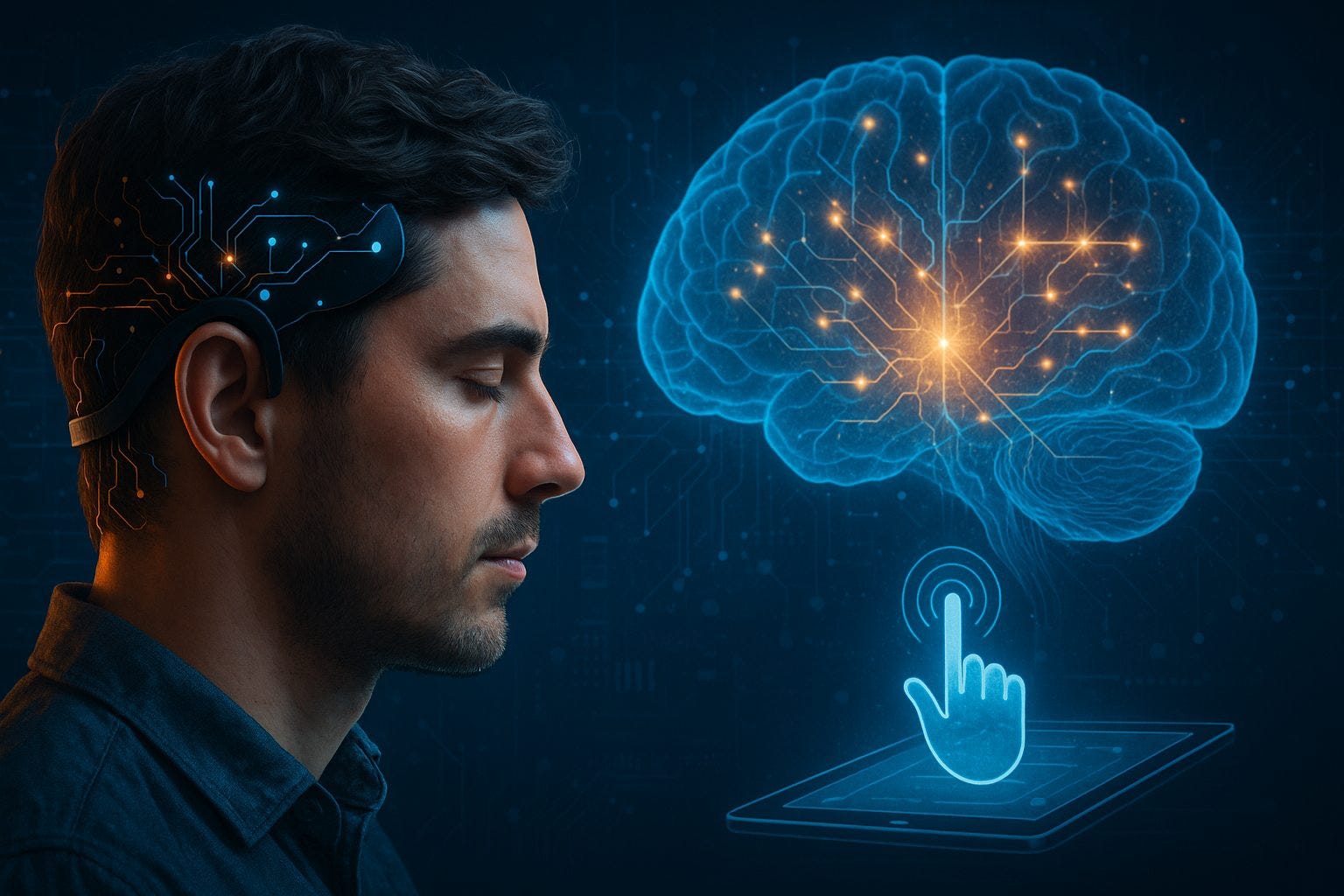
Imagine sending a message, controlling your computer, or even regulating your mood — without lifting a finger. By 2030, neurotechnology (neurotech) is poised to bring that sci-fi fantasy into everyday reality. Advances in brain-computer interfaces (BCIs), neural sensors, and AI-driven decoding are moving fast — not just for people with disabilities, but potentially for all of us. In this article, I’m walking you through five concrete ways neurotech could change daily life in the next few years. Hold on to your synapses — it’s going to be a wild ride. 😊
1. Hands-free control over devices — literally
We already live in a world of smartphones, voice assistants, and smart homes. But neurotech aims to take that to the next level: operating devices with your thoughts.
Recent breakthroughs show this is no longer just hype. In 2025, Precision Neuroscience unveiled a new BCI implant that sits on the brain’s surface (rather than penetrating deep tissue) but still captures high-resolution signals. Patients have been able to type, play games, and even control robotic devices purely with thought.
Meanwhile, less invasive BCIs (like EEG headsets) are improving — making hands-free control more practical for everyday use rather than just medical cases.
By 2030, we could see smart-home systems (lights, music, even cooking gear), computers, and wearable devices responding directly to neural commands. No gestures. No keystrokes. Just thought.
2. Restoring abilities — mobility, speech, even senses
One of the most powerful promises of neurotech lies in restoring lost functions.
For people with paralysis, stroke survivors, or neurodegenerative diseases — BCIs and neural prosthetics may offer new independence. A 2025 review outlines how neurotechnologies are already transforming diagnosis, treatment, and rehabilitation for motor, speech, and cognitive impairments.
Even more ambitious: a 2025 report on neurotech noted an implant from Neuralink (with “breakthrough device” status from the regulatory authorities) that aims to restore vision by stimulating the visual cortex in blind individuals.
By 2030, this could go beyond typing or controlling devices: we may see speech being restored to people who haven’t spoken in years, mobility regained (through mind-controlled prosthetics or exoskeletons), and perhaps even restored sensory functions. Air-Gordons of old science fiction — but real.
3. Enhanced learning, focus, and mental wellness
Neurotech isn’t just for impairment — it could become part of everyday mental performance and wellness.
Research published in 2025 suggests neurotech may transform lifelong learning, helping individuals improve focus, adapt faster, or learn languages more efficiently.
On the consumer side, neurotech firms are already more numerous than medical-focused ones — meaning the future might bring neuro-headsets for meditation, stress regulation, cognitive training, or even mood monitoring.
Imagine putting on a band before a presentation or a long flight, and the device helps calm your mind, sharpen your attention, or optimize learning speed. It might feel futuristic — but by 2030 this could be as normal as using noise-canceling headphones today.
4. A new kind of human-machine hybrid workforce
Beyond personal life: neurotech could reshape how we work.
Futuristic visions of hybrid human-machine collaboration — where you control robots, digital tools, or complex systems with your mind — are starting to take shape. As companies adopt neuro-enabled wearables, we may see enhanced productivity, near-instant control of digital environments, and a redefinition of what “work” feels like.
For physically demanding or precision work — manufacturing, complex design, creative tasks — neurotech could allow individuals to perform actions that are currently impossible or inefficient. Mental fatigue, ergonomics, and physical limitations might become less relevant in some fields.
For entrepreneurs, creatives, digital natives — this could unlock entirely new ways of building, designing, and producing.
5. Deep integration — the brain as a platform for health, security... and risks
By 2030, our brains might become a “platform” — not just for controlling devices, but for continuous health monitoring, mood tracking, and neurological diagnostics.
Neurotechnology is already being developed to monitor brain activity, detect early signs of neurological disorders, and even predict or intervene in conditions like epilepsy or depression.
But with great power comes serious responsibility. As noted in a 2025 expert roadmap, scaling neurotech requires rigorous attention to ethics, privacy, and safety — especially when devices can decode and even influence brain states.
There’s also a broader societal implication: mental autonomy, data privacy, and equal access. If neurotech becomes the next major platform, we must ensure it doesn’t become the domain of the privileged few.
⚠️ Not all rainbows and mind-control
Neurotech is stunning — but it doesn’t come without real challenges.
Safety & biocompatibility: Implants (invasive BCIs) still face questions about long-term health effects, tissue reaction, and durability.
Ethics & privacy: Who owns your brain data? What happens if someone hacks your neural interface? Regulatory frameworks are still catching up, and widespread adoption could outpace consent mechanisms.
Accessibility & inequality: Neurotech may be expensive and regionally uneven. Without deliberate policy, we risk deepening inequalities — where only the wealthy enjoy enhanced cognition or mobility.
But with careful regulation, transparent design, and inclusive access, these risks can be mitigated.
Conclusion — Are you ready to think your way to 2030?
The coming decade could bring a profound shift: from using our bodies to interact with machines, to using our minds. Neurotech might transform communication, work, health, learning — even identity itself.
Will we all be typing with thoughts, controlling music with mental flicks, or boosting focus via neural headsets? Maybe.
It’s ambitious. It’s bold. But increasingly — it feels inevitable.
What do you think — is neurotech a thrilling leap forward, or a step too far into the unknown? Drop your thoughts below 👇