

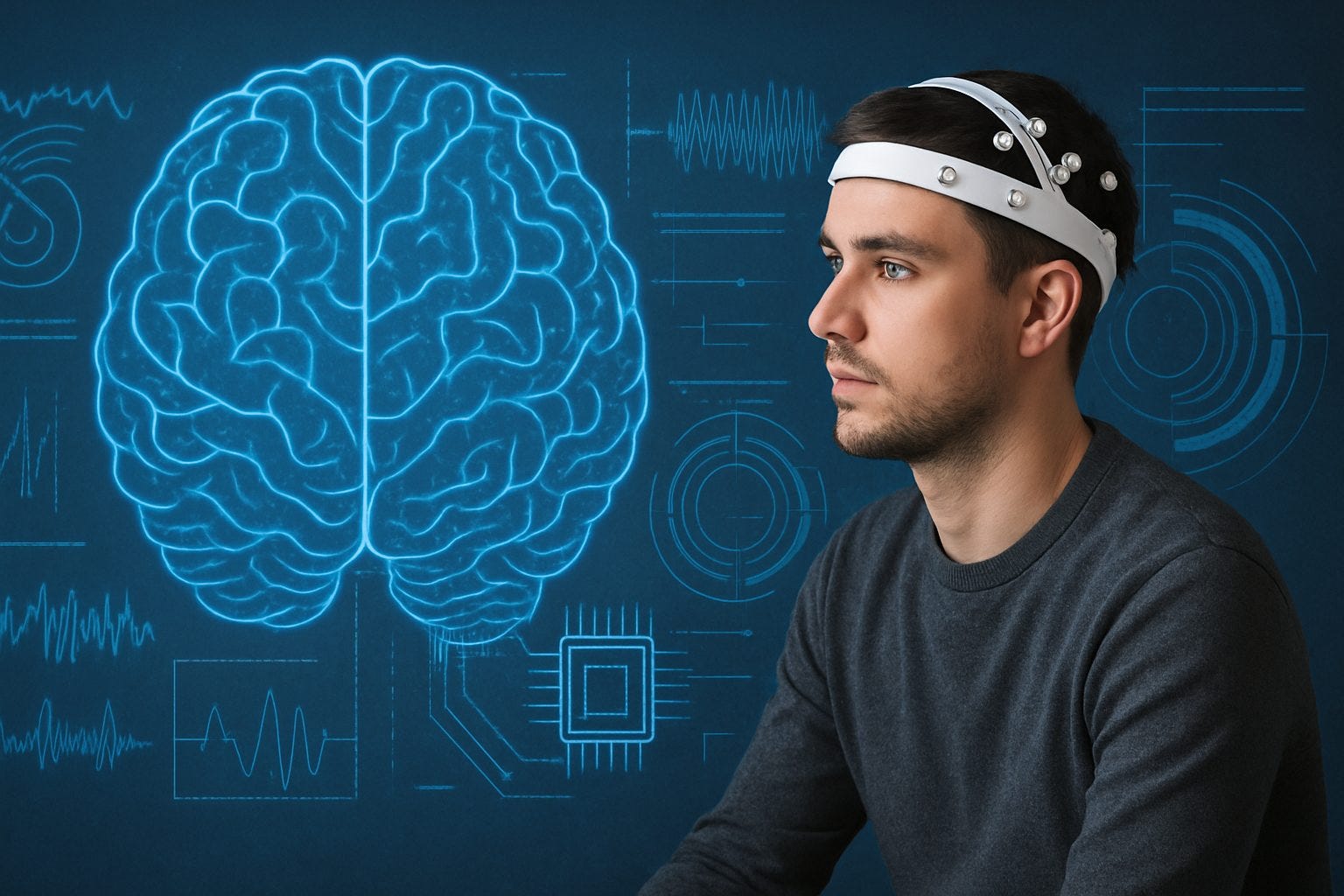
Welcome to the wild, wondrous — and slightly weird — world of neurotechnology. If you’re a founder or a budding entrepreneur scouting for your Big Next Idea, now’s the time to get cozy with this vocabulary. Neurotech isn’t just sci-fi anymore. It’s tooling up. From brain implants to non-invasive wearables, the revolution is real. And knowing the lingo doesn’t just make you sound smart at cocktail parties — it helps you spot opportunities, ask the right questions, and maybe even build something that shapes the future. 😉
Here are six key terms that deserve a spot in your mental Rolodex before you draft your pitch deck.
What is Neurotechnology — the Umbrella Term
At its core, Neurotechnology refers to any method, device or system that interfaces with the nervous system to either monitor or modulate brain (or neural) activity.
This umbrella covers everything from non-invasive headbands measuring brainwaves to surgically implanted electrodes deep inside the brain. Some neurotech reads your brain data. Others tweak or influence it. Some simply observe. Others act.
For a founder, this definition matters. Because depending on your product — a consumer wearable, a clinical device, or a hybrid — you will be walking in totally different regulatory, ethical, and technical territory.
1. Brain–Computer Interface (BCI) / Brain–Machine Interface (BMI)
Enter Brain–Computer Interface (BCI), sometimes also known as Brain–Machine Interface (BMI). It’s the stuff of sci-fi, but it’s real. BCIs create a direct communication pathway between the brain’s electrical activity and external devices: computers, robotic limbs, prosthetics, you name it.
BCIs come in different “flavors,” depending on how they interact with the body:
Non-invasive — electrodes or sensors sit on the scalp (e.g. EEG, fNIRS). Less risky, easier to deploy, but signal clarity is weaker.
Partially invasive — electrodes sit on the brain’s surface (e.g. ECoG), under the skull. Better signals, but more risk.
Fully invasive — micro-electrode arrays implanted directly into the brain tissue. Best signal quality, highest risk.
Why it matters: For any product concept that relies on decoding — reading thoughts, emotions, intentions — BCI is the core building block.
2. Neuroimaging / Neurorecording
Before you can interface with the brain — you need to see it. Neuroimaging (or neurorecording) refers to methods and tools that “listen” to brain activity: electrical signals, blood flow changes, oxygenation — essentially ways to glimpse what your brain is doing.
Some of the common techniques:
Electroencephalography (EEG) — records electrical activity from the scalp. Fast, non-invasive, but limited in spatial precision.
functional Magnetic Resonance Imaging (fMRI) — tracks blood flow changes correlated with neural activity. High spatial resolution, but slow and impractical for real-time use.
Magnetoencephalography (MEG), fNIRS, and other emerging modalities — each with tradeoffs in speed, resolution, and practicality.
For founders, neuroimaging is often the first ingredient in a neurotech recipe: gather data, analyze patterns, build insights.
3. Neuromodulation / Neurostimulation
Reading brain-signals is one thing. Changing them — that’s another. Neuromodulation refers to intentionally altering neural activity through stimuli — electrical, magnetic, optical, chemical, even acoustic.
A subset of neuromodulation is Neurostimulation — the purposeful use of electrical or electromagnetic stimulation to activate or inhibit parts of the nervous system.
Examples:
Deep Brain Stimulation (DBS) — surgically implanted electrodes deliver electrical impulses deep inside the brain to treat conditions like Parkinson’s or severe tremors.
Transcranial Magnetic Stimulation (TMS) or Transcranial Direct Current Stimulation (tDCS / tACS) — non-invasive magnetic or electrical fields modulate cortical activity.
Why it matters: If your vision involves “enhancing” cognition, mood, memory — or treating disorders — neuromodulation is your play. But it carries ethical, safety, and regulatory weight.
4. Closed-Loop Neurotech / Real-Time Feedback Systems
Neurotech isn’t just about “read-only” or “blast-it-with-electricity.” The bleeding edge often lies in closed-loop systems, where monitoring and stimulation are tightly coupled: the device watches your brain, decodes patterns, then reacts — in real time.
Imagine a device that notices your neural activity indicating stress, then applies a gentle stimulation to calm you. Or a prosthetic arm that moves in fluid sync with your brain signals. That’s closed-loop power.
For founders: closed-loop systems are attractive because they promise adaptive, intelligent, and personalized neurotech. But they also escalate complexity: algorithmic decoding, latency constraints, safety, ethics.
5. Neurodata & Neural Signatures
All this interfacing — imaging, stimulation, feedback — generates data. Enter neural data, a term you’ll hear more and more. It refers to the measurable electrical, chemical, or physiological signals recorded from the nervous system — signals that can be processed, analyzed, and interpreted.
Within neural data, you often hunt for neural signatures — patterns or biomarkers that correlate with mental states, intentions, emotions, or disorders. For example: a signature linked to motor intention (for prosthetic control), or signature related to depressive mood (for therapeutic neuromodulation), or stress.
From a startup vantage point, neural data is everything. It’s your input signal. It’s the raw material you can analyze with AI, ML, or custom algorithms to build predictive, interactive, or adaptive products.
6. Neural Engineering / Neural Interface Engineering
To make all the above happen — the monitoring, decoding, stimulation — you need hardware and software. That’s where Neural engineering (or neural interface engineering) comes in. It’s the interdisciplinary craft of designing sensors, electrodes, chips, software pipelines, implants, and UI that work together to connect brain and machine.
Neural engineering is part biomechanics, part bio-compatibility science, part electronics engineering, part AI/ML — and part ethics. Because you’re not building a mobile app. You’re building something that lives — or interacts — with the human nervous system.
Founders: this term reminds you: neurotech ventures are complex. They require collaboration across neuroscience, engineering, regulatory compliance, clinical know-how — and likely heavy capital. It’s not just software.
Bonus: Why These Terms Matter for Founders (Yes, You)
Common language — with serious weight. If you use terms like “BCI,” “neurodata,” or “neuromodulation” correctly, you instantly shift from “curious bystander” to “someone who knows what they’re talking about.” Investors, collaborators, scientists take note.
Scope and ambition clarity. Are you building a non-invasive wearable that tracks stress? That’s a neurodata + neural-engineering play. Are you aiming for implantable prosthetics that patients control with thought? That’s BCI + closed-loop + neuromodulation — a very different beast.
Ethics, regulation, trust. Neurotech touches the mind — not just the body. That means privacy, consent, long-term safety, unintended side effects. You need to know what functional class your product is, how invasive, and what regulations apply.
Opportunity spotting. Once you grasp the landscape, you begin to see gaps — unmet needs in rehabilitation, mental health, productivity, sensory augmentation, even entertainment or VR/AR.
Closing Thoughts and CTA
If you ask me — neurotechnology is the wild frontier of this century. And for founders with guts, curiosity, and a bit of patience, it’s a frontier brimming with possibility.
Here’s a small challenge: pick one of the six terms above. Then sketch — in one paragraph — a bone-simple product idea that uses that concept. Could be for therapy, could be for productivity, could be for fun. Post it here, and I’ll give you a rapid “reality check” on feasibility (technical, ethical, business).
The future conversations worth having begin with the right words—and you’ve got some now.