

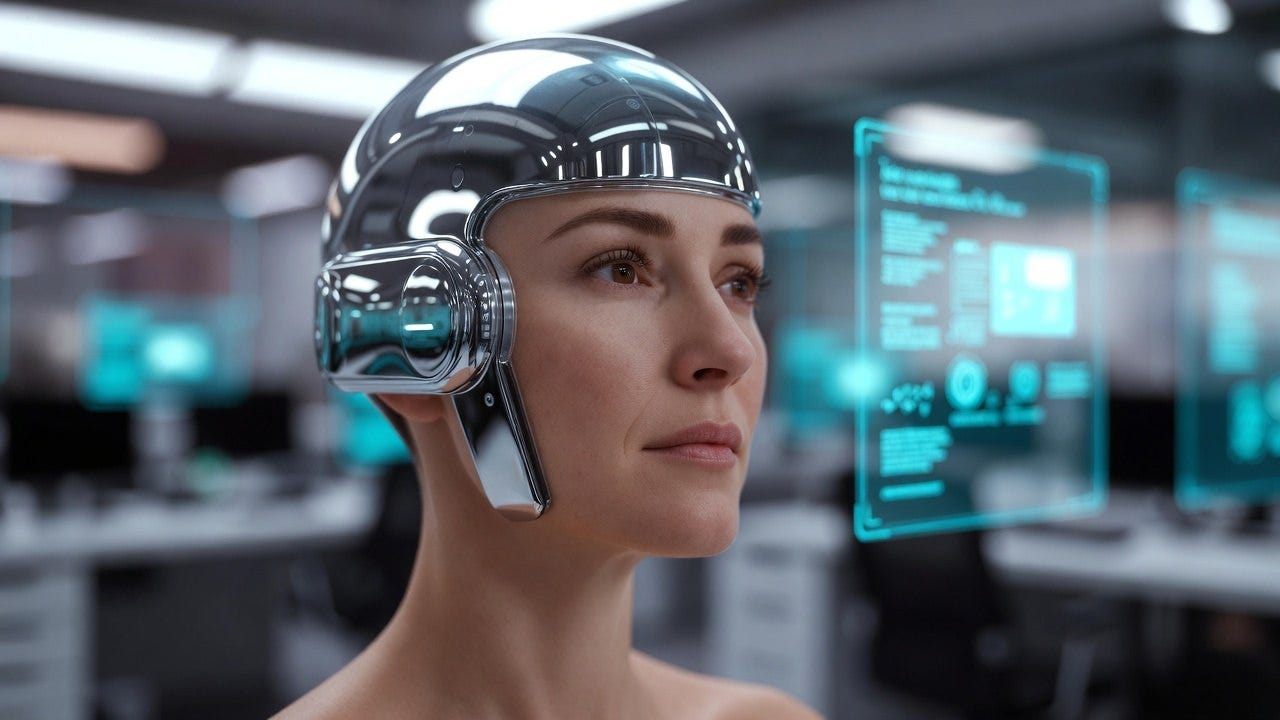
We imagine the future of work as ergonomic chairs, standing desks, and Zoom calls with virtual backgrounds. Cute. But what if your workplace didn’t care where you sat — only what was going on inside your head?
That’s where neurotechnology — tools that read, interpret, or even stimulate brain activity — starts to bend the arc of our daily grind. Forget keyboards and screen time. Think mental commands. Focus meters. Cognitive coaching delivered in real time.
If today’s wearables track steps and heart rate, tomorrow’s neurotech might track attention, stress, creative flow, and even help us think faster. It sounds like sci-fi — but companies like Neuralink, Synchron, and Kernel (and a host of startups) are already building these innovations and running human trials.
So buckle up. Work as we know it is about to get weird, wondrous… and wildly more brain-centric. 🧠💼
1. Productivity Means Measuring Minds — Literally 🚀
Forget apps that block social media. Neurotech is poised to measure your actual cognitive state in real time. Tools using EEG and other neural signals can detect when attention wanes, when stress spikes, or when you’re in the coveted “flow” state.
Imagine:
A headset that tells your tools to wait because you’re deep in thought
Software that nudges you to take a break when your neurons scream “battery low”
Meetings instantly ending when collective attention tanks
Some early concepts — like chairs or headbands that read brainwaves to coach focus — already point in this direction.
👉 CTA: What if your next productivity tool knew what you think before you do? Would you embrace that… or freak out? Drop a thought! 🧠👇
2. Learning Gets Supercharged (No Books Required?) 📚⚡
Training has always been slow. First you read. Then you practice. Then you maybe master your craft after years of repetitive effort.
Neurotech might throw that model out the window. Brain-computer interfaces (BCIs) can accelerate learning by interfacing directly with neural circuits or supporting attention and memory in real time.
Companies and researchers are already exploring neurostimulation and adaptive learning systems that react to your brain signals — speeding up skill acquisition and personalizing learning far beyond today’s AI tutors.
This could mean:
New languages absorbed faster
Training modules that adapt to your real brain fatigue level
Soft skills tweaked on the fly during conflict-resolution workshops
✨ Learning that feels effortless... might become a real workplace perk.
3. Collaboration Turned Cognitive Sync 🧠↔️🧠
If neurotech becomes commonplace, meetings won’t just be about agendas — they’ll be about alignment of minds. Okay, not literal telepathy (yet), but imagine tools that sense team engagement.
Instead of debating whether a team is “on the same page,” you’d know in real time who’s tuned in — and who’s brain-zoned out. Studies in workplace neurosurveillance warn this could raise ethical concerns about autonomy and self-censorship.
This sparks a big question:
Do we want our bosses to know our brains better than we do?
You might love optimized teamwork and hate the idea of cognitive tracking in performance reviews. It’s a Pandora’s box wrapped in a chic neural headband.
4. New Job Roles Will Emerge — and Old Ones May Fade 🧑🔧📉
BCIs and neurotech aren’t just gadgets. They’re infrastructure. And that infrastructure needs caretakers.
Expect demand for:
Neurotech specialists and engineers
Data interpreters who read neural output
Ethicists crafting policies on brain privacy
Neuro-UX designers building mind-friendly interfaces
Traditional careers might evolve — or vanish. Roles rooted in memorization or routine decision-making could be automated by systems that pull insights directly from neural patterns.
Already, fringe conversations imagine job listings that prefer candidates with BCI training or experience.
(Some people laugh… others shudder. 🤨)
Related: 7 Jobs Neurotech Will Create — And 3 It Might Replace
5. Interfaces Become Invisible — Thought Is the New Touch 🧠🖥️
Neurotech is not all implants and surgeries. Non-invasive tools like EEG wearables are already bridging minds and machines.
Soon, you might:
Launch apps without touching a screen
Control robots with intention (not instructions)
Switch context from email to design just by thinking
Robotics and automation ecosystems are already experimenting with neuro-driven control systems that reduce friction between human goals and machine execution.
This redefines interface design itself. The mouse and keyboard aren’t extinct yet — but they’re getting nervous.
Related: 5 Big Bets On The Future Of Brain-Machine Interfaces
6. Privacy, Ethics, and Brain Governance Become Central 🧩🔐
Let’s be honest: when technology steps into our minds, the term “privacy” takes on a whole new meaning. Neural data isn’t like location or heart rate — it’s the architecture of thought itself.
That’s why global bodies like UNESCO are already setting ethical standards for neurotech — from consent to neural data protection.
Questions loom large:
Should employers access attention metrics?
Who owns your neural data — you or your company?
Can a person opt-out without losing opportunities?
This is not an #AIethics debate reheated. It’s about the boundaries between mind and marketplace.
Related: 5 Ethical Questions Neurotech Forces Us to Answer (Sooner Than You Think)
Closing Thoughts: A Future You Can Both Marvel At — and Question 🤔
Neurotechnology’s trajectory isn’t a straight line — it’s a brainstorm swirling with possibility and uncertainty. It promises more intuitive work, higher productivity, faster learning, and interfaces that feel like extensions of ourselves. But it also teases darker tales of surveillance, brain data commodification, and new inequalities between “wired” and “unwired.”
Right now, we stand at the edge of something profound — a shift where work could become as much about managing the mind as mastering a skill. And that’s exciting. Also unsettling. Perfectly human.
✨ Let me know: Which neurotech innovation sounds the coolest to you? The brain-learning boost? The mind-controlled interfaces? Or the idea that maybe — just maybe — your next coworker could be reading thoughts (ethically… hopefully)? 😊