

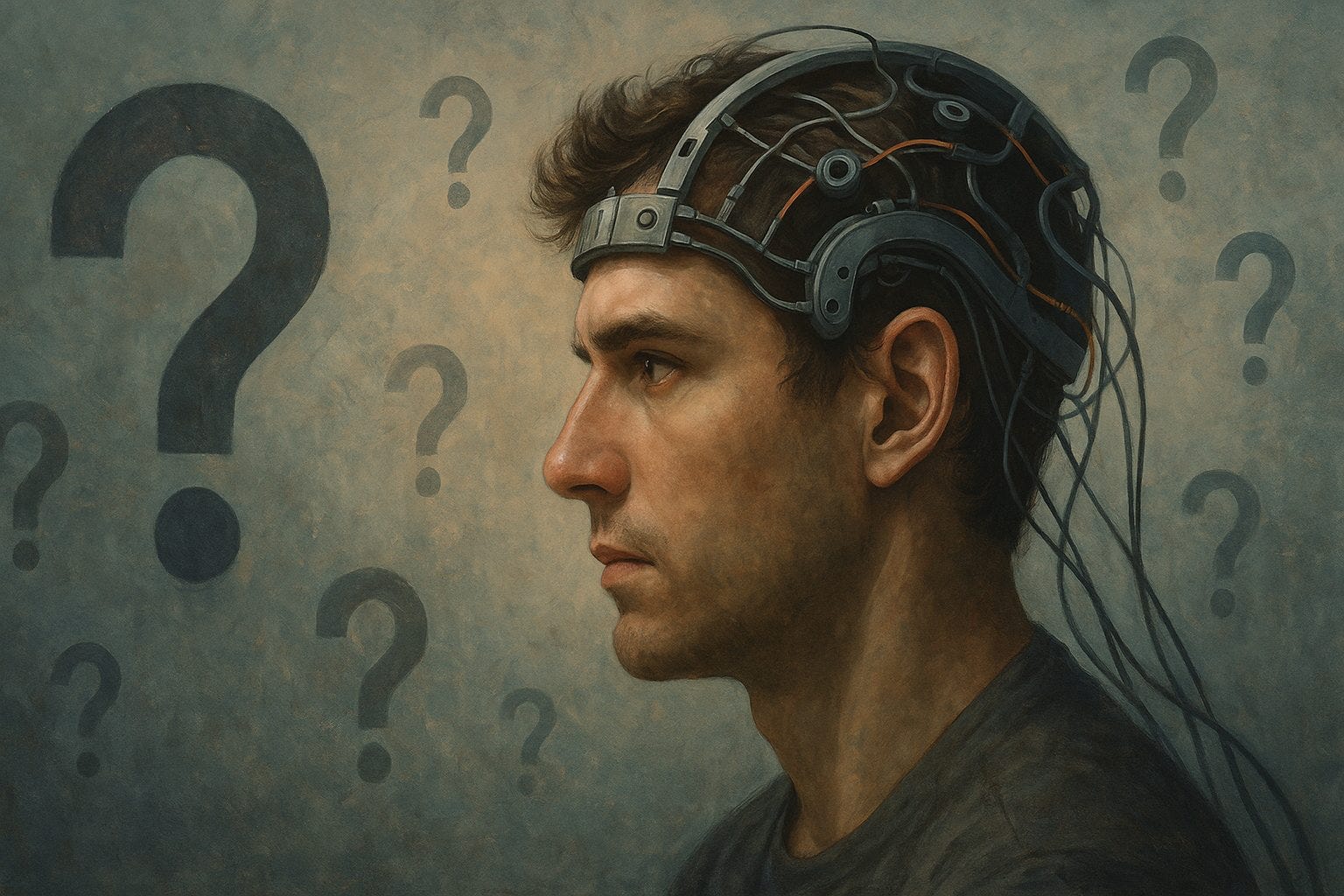
Neurotechnology — devices that link our brains directly to machines — feels like science fiction come to life. One day you’re playing with fancy EEG headsets or mind-control prototypes; the next, someone is seriously pitching “download your brain, live forever.” The potential feels limitless. But before we collectively sign off on plugging our skulls into Big Tech, we need to zoom out. Because these tools don’t just touch skin — they touch the most intimate parts of us: our thoughts, privacy, identity.
In this article, I explore 7 critical questions every scientist, entrepreneur, policymaker — and every informed citizen — should ask before neurotech becomes as common as smartphones. I’m writing as someone fascinated by the possibilities, but also deeply unsettled by what could go wrong.
1. Who owns your mind? — Privacy, data and “neural rights”
Neurotech collects neural data. That means brainwaves, patterns, maybe emotions or intentions. That’s not like tracking your Netflix binge. That’s your mental life. Once collected, who controls it? Who can see it? ℹ️
The concern is far from abstract — experts warn that without robust safeguards, neural data can be misused for profiling, surveillance, or manipulation. The very notion of “neurorights” — mental privacy, cognitive liberty, freedom from unwanted mental invasion — is gaining traction.
Consider a scenario: a cheap EEG headset you wear while gaming “analyzes” your emotional response. That data could be stored, sold, used to target ads or influence behavior. Creepy? Absolutely. And currently, the law does not clearly treat neural data the same way as medical or financial data.
Until society defines — in law and ethics — what neural data means, we risk turning minds into the new commodity.
2. Can you really consent — informed consent and user understanding
Ethical consent is tricky when what’s being consented to is almost unfathomable. It’s hard enough to read a privacy policy; now imagine reading one that says: “We may record your inner speech, emotional state, memory cues.”
In the case of implantable or even non-invasive brain-computer interfaces (BCIs), many researchers argue that consent is often not truly informed. People with severe disabilities may lack full capacity to opt in or out, or may not fully grasp the long-term implications.
Even more, the hype around neurotech — media showing miraculous “mind-control” demos — can distort expectations. When risks are downplayed and benefits oversold, you’re not just getting consent. You’re getting consent under illusion.
We need consent protocols built not just around can you click “I agree”, but around do you really understand what you’re signing up for — cognitively, psychologically, long-term.
3. How safe is safe enough? — Health, security, and long-term effects
BCIs are not like wristwatches or phones. Many are invasive: tiny electrodes in the brain, deep-brain stimulation modules, or implants that live inside your skull. That raises real safety issues — from surgical risks and infections, to long-term biocompatibility.
But there’s more. A 2025 study from Yale Digital Ethics Center warns about another danger: cybersecurity threats. Implants could be hacked. Data could be stolen. Devices could be manipulated. Someone malicious might even tamper with brain implants — which is no longer sci-fi.
And what about long-term unknowns? Changes in personality, unintended physiological effects, or neuroplastic changes we can’t yet predict. The truth: we simply don’t know yet. Betting human lives — and minds — on god-knows-what seems premature.
4. Who has access — fairness, inequality, and social stratification
Neurotech likely won’t be cheap, at least at first. That opens a troubling possibility: brain enhancement, neural augmentation, cognitive upgrades for the wealthy — leaving everyone else behind.
If BCIs become a tool for enhanced memory, mood management, focus, or productivity, we risk pushing existing inequalities deeper. Richer people get smarter, healthier, faster — poorer ones get left behind or become data sources. This sort of neuro-divide isn’t just inequality. It becomes inequality inscribed onto minds.
Beyond economic inequality, there’s the question of global justice: which countries or populations get access to safe neurotech, and which become unregulated testing grounds or data mines.
Mass adoption must come with plans for equity — not just for markets.
5. Who’s accountable when things go wrong? — Responsibility, agency, and liability
If a neuro-device misreads your thoughts, or accidentally triggers unwanted brain stimulation — who’s to blame? The device maker? The hospital? The user (who presumably clicked a consent form)?
These questions don’t sit neatly inside existing regulatory frameworks. Our legal systems recognize car crashes or data breaches — but don’t yet recognize “brain-data abuse,” “cognitive manipulation,” or “unaltered personality shift.”
Moreover, neurotech blurs the line between “you” and “machine.” Are you partly a cyborg now? If your thoughts or actions are mediated by a BCI, is the machine partly responsible — or are you? These are not just technical puzzles. They are philosophical, moral, deeply human.
6. Does widespread neurotech change what it means to be human? — Identity, autonomy, and authenticity
This might be the most existential question of all: if we rely on brain-machine interfaces to think, speak, remember, or feel — are we still ourselves?
Think about it. Memory implants, mood-enhancing BCIs, neural prostheses: they don’t just treat disease. They alter who we are. Some ethicists warn that this could erode authenticity or reduce mental diversity — if everyone ends up using the same “optimized” brain templates.
Others worry about autonomy: if devices can subtly influence mood, attention, or decisions — even with consent — are we truly free? Are certain decisions still ours — or the device’s?
We need public conversation about the meaning of identity, personhood, authenticity in a world where brain interventions are normalized.
7. Who watches the watchers? — Governance, regulation, and global standards
Until recently, neurotech has largely operated as a frontier — fast, messy, often hidden behind lofty marketing promises. That changes with framework adoption.
In November 2025, UNESCO adopted the first global ethical framework for neurotechnology. Among its aims: protect mental privacy, safeguard human dignity, maintain freedom of thought.
These are important first steps. But global standards don’t spontaneously become local laws. We still face patchwork regulations, corporate profit motives, and rapidly accelerating technology. In many places, oversight remains weak or nonexistent.
For mass adoption to make sense — and to avoid what some call the “neuro-wild west” — we need regulatory guardrails, transparency, long-term safety studies, and public participation.
Conclusion: We’re at the crossroads — and it’s worth pausing
Neurotechnology promises wondrous things: restoring mobility, giving voice to those trapped in silence, treating mental illness in ways we can barely imagine. I want to believe in that promise. I really do. It feels hopeful.
But I also think we can’t — and shouldn’t — sprint ahead blindfolded. Brains are not just another dataset. They are us.
So here’s my challenge to you — and to everyone: ask questions. Demand transparency. Support ethical frameworks. Push for law and regulation. And when someone promises you “mind reading”, “immortality”, or “enhanced cognition” — ask: at what cost, and who pays?
If you care about what it means to remain human in a neuro-enhanced world — don’t just be a consumer. Be a guardian.
👉 What do you think? Which of these ethical questions matters most to you — and why? I’d love to hear.