

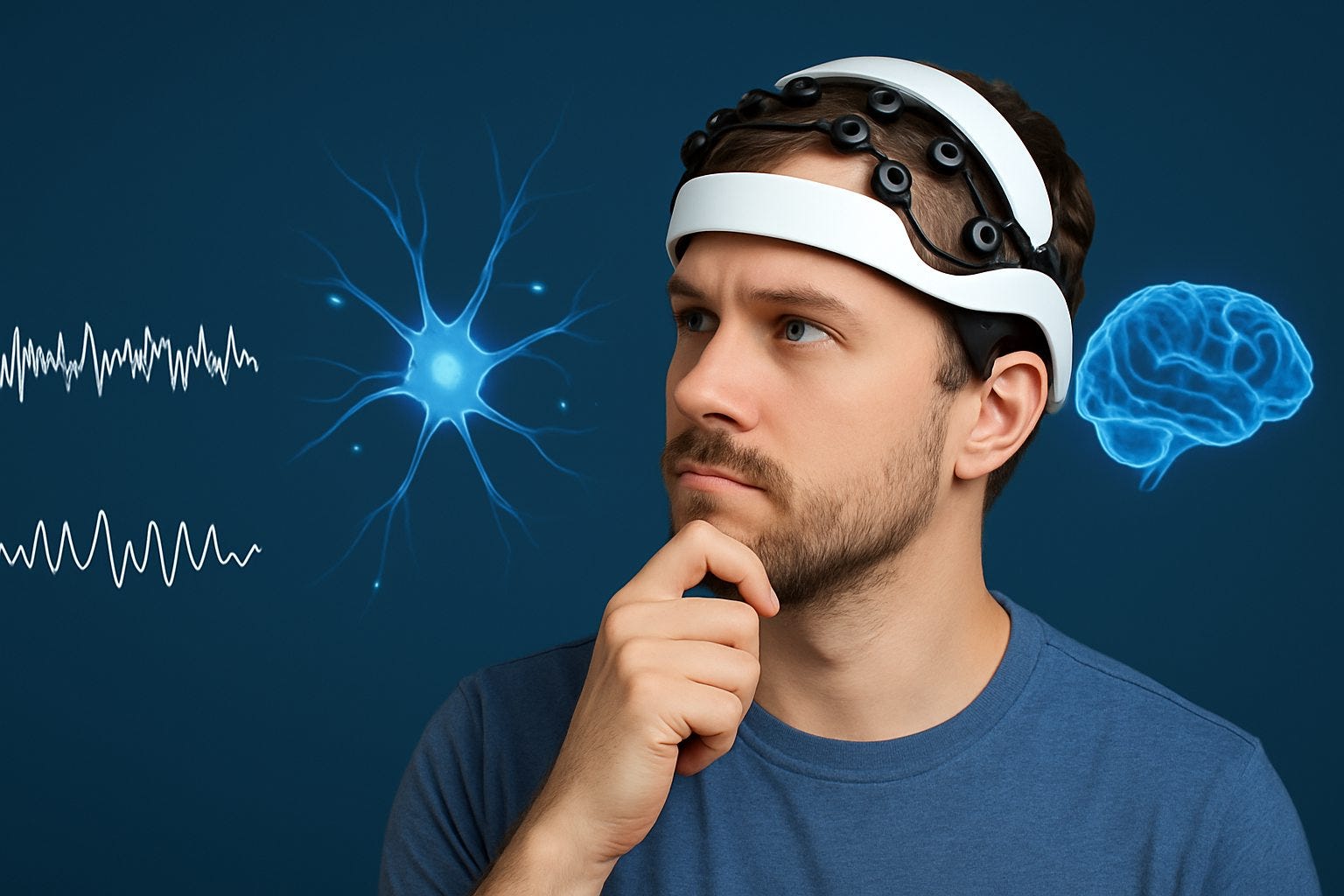
Imagine if you could eavesdrop on your own brain — not metaphorically, but literally. Picture a small headset reading the electric hum of your neurons, or even a tiny implant translating your thoughts into digital commands. That is the world of neurotechnology — a wild, fascinating frontier where biology meets bytes, and where the sci-fi you once laughed at might start feeling uncomfortably real.
Now, you don’t need a neuroscience degree to get what’s going on. In this article, I walk you through 7 simple ways to understand neurotech — no lab coat required. By the end, you’ll be fluent enough to follow headlines, impress your friends, and maybe even ponder if your next gadget should come with brainwave reading. 😉
1. What is NeuroTech — in Plain English
At its core, Neurotechnology (or “neurotech”) means any technology that connects with the nervous system — especially the brain — to either read what it’s doing or influence it.
On the “read” side, you get tools that monitor brain activity; on the “write” side, devices that stimulate or modulate that activity.
Think EEG headsets that detect your brain’s electrical chatter, or implants that send tiny pulses to calm tremors or restore movement.
Neurotech isn’t a single gadget — it’s a big umbrella. It spans everything from medical tools for epilepsy or paralysis, to experimental brain–computer linkups, to consumer gadgets that claim to “boost focus.” It’s messy. It’s beautiful. And it’s rapidly growing.
2. Meet the Main Players: The 3 Big Buckets
When you strip away the hype, most neurotech fits into one of three simple groups. Understanding these helps you follow the noise.
Neuroimaging / Monitoring
These are the “listening” tools. They watch the brain. Classic examples:
Electroencephalography (EEG) — electrodes on your scalp to read electrical activity.
Functional MRI (fMRI) — tracks blood flow changes to see which brain areas light up during tasks.
Emerging sensing techniques aiming for even finer detail.
These give scientists (and eventually users) a window into what the brain is doing — from basic activity to emotional states, attention, maybe even intention.
Neuromodulation
These are the “poking” tools. They don’t just read — they influence.
Noninvasive methods: small electrical currents or magnetic pulses through the skull (like tES or TMS) to boost memory, mood, focus.
Invasive or semi-invasive implants: electrodes inside or near the brain to treat disorders — e.g., deep brain stimulation for Parkinson’s, spinal cord stimulators for chronic pain, nerve stimulators.
Basically: sometimes we just want to listen. Other times, we want to nudge or steer.
Brain–Computer Interfaces (BCIs)
This is the sexy frontier — the “mind-control your phone” territory. A BCI is a system that translates brain signals into commands for external devices — so you could (in theory) control a computer, robotic arm, or wheelchair with your thoughts.
BCIs come in all flavors:
Noninvasive headsets (low signal fidelity, but no surgery)
Semi- or invasive implants (higher fidelity, but higher risk).
Hybrid systems and “closed-loop” devices that both read and stimulate.
So neurotech isn’t one trick — it’s a symphony of approaches, each with trade-offs in risk, reward, and readiness.
3. Real-World Wins: How NeuroTech Already Helps People
Neurotech isn’t just speculative sci-fi anymore. It’s saving lives, restoring capabilities, and expanding what’s possible.
Hearing restored: Thanks to neural implants like cochlear implants, hundreds of thousands regain hearing.
Paralysis bypassed: Devices such as the Stentrode (a minimally invasive electrode array) let people with paralysis control computers through thoughts — no open-brain surgery.
Relief for neurological diseases: Neuromodulation — like deep brain or nerve stimulation — treats Parkinson’s, epilepsy, chronic pain, and other conditions.
Research and diagnostics: Neuroimaging helps scientists understand depression, sleep disorders, memory, cognition.
In short: this isn’t futuristic — it’s already here. For many, neurotech means quality of life regained.
4. Why It’s Getting Cheaper, Faster, and More Accessible
Once the domain of pricey medical labs. Now the frontier of startups.
The rise of consumer-oriented neurotech: According to a 2025 report, the consumer neurotech scene (think EEG headsets, productivity tools, “focus” gadgets) is booming, blending clinical-grade ideas with wearable tech.
Advances in hardware + AI signal processing: Better sensors, AI-driven decoding of brain signals, and cheaper electronics enable non-invasive BCIs and even mixed reality interfaces.
Convergence across disciplines: Neurotech lives at the intersection of neuroscience, computer science, engineering, ethics, even philosophy — meaning breakthroughs can come from many directions, not just medical labs.
This democratization — cheaper EEG headsets, open-source platforms, and DIY neuro-experiments — makes neurotech more approachable than ever.
5. Why It’s Also a Bit Unsettling (Ethics, Privacy, You Name It)
With great brain-power comes great responsibility. Neurotech doesn’t just peek into your mind — sometimes it touches it.
Mental privacy & identity risk: When devices can read or influence thoughts, emotions, even memory patterns — who owns that data? What if they mess with it? The global discussion around “neural data” rights is already heating up.
Uneven signal fidelity vs. invasiveness: Non-invasive devices are safer but noisy. High-fidelity implants are powerful but risky. There’s a trade-off between signal quality, invasiveness, and practicality.
Ethical gray zones: Stimulating or modulating the brain — even for wellness — nudges into questions about consent, identity, and autonomy. Are we opening doors we can’t safely close?
Neurotech promises miracles — but it also demands maturity.
6. How You (Yes, You) Can Dip a Toe into NeuroTech — Without a PhD
If you’re curious, skeptical, or just enjoy weird tech, here are gentle ways to explore neurotech:
Try a consumer EEG headset (or follow developments in one): You won’t decode your inner monologue, but you can get a feel for how brain data is captured and used (e.g. for focus training or meditation feedback).
Read up on accessible sources: Many recent reviews, white-papers, and even regulatory assessments explain neurotech in plain English. Staying informed helps you spot hype vs. reality.
Observe neurotech in real-world use (or clinical trials): Follow work on implants, BCIs, neurostimulation — especially how they impact lives. It’s not sci-fi anymore.
Think ethically: If neurotech becomes mainstream, society-level questions will matter. Who controls neural data? What’s voluntary, what’s invasive, what’s protected?
You don’t need to build circuits or read neuron-spikes. Curiosity and a bit of reading go a long way.
7. Why NeuroTech Matters — For Everyone, Not Just Scientists
Because at its best — and that place is nearer than you think — neurotech gives us superpowers.
Healing: For people with disabilities, paralysis, degenerative diseases, brain injuries — neurotech offers a second chance.
Augmentation: Perhaps one day, we’ll boost memory, focus, learning. Or help mental health in deeper ways.
Connection: Communication, prosthetics, even virtual interaction — controlled by thought. No keyboard needed.
Insight: A better understanding of how we think, feel — and maybe, who we are.
If you believe that technology’s noblest goal is to uplift humanity — neurotech might be one of the most powerful levers ever invented.
So next time you hear about a new brain-computer interface, or a wearable that claims to “optimize your mind,” you won’t blink. You’ll nod. You’ll judge. You’ll think — “I get it.”