

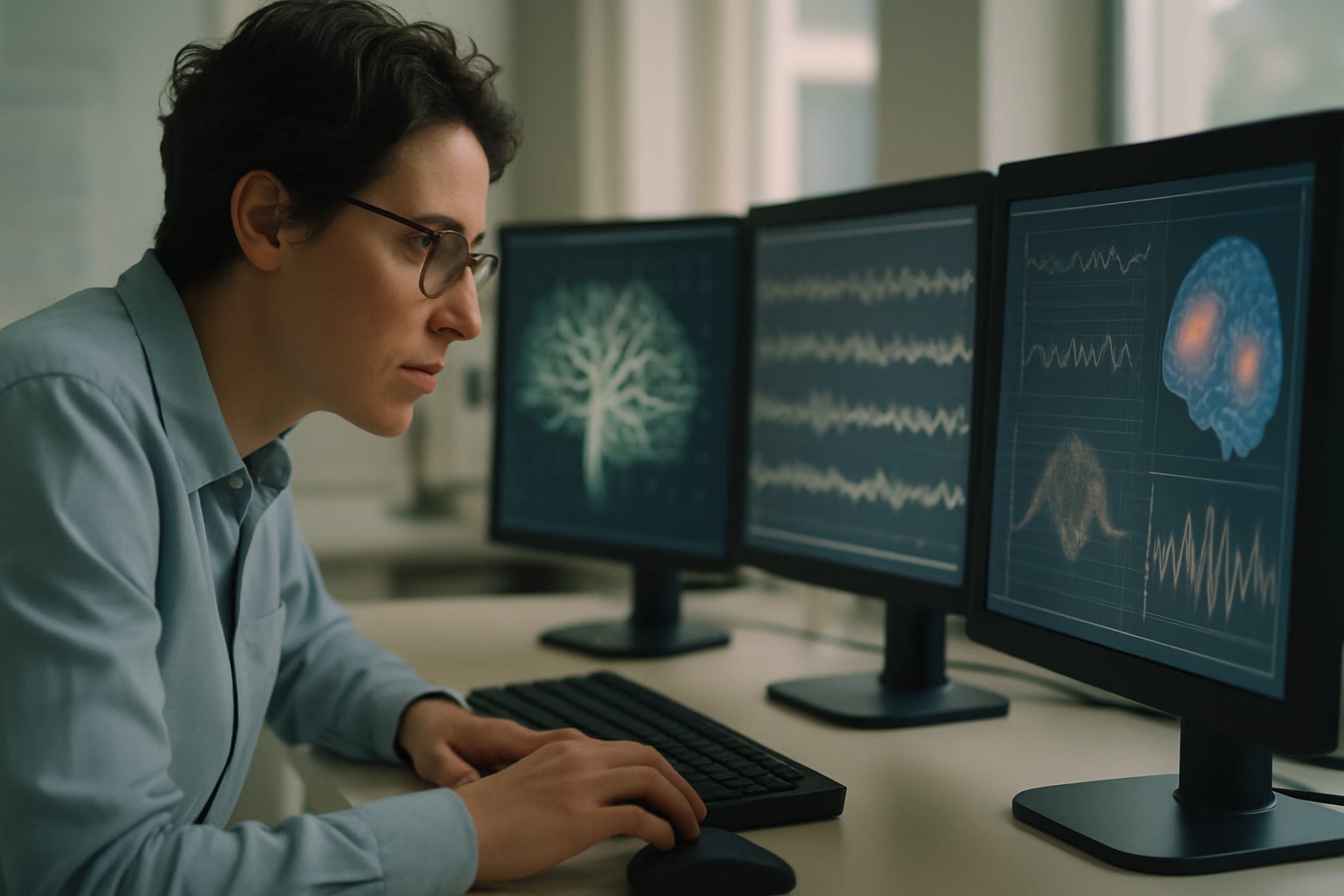
Your brain never shuts up. Right now, tens of billions of neurons are firing, some slow and some absurdly fast, and two very different machines are built to catch that chatter: the EEG and the fMRI. People throw these terms around like they’re interchangeable. They are not. One listens to electricity. The other watches blood. Getting the difference straight is the fastest way to make sense of every brain-computer interface headline you’ll read this year, from meditation headbands to implants that let paralyzed patients type by thought alone.
I used to mix them up myself, nodding along at conferences while quietly wondering why anyone needed two brain scanners when one would do. Turns out that’s exactly the point. Neither tool gives you the whole picture, and the gap between what each one can and can’t see explains most of how modern neurotech actually works. 🧠
What an EEG is actually listening to
An electroencephalogram, or EEG, straps a cap of electrodes onto your scalp and records the tiny electrical storms your neurons kick up as they talk to each other. A rough morning and a calm afternoon produce genuinely different electrical signatures, and EEG catches that shift in real time, down to the millisecond. That speed is its whole appeal. Mayo Clinic notes the test detects the electrical impulses brain cells use to communicate, a method doctors have trusted since 1929, when German physician Hans Berger first proved scalp electrodes could pick up brain activity at all.
What an EEG actually reports back are patterns called brain waves, sorted into frequency bands that map loosely onto mental states:
Delta (0.5-4 Hz): deep, dreamless sleep 😴
Theta (4-8 Hz): drowsiness, meditation, that hazy pre-sleep haze
Alpha (8-13 Hz): relaxed, alert, eyes closed, not doing much
Beta (13-30 Hz): focused and actively problem-solving 💡
Gamma (30-100+ Hz): peak concentration, where the brain stitches separate senses into one experience
None of these run in isolation. Your brain layers several bands at once, like instruments playing at the same time but at different volumes. That’s part of why NeurotechMag’s own breakdown of seven signals your brain is giving you treats EEG less like a single dial and more like an entire mixing board that neurotech companies are learning to read in real time. ⚡
Have you ever worn a sleep tracker or a meditation headband and wondered what it’s actually measuring? Odds are good it’s some flavor of consumer EEG, sampling a few of these bands and translating them into a focus score or a sleep stage 🌙, using the exact same physics that once required a hospital lab.
What fMRI is actually looking at
Functional MRI takes the opposite approach. Instead of listening for electricity, it watches blood. When a brain region works harder, it demands more oxygen, and fresh blood rushes in to meet that demand. fMRI tracks that traffic pattern, known as the BOLD signal (blood oxygen level-dependent), and turns it into a three-dimensional map of which regions lit up during a task. The Wikipedia entry on fMRI is a solid primer if you want the full physics behind it.
Some quick facts worth knowing:
Spatial resolution: down to a few millimeters, sharp enough to separate neighboring brain regions
Temporal lag: roughly 2 to 6 seconds between a neuron firing and the blood response showing up
Typical cost: often north of $1,000 per scan session
Environment: a loud, enclosed scanner, off-limits for anyone with certain metal implants
That precision is why fMRI keeps showing up in the biggest brain-decoding headlines. In March 2026, Meta’s Fundamental AI Research team unveiled TRIBE, a model trained on fMRI recordings of people watching movies and listening to podcasts. It reportedly reached a 70-fold jump in resolution over earlier decoding systems, according to Neuroscience News, and researchers now use it to simulate how a brain might respond to a new image or language without running a fresh scan every time. 🔬 That’s a genuinely big deal for a field that used to need hours of scanner time per volunteer.
fMRI isn’t cheap or portable, though. The machine itself is a room-sized magnet that clanks loudly for an hour while you lie completely still 🧲💸. Nobody’s wearing an fMRI headband to the gym anytime soon.
The tradeoff nobody gets to skip
Here’s the physics that shapes almost every neurotech product decision: you can have great timing or great location, but rarely both from a single device. It’s the biggest reason the field looks the way it does.
EEG: millisecond timing, coarse location, cheap, wearable outside a lab
fMRI: seconds-level timing, millimeter location, expensive, needs a dedicated scanner room
MEG (a less common cousin): millisecond timing like EEG, sharper location, closer to fMRI in cost and bulk
Combined EEG-fMRI setups: researchers occasionally run both at once, logistically painful as that is, to borrow the timing of one and the location of the other
Why does the tradeoff exist at all? Neurons fire fast ⚡. Blood flow reacts slow 🩸. Any tool built to catch one will, by nature, blur the other. It’s not a gap anyone’s solved yet, and it might not be solvable with current physics. 🤷
That’s also why BCI companies pick their tool based on the job at hand. Want a wearable that reacts instantly to help someone move a cursor with their thoughts? EEG, every time. Want to map exactly which brain region handles a specific memory before surgery? fMRI wins, no contest.
What the signals actually mean in practice
None of this matters much until you connect it to what people build with it. EEG’s speed makes it the backbone of most consumer and clinical brain-computer interfaces. A classic example is the P300 speller: a paralyzed patient stares at a flashing grid of letters, and whichever letter makes their brain produce a distinct spike, called the P300 response, gets typed. No muscles required, just intact cortex and a sensor fast enough to catch a signal that arrives in under half a second. 🦾
Consumer devices lean on the same electrical signals, just aimed at gentler goals. NeurotechMag’s rundown of neurotech devices you can actually buy today covers headsets that turn beta-wave dominance into a focus score or a rise in alpha waves into a meditation prompt. It’s the same physics that helps a locked-in patient communicate, just repackaged for people trying to survive a Monday. 💬
fMRI, meanwhile, does its best work behind the scenes in research and diagnosis:
Mapping which brain regions to avoid during tumor or epilepsy surgery 🏥
Studying how depression, anxiety, or addiction show up as network-wide changes rather than one broken spot
Training AI systems like TRIBE to predict, and eventually reconstruct, what someone saw or heard from brain activity alone
Confirming whether a new drug or brain stimulation therapy is actually changing brain function, not just self-reported mood
What’s your take? Would you rather wear something that reads your brain’s electricity all day long, or take an occasional deep scan that maps you in exquisite detail? 👇
Where this is heading
Neither EEG nor fMRI is going away, and neither is winning outright. What’s changing is how aggressively companies pair cheap, fast electrical data with occasional, expensive, high-resolution scans, then let AI fill the gaps between them.
A few numbers worth sitting with:
Disclosed neurotech funding topped $1.3 billion in 2025 alone
Analysts project the market climbing past $47 billion by 2035, more than double where it sat in 2025
CES 2026 already featured non-invasive BCI wearables built for everyday life, not hospitals
That’s the bet behind six signals that neurotech is reaching a tipping point, where the jump from lab to living room already looks underway. 🚀
My honest read: EEG keeps winning the wearable, everyday, real-time race, while fMRI keeps its grip on the deep, precise, expensive end of research and diagnosis 🔭. The interesting fight isn’t EEG versus fMRI. It’s which company figures out how to make the cheap, portable option good enough that the expensive one becomes optional for more and more use cases. 🧭
So next time you see a headline about someone moving a robot arm by thought or an AI reconstructing an image from a brain scan, ask yourself one question: which of these two tools did the heavy lifting?