

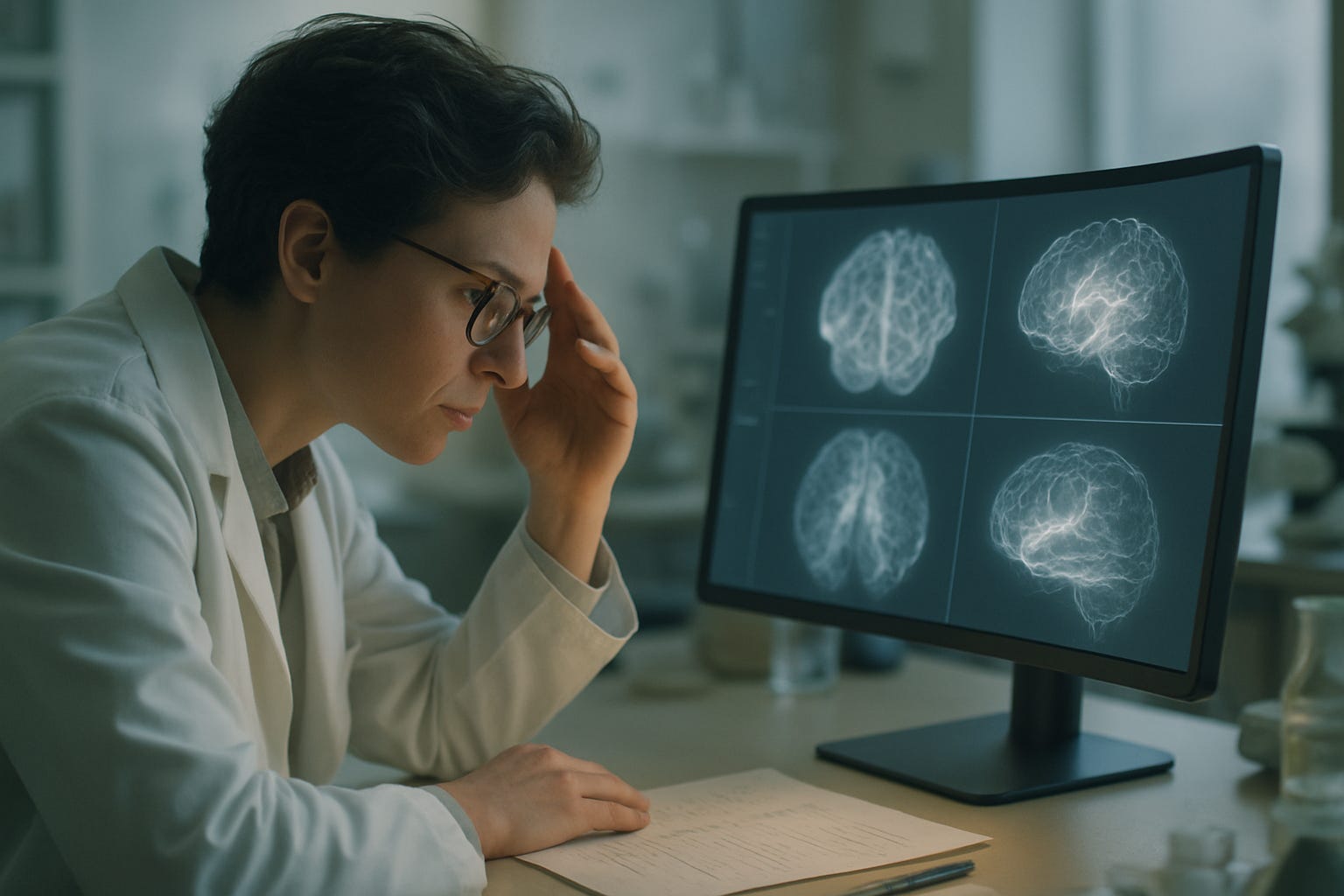
Not long ago, “mind reading” belonged to carnival acts and bad sci-fi. Today it belongs to Nature Communications Biology, MIT preprint servers, and a growing number of research labs where scientists feed raw electrical brain signals into large language models and watch readable text come out the other side. What changed? Mostly, the AI got a lot better. The brain hasn’t changed much in the last few hundred thousand years, but the tools we’re using to interpret it have transformed almost beyond recognition.
Neural decoding — the science of translating brain activity into usable information — has been around since the 1990s in primitive form. What’s new is the marriage of that field with modern deep learning, and the results are genuinely startling. We’re not talking about detecting whether someone is happy or sad. We’re talking about reconstructing the specific sentence a person is silently reading, or generating a photorealistic image of what they’re looking at, straight from the wobble of blood oxygenation in their visual cortex. This is not a metaphor. It’s happening now.
So how does it actually work? And what does it mean that a machine can — sort of, sometimes, imperfectly but impressively — read your mind?
The basic problem: the brain is a noisy place 🧠
The first thing to understand is that reading neural activity is nothing like reading a hard drive. The brain generates billions of signals simultaneously, most of them redundant, many of them corrupted by movement artifacts, electrical interference, or just the ordinary chaos of biological tissue doing its thing. Getting a clean signal out of that environment is hard. Getting meaning out of that signal is, or was, even harder.
The two main non-invasive tools researchers use are:
fMRI (functional magnetic resonance imaging): measures blood flow as a proxy for neural activity, with excellent spatial resolution but terrible time resolution — roughly one snapshot every two seconds
EEG and MEG (electro- and magneto-encephalography): measures electrical and magnetic fields from neurons firing, capturing millisecond-by-millisecond changes but with much murkier spatial precision
Each has real trade-offs. fMRI tells you where something is happening in the brain with reasonable clarity. EEG and MEG tell you when with great precision. Neither, by itself, gives you the whole picture.
What deep learning brought to the table was a way to extract signal from noise at a scale no human analyst could manage. A convolutional neural network trained on thousands of hours of brain recordings learns to recognize patterns that would be invisible to the naked eye — subtle correlations between, say, the activity in your visual cortex and the color red, or between your motor planning areas and the letter “T.” The models don’t understand meaning in any philosophical sense. They learn statistical associations at a frightening level of detail, and that turns out to be enough to do something that looks a lot like reading. 🔬
What’s the most surprising thing about this process to you — that it works at all, or that it works so accurately? Think about that as we go deeper.
From matching to generating: the LLM revolution in brain decoding 💡
For most of neural decoding’s history, the approach was essentially a matching game. You’d train a model on a fixed set of possibilities — say, 50 words or 10 images — and then ask it to pick which one matched a given brain state. Useful for research. Not useful for a patient who needs to say something that wasn’t in the training set.
The shift came when researchers started coupling brain decoders with large language models. In March 2025, a team published BrainLLM in Communications Biology, a system that uses fMRI signals not to select from pre-generated candidates but to directly steer the generation phase of a language model. Feed it the brain recording, and it generates coherent language from scratch — not by picking from a list, but by actually producing novel text aligned with what the brain was processing. The system got stronger as the training datasets grew larger, which suggests that more brain data really does make these models meaningfully better.
Around the same time, Meta AI published Brain2Qwerty, a deep learning architecture trained on MEG and EEG signals from 35 participants who typed memorized sentences. With MEG data, the model achieved a character error rate of 32% on average — and for the best-performing participants, that dropped to 19%, meaning the system correctly decoded roughly four out of five characters without any implant, without any surgery, just from magnetic field fluctuations measured outside the skull. With EEG, the error rate jumped to 67%, which highlights a real gap in the technology that researchers are actively trying to close.
The key insight from Brain2Qwerty is that motor planning signals — the neural activity that precedes physical movement — are surprisingly readable, even when the movement itself is subtle. The brain starts preparing to type a letter before the finger actually moves, and that preparatory activity carries enough information for a well-trained model to make a good guess.
Visual decoding has followed a parallel trajectory, arguably even more dramatic. Researchers have combined CLIP-style semantic embedding (the same technology that powers image-text models) with diffusion model generation to reconstruct images directly from fMRI signals. Someone looks at a photograph. The model reads their visual cortex. It generates an image. That image, in the best experiments, looks recognizably like what the person was looking at — not pixel-perfect, but capturing the semantic content, the objects, the scene structure, with accuracy that has improved dramatically between 2023 and 2025.
Going non-invasive: the MEG and EEG frontier ⚡
The loudest names in brain-computer interface news are invasive. Neuralink, which had implanted its chip in 21 human patients as of January 2026, uses electrodes physically threaded into the cortex. The resolution is extraordinary — 1,024 electrodes on 64 threads thinner than a human hair, giving access to the kind of clean, high-resolution signal that makes decoding relatively straightforward. Noland Arbaugh, Neuralink’s first patient, has used his implant to play chess, browse the web, and learn languages, all through thought-controlled cursor movement.
But the vast majority of people who could benefit from neural decoding aren’t going to elect brain surgery. This is why the non-invasive frontier matters so much, and why the progress there is arguably the more important story.
Meta’s research team at Neurospin has demonstrated that MEG alone, paired with a well-designed contrastive learning model, can identify speech segments from brain recordings at up to 80% accuracy in the best participants — identifying specific speech clips from a pool of over 1,000 candidates with no implant required. A separate Meta team working on decoding individual words from EEG and MEG evaluated their pipeline across 723 participants, reading or listening to five million words across three languages — probably the largest non-invasive brain decoding study ever attempted, and the results show consistent improvement with more data.
The realistic comparison right now looks roughly like this:
Invasive BCIs: character error rates below 5%, real-time output, but require neurosurgery
MEG-based decoding: roughly 19–32% error rates in the best cases, not yet real-time, requires a $2 million room-sized machine
EEG-based decoding: error rates above 60%, but cheap, wearable, and potentially scalable
MEG is impressive but impractical for most people right now — those machines cost up to $2 million and require magnetically shielded rooms. EEG is cheap and portable but still producing error rates that would make the technology frustrating to use in practice. The middle path researchers are hunting for is probably some combination of better hardware miniaturization and better AI models trained on much larger datasets. And given how quickly both have improved in the last three years, dismissing that middle path seems unwise.
When the decoder gets a password 🔐
One of the more quietly remarkable developments in 2025 came from a study published in Cell about a brain implant that can decode internal speech — what you’re saying to yourself, silently — but only if the user first thinks of a preset password. The security model is deliberate: the device stays inactive until it recognizes the authorization pattern, and then starts decoding. It’s a fascinating inversion of normal security thinking. Usually we protect devices from the outside. Here, the researchers are protecting the brain from the device.
This matters because the ethical dimensions of neural decoding have started generating serious regulatory attention, and for good reason:
A 2024 audit by the Neurorights Foundation found that 96.7% of consumer neurotechnology companies reserve the right to transfer brain data to third parties
In 2024, Colorado and California became the first U.S. states to explicitly protect neural data under privacy law, with at least six more states following
In September 2025, senators Schumer, Cantwell, and Markey announced the MIND Act — the Management of Individuals’ Neural Data Act — which would cover both implanted BCIs and wearable neurotech
UNESCO adopted sweeping global standards on neurotechnology ethics in Paris in November 2025, treating neural data as a special category requiring explicit guardrails
The concern isn’t hypothetical. Neural data is not like a browsing history or a location trace. It encodes emotional states, health conditions, cognitive patterns, and potentially — as decoding technology improves — actual thoughts. The brain has been, until very recently, the last genuinely private space. Once a decoder is accurate enough to capture something approaching inner speech, that assumption evaporates.
Here’s the question worth sitting with: if a company can read your internal monologue through a consumer headset, does your right to remain silent still mean anything?
What this actually gets right — and what it still gets wrong 📈
Neural decoding in 2025 is genuinely impressive and also genuinely limited, and it’s worth being clear about both. The technology gets a lot of press framing that makes it sound more complete than it is.
The real strengths:
Reconstructing perceived content (images you’re looking at, sentences you’re reading) is substantially more accurate than reconstructing imagined or internally generated content
Performance scales with data — more training examples, more participants, better results
Invasive methods have reached speeds and accuracy levels that are practically useful for patients with communication impairments right now
The real limitations:
Most systems are highly subject-specific — a model trained on your brain activity doesn’t automatically work on someone else’s
fMRI, the most powerful tool for spatial decoding, costs thousands of dollars per session and can’t be used in real time
Open-ended language reconstruction (generating whatever a person is thinking about, freely, without constraints) remains an unsolved problem — current systems work best when the possible outputs are constrained or the content is being actively perceived rather than internally generated
EEG-based systems are far less accurate than MEG or invasive methods, though they’re the only realistic consumer technology in the near term
The neuroscientist Christopher Rozell of Georgia Tech put it plainly at the Society for Neuroscience’s 2025 annual meeting, calling AI “deeply integrated into neuroscience” and noting that it enables “new discoveries and therapies by allowing us to identify patterns and mechanisms that were invisible before.” That’s accurate. What’s also accurate is that the gap between “identifying patterns” and “reading your mind” is still large enough to matter.
The field is moving fast enough that it’s probably worth keeping an eye on it regardless of whether you’re a patient, a researcher, a policy maker, or just someone who’d like to understand what happens to the concept of mental privacy when fMRI gets cheap and portable. That day may be further away than the headlines suggest — or it may not. Given how wrong similar predictions about AI capabilities turned out to be over the past decade, epistemic humility seems warranted.
What do you think the right line is between using neural decoding for medical benefit and protecting people from having their thoughts read without meaningful consent? It’s one of the more important design questions the next decade will have to answer.