

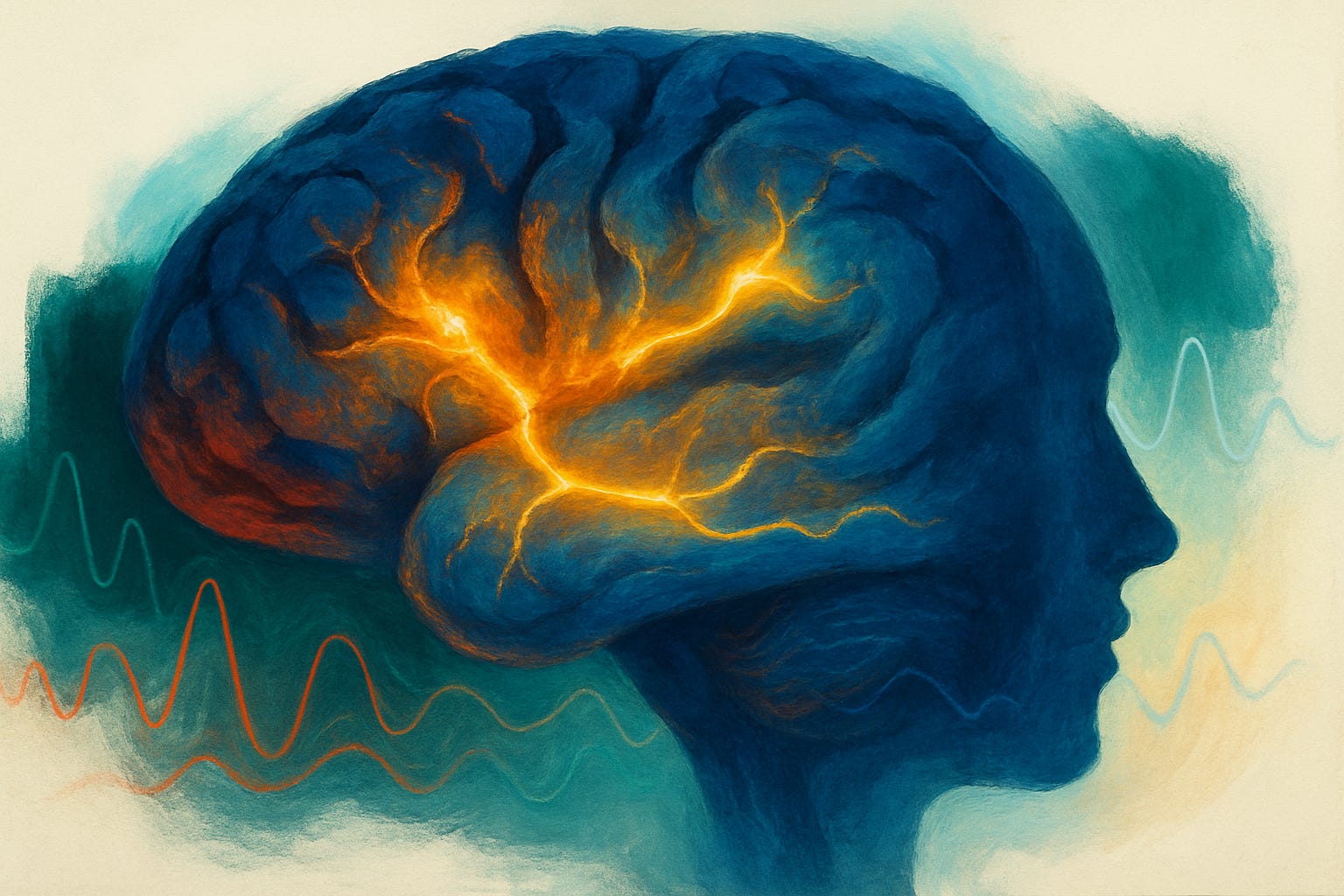
A panic attack is your nervous system’s fire alarm going off when there’s no fire. Your heart races, your breath gets shallow, and your brain tells you something catastrophic is happening even though nothing actually is. 😮💨 For decades, the main tools for panic disorder have been SSRIs, benzodiazepines, and cognitive behavioral therapy. Now a smaller but genuinely interesting body of research is testing whether people can train their own brainwaves and heart rhythms to interrupt that alarm before it fully fires. The evidence is real. It’s also earlier and messier than most headlines about “quitting panic attacks” let on, and it splits into two technologies that get lumped together but work in completely different ways.
Panic disorder has a measurable signature in the brain and the heart
Before training anything, researchers first had to find what’s actually different in a panicking nervous system. 🔎 Two threads of evidence stand out. In the brain, a 2021 study out of Berlin compared 55 patients with panic disorder to 42 healthy controls and found more right-than-left fronto-lateral alpha power, a pattern linked to reduced prefrontal control over emotional reactivity. In the body, multiple research groups, including a long-running project at the University of Potsdam, have documented that panic disorder patients tend to show lower vagally mediated heart rate variability (vmHRV), and that people with low vmHRV respond worse to standard exposure therapy. 🫀
That second finding matters more than it might sound. It means autonomic nervous system tone isn’t just a symptom of panic disorder, it may actively interfere with the treatments that already work. A few things worth holding onto here:
These are biomarker studies, meaning they identify a pattern associated with panic disorder, not a cause
Reduced vmHRV is also linked to worse outcomes in exposure therapy, one of the most established treatments for panic
The alpha asymmetry finding is specific to fronto-lateral sites, not a general “panic brainwave”
Neither finding alone tells you whether changing the pattern actually reduces panic attacks
That last point is the whole ballgame, and it’s exactly what the next two sections test. 🤔 Have you ever wondered whether your own resting heart rhythm looks different from someone who’s never had a panic attack? There’s now an actual research answer, even if it’s not a simple one.
EEG neurofeedback: training brainwaves, with real but mixed results
EEG neurofeedback shows you your own brain electrical activity in real time, usually as a game or a sound that changes when your brainwaves shift toward a target pattern. 🎮 For anxiety specifically, the most studied protocol trains frontal alpha asymmetry, nudging activity toward the left hemisphere pattern associated with approach rather than avoidance behavior. A 2017 randomized controlled trial in Behavioral Research and Therapy found that 32 women who completed this training showed reduced negative affect and anxiety symptoms compared to an active control group. More recently, a 2025 trial out of Shahid Beheshti University in Tehran compared two different neurofeedback protocols, sensorimotor rhythm training and alpha-theta training, in 40 university students with generalized anxiety disorder. ⚡
Notice that neither of these trials targeted panic disorder specifically. That’s an honest gap in the field right now. Here’s how to read the EEG neurofeedback evidence without overselling it:
Sample sizes are small, mostly 30 to 90 participants, which limits how confidently results generalize
Most trials study generalized anxiety disorder, not panic disorder with its sudden, discrete attacks
Session counts vary widely, from 10 sessions to 15, with no settled standard protocol
Results are promising but inconsistent across studies, which is typical for an early-stage clinical research area, not a red flag on its own
None of this means EEG neurofeedback doesn’t work. It means it’s a research-stage intervention for anxiety broadly, with panic disorder as an underexplored subset, not a validated panic-specific protocol you can point to and say “this is the one.” 🔬
Heart rate variability biofeedback: the more panic-specific science
If EEG neurofeedback trains the brain, heart rate variability biofeedback (HRVB) trains the autonomic nervous system directly, and it has a more direct line to panic disorder research. 🎯 The technique, developed largely by Paul Lehrer and Richard Gevirtz, has people breathe at a slow, specific pace, typically 4.5 to 6.5 breaths per minute, while watching real-time heart rhythm feedback. Done correctly, this can amplify a natural cardiac pattern called respiratory sinus arrhythmia by four to ten times over resting baseline, which strengthens the baroreflex loop that regulates blood pressure and heart rate together. 🫁
A small but genuinely panic-specific study published in August 2025 by researchers at Humanitas University and IRCCS Humanitas Research Hospital in Milan, led by Giampaolo Perna’s group, tracked 10 outpatients with panic disorder through HRV-biofeedback training and found measurable improvements in heart rate variability from before to after the intervention. That’s encouraging, and it’s also a pilot study with a single-digit-to-low-double-digit sample and no control group, so treat it as a promising early signal, not proof. A few honest caveats:
Ten patients is a pilot cohort, built to test feasibility, not to establish efficacy
The study measured HRV changes, which is a physiological marker, alongside symptom severity, not panic attack frequency as the sole outcome
Nine of the ten patients also had agoraphobia, a common but not universal feature of panic disorder
Larger, controlled, panic-specific HRVB trials are still needed before this becomes standard care
This is the piece of neurotech most likely to earn the word “promising” honestly, precisely because the underlying mechanism, low vmHRV as both a marker and a barrier to treatment response, gives researchers something specific to target. 📈
What you can actually buy, and what it’s cleared to treat
Here’s where regulatory precision matters most, and where consumer marketing tends to blur two very different categories. 🧾 Alpha-Stim, a cranial electrotherapy stimulation (CES) device, is FDA cleared specifically for anxiety, insomnia, and pain, delivered via earclip electrodes over 20-minute sessions, available by prescription in the US. Note the word stimulation. CES actively delivers current to modulate cranial nerve and cortical activity. That’s a fundamentally different mechanism from neurofeedback, which only measures your own signal and reflects it back to you. Confusing the two is a real credibility risk for anyone covering this space. ⚕️
Sitting one tier down, in the unregulated wellness lane, is HRV biofeedback hardware like HeartMath’s emWave2, a handheld sensor that displays a coherence score based on heart rhythm smoothness, priced around $199. It’s built on the same resonance-breathing science as the clinical HRVB research above, but it’s sold as a stress-management tool, not a treatment for a diagnosed disorder, and it hasn’t gone through the FDA clearance process Alpha-Stim has. The practical map right now looks like this:
FDA-cleared for anxiety: Alpha-Stim (CES), a stimulation device, prescription-only in the US
Research-stage, not commercially available as a cleared treatment: the EEG and HRV neurofeedback protocols used in the trials above
Unregulated consumer wellness: HRV biofeedback hardware like emWave2, general stress-management claims only
None of these three categories currently has an FDA clearance specifically naming panic disorder, as opposed to anxiety more broadly
That gap between “anxiety” and “panic disorder” on FDA labels isn’t a technicality. It reflects which conditions actually got tested in the clinical trials that led to clearance. 🧠
What this means if you’re thinking about trying this instead of your medication
If you take medication for panic disorder and you’re intrigued by any of this, the single most important thing is not to make that decision alone. 🩺 Talk to the prescriber who put you on it before changing anything, since stopping psychiatric medication abruptly can itself trigger the exact symptoms you’re trying to escape. Neurofeedback and HRV biofeedback are, at their current stage of evidence, best understood as adjuncts under a clinician’s guidance, not medication replacements you self-administer based on a pilot study. 🚀
With that said, here’s a realistic way to think about where you fit into this research right now: 🗺️
If you have diagnosed panic disorder, ask a psychiatrist or psychologist familiar with biofeedback whether HRVB is available through your care team, since it has the more panic-specific evidence base
If you’re managing general stress or mild anxiety rather than diagnosed panic disorder, a consumer HRV device like emWave2 is a reasonable, low-risk self-regulation tool
If you’re drawn to EEG neurofeedback, look for a provider running an actual clinical protocol with pre- and post-assessment, not just a wellness studio offering sessions
If anyone markets a device as an FDA-cleared cure for panic attacks specifically, that claim doesn’t match what’s actually been cleared, and it’s worth double-checking directly with the FDA’s own device database
So which is it: a nervous system worth investigating with a clinician who understands both the biology and the medication you’re already on, or a slow-breathing habit worth building on your own first? Either path beats guessing, and the research above at least gives you real questions to bring to that first appointment.