

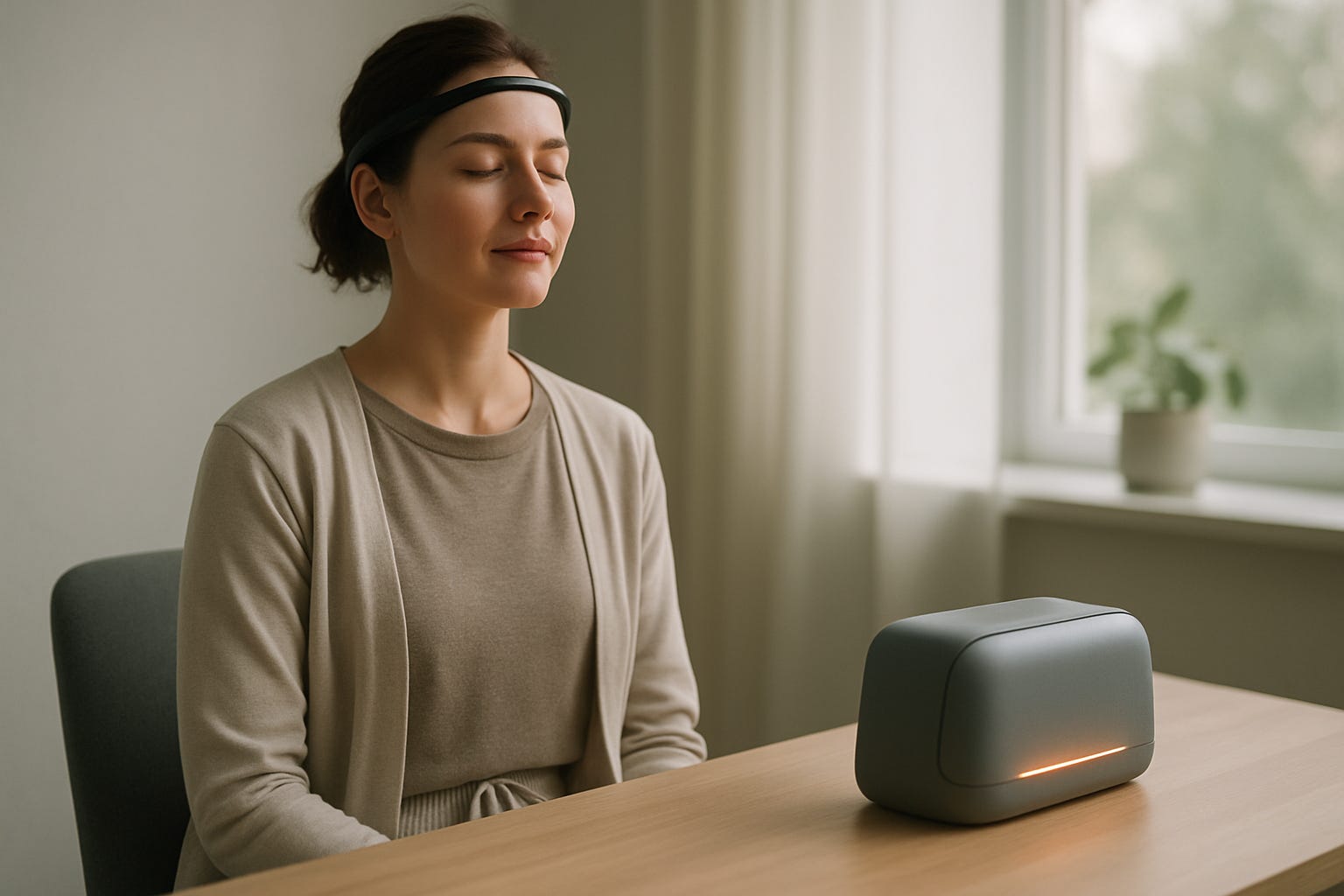
There is a particular kind of cruelty to anxiety: the harder you try to think your way out of it, the worse it gets. The more you reason with the racing thoughts, the louder they become. It’s your own brain working against you, and no amount of willpower changes the math. This is why, for decades, the standard clinical response has been medication — not because SSRIs and benzodiazepines are perfect, but because they sidestep the problem entirely by adjusting brain chemistry from the outside in.
Neurofeedback therapy proposes a different approach: train the brain to regulate itself. Instead of a pill you take every morning, it’s a learning process, one where your own real-time brain activity becomes the teacher. The idea isn’t new — the field dates back to the 1960s — but the technology behind it, the clinical evidence supporting it, and the consumer devices making it accessible have all shifted considerably in the last few years. If you’ve been looking for an alternative to medication for anxiety, or even just curious about what “brain training” actually means in practice, this is worth understanding. 🧠
What neurofeedback actually does to your brain
Every mental state you experience has a corresponding electrical signature. When you’re anxious, your brain produces excess high-frequency beta waves — the neural equivalent of an engine revving too hard. When you’re calm and alert, alpha waves (8-12 Hz) dominate. When you’re in deep relaxation or creative flow, theta waves (4-8 Hz) emerge. These aren’t metaphors. They’re measurable electrical patterns that EEG sensors pick up from your scalp in real time.
Neurofeedback works by making those invisible patterns visible — and then using that visibility to teach your brain to change them. The basic setup looks like this:
EEG electrodes attach to your scalp and record your brainwave activity continuously
Software translates that activity into an audio or visual signal — often music, a video, or a simple game 🎮
When your brain produces the target pattern (more alpha, less beta, for example), the feedback rewards you: the music plays clearly, the screen brightens, the game progresses
When you drift away from the target state, the feedback dims or pauses
Over repeated sessions, your brain learns to produce the target pattern more reliably — a process driven by operant conditioning, the same mechanism that lets you learn anything through reward and repetition
The particular protocol most studied for anxiety is alpha-theta training, developed in the late 1980s by Eugene Peniston originally for combat veterans with PTSD and alcoholism. Alpha-theta training rewards increases in both alpha and theta activity until theta amplitude crosses above alpha, guiding the brain into a deep hypnagogic state — the borderland between waking and sleep where emotional processing becomes unusually accessible. People describe it as profoundly relaxing, sometimes emotionally revelatory. ⚡
What’s appealing about the mechanism is that it’s bidirectional. You’re not suppressing anxiety from the outside in, like a drug. You’re building the brain’s own capacity to self-regulate. The skills, in theory, persist after training ends — unlike medication, which stops working the moment you stop taking it.
What the research actually says (the honest version)
Let’s be straightforward here: the evidence for neurofeedback and anxiety is promising but not settled, and anyone who tells you otherwise is selling something. 🔬
The positive findings are real. A 2025 study published in Frontiers in Public Health tested a Neurofeedback-Assisted Mindfulness Training Program (NAMTP) in a randomized controlled trial running from February 2024 to February 2025, and found it reduced anxiety in young adults. A separate study published in Brain Research in late 2025 assigned 25 participants with moderate or higher anxiety scores on the GAD-7 scale to either real alpha-theta neurofeedback or mock feedback over nine sessions. The real feedback group showed significant anxiety reduction at the end of training; the mock group did not. A 2024 systematic review and meta-analysis in Frontiers in Psychiatry covering neurofeedback for PTSD — which overlaps heavily with anxiety — found consistent symptom reduction across multiple randomized controlled trials.
The critical caveats are also real:
Most studies have small sample sizes, often 20-30 participants, because the equipment is expensive and the protocols are time-intensive
Designing a genuine placebo control for neurofeedback is legitimately hard — sham feedback often feels different to participants, which undermines blinding
A 2025 meta-analysis published in the Journal of Medical Internet Research found that consumer-grade neurofeedback combined with mindfulness was not demonstrably more effective than control conditions in many of the 21 studies it reviewed, and raised the possibility of “neurosuggestion” — essentially placebo effects enhanced by the technology’s authority
Psychology Today notes plainly that some research shows neurofeedback performs no better than a placebo for certain populations
My reading of this evidence is that neurofeedback probably works for some people and probably doesn’t work for others, and we don’t yet have the tools to reliably predict which group someone falls into before they start. That’s a frustrating conclusion, but it’s an honest one. What I find encouraging is that a November 2025 systematic review in ScienceDirect specifically flagged what the next step needs to be: large-scale, blinded, durability-focused trials with standardized protocols. The research community knows what questions remain open, and they’re asking them. That’s different from a field that’s hiding its weak spots. 📈
The clinical side: what sessions actually look like
For anyone considering professional neurofeedback for anxiety, the practical details matter. A proper clinical program typically starts with a QEEG brain mapping session — a quantitative assessment of your baseline brainwave patterns across multiple frequency bands and electrode sites. This costs between $500 and $3,000 depending on the clinic, and it’s what allows a practitioner to design a protocol actually tailored to your specific brain activity rather than a generic template.
Individual sessions typically run $100 to $300 each. Most anxiety protocols involve 20-40 sessions, often two or three times a week. The math: a full treatment course at a mid-range clinic could run $3,000 to $8,000 not counting the initial mapping. Insurance rarely covers it. That’s a significant barrier and worth naming directly.
What the session itself feels like varies by protocol, but for alpha-theta training, most people describe it as:
Sitting or lying comfortably with electrodes lightly attached to their scalp
Listening to music that subtly responds to their brainwave state — becoming clearer during alpha-theta states, fading slightly when beta dominates
Entering a deeply relaxed, often slightly dreamlike state after 20-30 minutes 💊
Not “doing” much consciously — the brain learns without deliberate effort
One finding worth paying attention to: Myndlift’s internal data shows that members who completed a dedicated Neuro Coach call were roughly 90% more likely to still be training by session 15 compared to those who didn’t. That’s a striking number, and it suggests that accountability and guidance matter as much as the technology itself. Brain training without a coach is like having a gym membership you never use.
The cost-benefit comparison with medication is genuinely interesting, though not straightforward. Monthly SSRIs for anxiety might run $30-$150 depending on the drug and whether it’s generic. A 30-40 session neurofeedback course at $150 per session is $4,500-$6,000 upfront. But medication requires ongoing cost indefinitely; neurofeedback, if it works, may produce durable results that don’t need constant maintenance. Dr. Andrew Hill’s cost analysis puts the break-even point against ongoing medication and doctor visits at one to three years — though he notes this is a clinical observation and cost-modeling argument, not a head-to-head trial finding. Worth knowing. Not worth overstating.
Does the cost-versus-durability comparison resonate with what you’ve experienced in your own search for anxiety treatments? The tradeoff between upfront investment and ongoing expense is something most people with anxiety have already been navigating for years.
The consumer layer: devices you can try today
The clinical route isn’t the only option anymore. A wave of consumer EEG headsets has brought neurofeedback-style brain training within reach of ordinary budgets, though with meaningful tradeoffs in signal quality and clinical rigor. 🚀
The most established is the Muse S Athena, released in March 2025 by Interaxon — the first consumer wearable to combine both EEG and fNIRS (functional near-infrared spectroscopy) sensors in a single headband. EEG captures electrical brainwave patterns; fNIRS tracks blood oxygenation in the prefrontal cortex. Together, they give a more complete picture of brain state than either alone. Priced around $300-$400, it pairs with the Muse app for meditation neurofeedback and with Myndlift’s clinical-facing platform for more structured training protocols.
Other options worth knowing:
Sens.ai ($1,450): combines EEG, heart rate variability biofeedback, and photobiomodulation in a single headset; has 16 structured training missions that escalate in difficulty over dozens of sessions
Mendi ($299): uses fNIRS specifically for prefrontal cortex training; no subscription fees; simpler and more accessible for beginners
Neurosity Crown ($1,499): 8-channel EEG with an onboard computer and developer API; better suited for productivity hackers and those building their own BCI applications than for anxiety treatment specifically
FocusCalm ($400 total): developed at Harvard’s Innovation Lab; game-based approach that’s reportedly used by professional athletes in MLB, NFL, and NBA contexts
The honest limitation of consumer devices is what IEEE Pulse flagged in August 2025: there’s a real risk of opportunity cost. If someone invests time and money in a consumer neurofeedback device instead of pursuing a therapy with stronger evidence — CBT, for instance, which has an extremely strong evidence base for anxiety — the device may cause indirect harm even if it causes no direct harm. That’s not a reason to avoid consumer devices. It’s a reason to use them with open eyes, not as a replacement for professional care but as a complement to it or a first step toward understanding your own brain. 🧬
If you do try a consumer device, the realistic timeline from users and small studies suggests: two to four weeks with consistent sessions (three to five per week) before noticing anything at all, eight to twelve weeks before meaningful changes in daily anxiety feel stable, and six months or more for what researchers call deeper neuroplastic changes in baseline stress reactivity.
What to actually do if you want to explore this
Neurofeedback is not magic, and it’s not snake oil. It sits in a genuinely interesting middle ground: real biological mechanism, real clinical evidence in specific contexts, real methodological problems that haven’t been fully resolved, and a consumer market that has outrun the research in some directions.
If you’re considering it, here’s a practical framework:
Start with your doctor or psychiatrist, not a neurofeedback clinic. Get a full picture of your anxiety — diagnosis, severity, what treatments you’ve already tried — before adding another variable 💡
Research practitioners carefully. Look for board certification through the Biofeedback Certification International Alliance (BCIA), which requires specific training and ongoing education. The field has enough unqualified providers that credentials genuinely matter
If cost is a barrier, ask whether any university research programs in your area offer neurofeedback at reduced rates as part of ongoing studies — this is common and underused
Consumer devices are a reasonable starting point for curiosity but not for treating clinical anxiety on their own. If you try a Muse or Mendi, use it as a tool for self-understanding rather than self-treatment
Don’t stop medication to try neurofeedback. These are not competing options; they can run concurrently, and dropping a medication without medical supervision is risky
As NeurotechMag has covered in depth, neurotech is no longer limited to lab settings or clinical trials — it’s a consumer reality with real device choices at multiple price points. And as the broader brain-computer interface space has shown, the fastest-moving question isn’t whether these technologies work in principle. It’s how to get the right ones to the right people with the right expectations. ⚡
Neurofeedback for anxiety is squarely in that question. The mechanism is real. The evidence is encouraging in specific populations and weak in others. The devices are accessible. The expertise to use them well is unevenly distributed and genuinely hard to find.
Here’s the question I’ll leave you with: if a treatment works for 40% of people with your condition, has no serious side effects, and doesn’t require you to take a pill every morning for the rest of your life — at what point does the uncertain evidence stop being a reason to wait and start being a reason to try?