

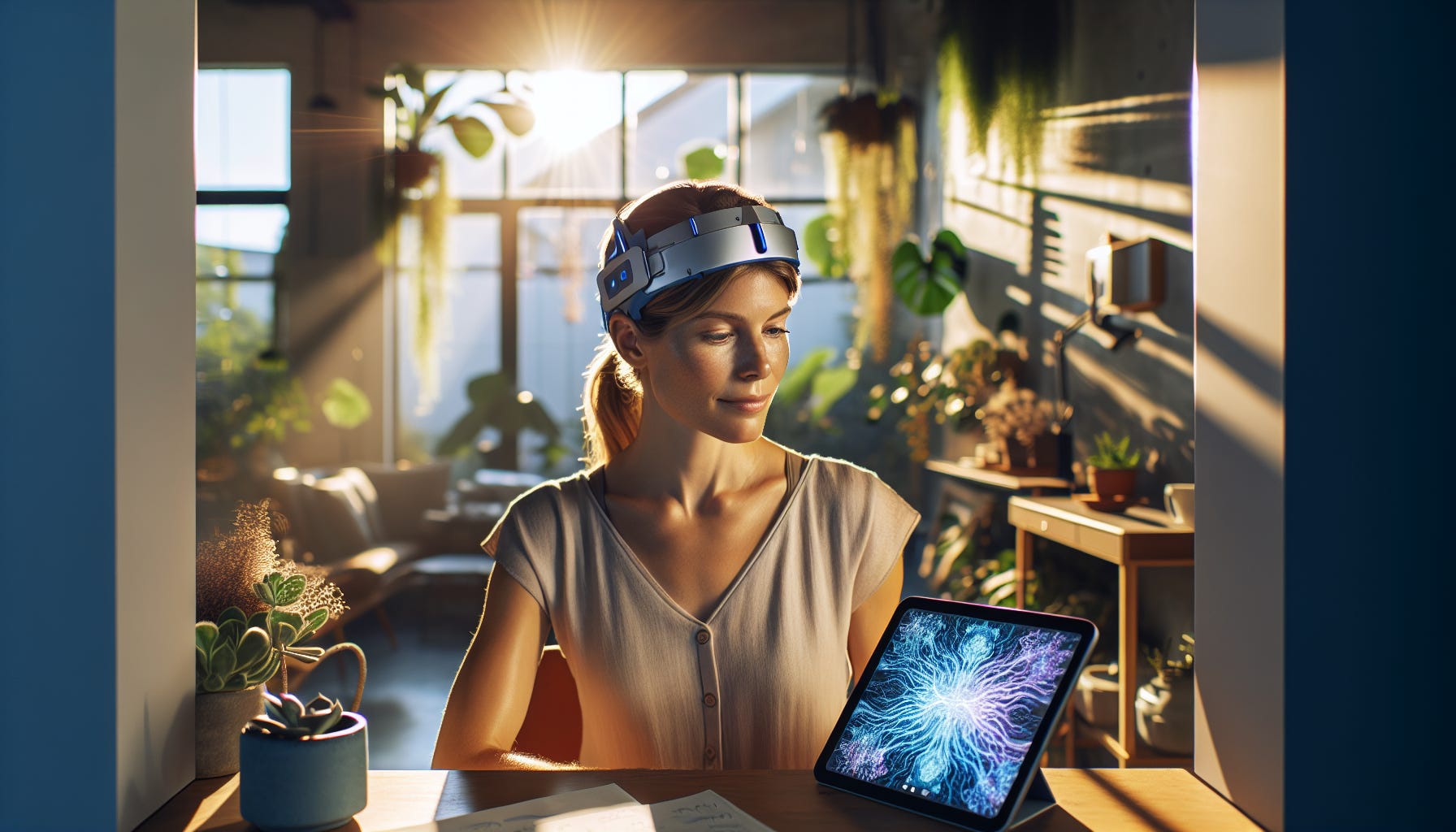
The revolution didn’t happen overnight. There was no dramatic announcement, no breathless media coverage. Instead, it crept quietly into clinics and homes across America through something far more powerful than hype: FDA approvals.
In December 2025, the Food and Drug Administration did something unprecedented—it cleared the
first at-home, non-drug brain stimulation device for depression. By early 2026, multiple neurotech companies were shipping headsets, headbands, and wearable devices directly to patients’ homes 🏠.
More than 20 million US adults live with depression, a 60% increase over the past decade, and for many of them, the traditional cycle of trying medication after medication is finally being disrupted.
This isn’t about replacing every antidepressant prescription—that’s not how medical progress works. But for a growing number of patients, neurotech is becoming the first-line treatment, the backup plan, or the bridge to recovery that pills couldn’t provide. The numbers tell the story: in real-world settings, up to 83% of patients show improvement with TMS, and more than half may achieve full remission. Meanwhile, up to a third of patients with major depressive disorder do not respond to antidepressants.
The quiet FDA revolution
Here’s what happened while most people weren’t paying attention: the FDA went on an approval spree 📈.
Flow Neuroscience’s FL-100 became the first at-home, non-drug brain stimulation device approved in December 2025.
Neurolief’s Proliv™Rx received FDA approval in January 2026 as adjunctive treatment for adults with major depressive disorder who haven’t responded to antidepressants.
BrainsWay expanded deep TMS to adolescents aged 15-21, and received clearance for an accelerated protocol that shortens treatment from 4 weeks to just 6 days.
The regulatory floodgates opened because the evidence became undeniable.
Expert panels reviewed nearly 2,400 studies and confirmed that TMS is safe and effective, even for people whose depression hasn’t responded to medications. These weren’t small pilot studies—they were large, rigorous trials that met the FDA’s gold standard requirements.
Key FDA approvals transforming depression treatment:
Flow FL-100: At-home transcranial direct current stimulation
Neurolief Proliv Rx: Combined occipital and trigeminal stimulation
SAINT Neuromodulation System: MRI-guided accelerated TMS approved in 2022
Multiple deep TMS expansions for broader patient populations
What I find remarkable is the speed 🚀.
Flow expects their headset to be available by mid-2026 for about $500, and the company is already talking with insurers about coverage. This isn’t some distant future—patients can order these devices today.
From clinic walls to living rooms
The home-use revolution changes everything. Traditional brain stimulation required daily clinic visits for weeks — TMS typically requires 20 to 36 sessions, each lasting 30 minutes, over four to six weeks. That’s a massive time commitment that many patients simply can’t manage due to work, family, or transportation barriers.
Now?
Flow’s rechargeable device pairs with a smartphone app for treatment sessions and is cleared for adults 18 and older who do not have treatment-resistant depression.
Neurolief’s device delivers focal, multi-channel stimulation targeting occipital and trigeminal pathways with gentle electrical pulses. The science that once lived behind hospital walls now fits in your bedroom.
Home neurotech advantages:
No daily clinic commutes
Treatment on your schedule
Lower costs than clinical procedures
Privacy and comfort of home
Reduced need for specialized clinical infrastructure
The clinical results are impressive too.
Among real-world users, 77% see improvements in as little as three weeks, with 58% of participants meeting remission criteria at 10 weeks in Flow’s pivotal trial.
Based on real world evidence from >40,000 users, the self-reported incidence rate of side-effects is just 4.5%.
When pills hit a wall 💊
Here’s the uncomfortable truth about antidepressants that the pharmaceutical industry doesn’t advertise: they fail a lot of people.
Few treatments have received regulatory approval for treatment-resistant depression, and currently, only esketamine and an olanzapine-fluoxetine combination have FDA marketing indications specifically for TRD.
The side effect burden is real and often underestimated.
The most prevalent side effects of antidepressants include sexual dysfunction, drowsiness, weight gain, insomnia, anxiety, dizziness, headache, dry mouth, blurred vision, nausea, rash, and tremor.
SSRIs like Zoloft and Lexapro come with weight loss or gain, sexual dysfunction, gastrointestinal distress, and withdrawal symptoms.
Compare that to neurotech’s side effect profile.
The most common TMS side effects are mild, like scalp discomfort or headaches, with serious side effects like seizures being extremely rare.
Flow’s device reports side effects that are generally mild and transient, including skin dryness, irritation, or redness after prolonged use.
The antidepressant plateau problem:
Antidepressants typically take four to eight weeks to become fully effective
For many people, the first antidepressant tried isn’t effective
Patients cycle through medications for years without sustained relief
An estimated 30% of people with treatment-resistant depression have attempted suicide at least once
The neurotech alternative offers something fundamentally different: direct intervention in brain circuits rather than systemic chemical changes.
TMS uses magnets and specialized equipment to deliver rapid magnetic pulses to stimulate brain cells in underactive regions.
This modulation helps restore normal communication within mood-regulation networks with no anesthesia, no systemic drug exposure, and no demonstrated lasting adverse effects.
The deep brain frontier 🧠
While at-home devices grab headlines, the most dramatic neurotech advances are happening inside patients’ skulls. Deep brain stimulation—the surgical implantation of electrodes that act as “brain pacemakers”—is showing remarkable results for treatment-resistant depression.
Half of patients who received brain implants experienced significant improvement in their depression symptoms, with more than one-third virtually depression-free following treatment in a recent study.
Mount Sinai became the first in the United States to perform a DBS procedure as part of the TRANSCEND trial, investigating Abbott’s systems for treatment-resistant depression.
The technology is becoming smarter and more personalized.
Researchers found that brain activity at theta frequency could predict which patients would have the best response to deep brain stimulation, enabling personalized treatment.
Because theta activity tracks anxiety states in real time, stimulation can be turned up when activity is high and down when it’s low.
DBS breakthroughs changing the game:
Medial forebrain bundle stimulation achieved 86% responder rate and the most significant symptom reduction due to its role in dopamine pathways
AI models can now identify signs of depression relapse five weeks before symptoms appear
Closed-loop systems use real-time feedback to adjust electrical stimulation automatically
The surgical nature of DBS means it’s reserved for severe cases, but as many as 2.8 million Americans are diagnosed each year with treatment-resistant depression. For these patients, DBS isn’t experimental—it’s hope.
The acceleration advantage ⚡
One of neurotech’s most compelling features is speed. Traditional antidepressants make you wait—weeks or months to know if they’re working. Neurotech treatments can show results much faster.
UCLA research found that patients who received five TMS sessions per day for five days experienced meaningful symptom relief comparable to the traditional six-week schedule, with some showing strong gains weeks later.
The Stanford SAINT approach compresses multiweek treatment courses into several days and has demonstrated rapid, robust antidepressant effects.
Even the slower neurotech protocols beat pills on timing.
TMS patients can begin to see results as early as two to three weeks, with most patients experiencing symptom relief months after completing treatment and nearly half remaining in remission at one year.
Speed comparison across treatments:
Traditional antidepressants: 4-8 weeks minimum
Ketamine: Relief within 40 minutes for some patients
Accelerated TMS: Meaningful relief in just five days
Zuranolone: Some feel better within 2-3 days
The psychological impact of faster results shouldn’t be underestimated.
Depression already steals time from people’s lives—an insurance policy shouldn’t take up more of it. When someone is suffering, every day matters.
The economics of brain stimulation 💰
Cost remains a major barrier, but the landscape is shifting fast.
In 2025 alone, disclosed funding in neurotechnology surpassed $1.3 billion.
Market research predicts the neurotechnology sector will grow from around $15-17 billion in 2025 to well over $47 billion by 2035.
The home-use devices are surprisingly affordable.
Flow’s headset will cost about $500, while clinical TMS can run thousands of dollars per treatment course.
Most insurance plans cover TMS treatment, making it accessible for many who qualify, but coverage for home devices is still being negotiated.
Healthcare systems are starting to see the long-term value proposition.
Multiple hospitalizations of a patient with chronic depressive symptoms throughout the year cost more than an entire course of TMS, according to clinicians advocating for broader access.
The money equation:
Clinical TMS: $3,000-15,000+ per course
At-home devices: $500-2,000 one-time cost
Medication: $50-500+ monthly, indefinitely
Treatment-resistant depression linked to significantly increased healthcare expenses.
What really changes the economics is effectiveness. If a $500 device can achieve remission rates comparable to expensive clinical treatments, the math becomes compelling for insurers, hospitals, and patients.
The insurance coverage conversation is happening now.
Flow is already talking with insurers and hopes coverage could begin by the end of 2026. Once major insurers start covering at-home neurotech, adoption will accelerate rapidly.
Are we witnessing the quiet disruption of traditional depression treatment? The evidence suggests yes. Not through dramatic replacement, but through gradual adoption by patients who’ve tried everything else and clinicians who see the results. The future might not be pills vs. devices—it might be personalized combinations of both, guided by AI and delivered wherever patients need them most 🏠✨.
What neurotech approach interests you most—the convenience of at-home devices or the precision of implanted systems? The revolution is happening now, and patients are already choosing.