

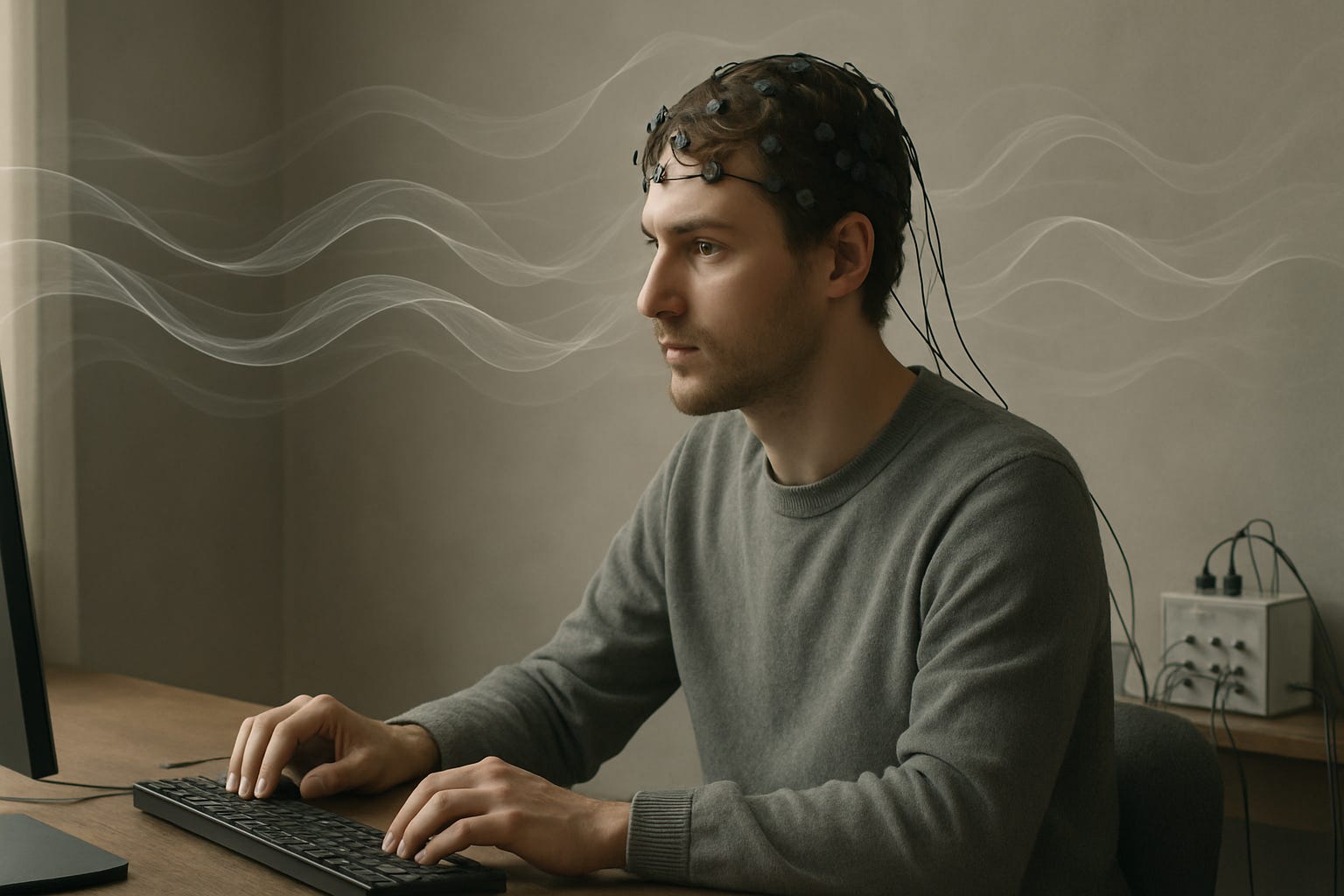
Your brain never shuts up. Right now, tens of billions of neurons are firing electrical pulses at each other, and a tiny fraction of that chatter leaks out through your skull as a faint electrical signal. Scientists have spent decades figuring out how to catch that signal and turn it into something useful: a cursor movement, a typed sentence, a diagnosis. In 2026, that effort has moved well past the lab. Companies are shipping consumer headsets, implanting chips in paralyzed patients, and training AI models to translate raw brain static into language. Here’s how the “reading” part actually works, and what it’s turned up so far. 🧠
What a brainwave actually is
The term “brainwave” oversells it a little. What electrodes actually pick up is the summed electrical activity of thousands of neurons firing in rough sync, not a single clean signal from one thought. Scientists sort that activity into frequency bands, and each band tends to show up under different conditions.
A few of the big ones:
Delta waves (below 4 Hz) dominate during deep, dreamless sleep
Theta waves (4-8 Hz) show up during drowsiness, meditation, and some memory tasks
Alpha waves (8-12 Hz) rise when you’re relaxed and your eyes are closed, and drop when you focus or move
Beta waves (13-30 Hz) spike when you’re alert and actively problem-solving, and they even sync with your muscles when you hold a position
Gamma waves (above 30 Hz) are linked to high-level processing like attention and perception
There’s also a specific blip called the P300, a positive voltage spike that appears roughly 250 to 500 milliseconds after your brain registers something meaningful, like your name flashing on a screen. It’s wonderfully consistent across almost everyone, which is why it powers one of the oldest brain-computer interface tricks in the book: the P300 speller, where you stare at a flashing grid of letters and the system figures out which one you’re looking at by watching for that spike. NeurotechMag broke down these signal types in more detail in 7 signals your brain is giving you, and it’s worth a read if you want the deeper cut. 📊
Here’s a question worth sitting with: if a handful of frequency bands and one reliable spike can already control a cursor, how much more is buried in the noise we haven’t learned to read yet?
From squiggles to sentences: the decoding leap
For most of EEG’s history, reading brain signals meant matching known patterns, like the P300, to known intentions. That’s fine for simple binary choices, but it falls apart when you want someone to type a full sentence. The real shift over the past two years has been handing that problem to AI.
The clearest example is Meta’s Brain2Qwerty, developed with the Basque Center on Cognition, Brain and Language, a research group specializing in language and the brain. The system watches brain activity while someone types on a keyboard and tries to reconstruct what they typed, without any implant. The first version, described in a paper accepted at Nature Neuroscience, used magnetoencephalography (MEG) and hit a character error rate of 32%, cutting the error rate roughly in half compared to plain EEG, which came in around 67%. The newest version, Brain2Qwerty v2, moved to word-level decoding and reached 61% average word accuracy across participants, with the best individual volunteer hitting 78%, trained on some 22,000 typed sentences from nine people. Meta has open-sourced the training code for both versions, so other labs can build on it directly instead of starting from zero. 💡
A few things stand out about this jump:
Non-invasive accuracy went from roughly 8% for older methods to 61% word accuracy in about a year
MEG still crushes EEG for this task, mostly because MEG picks up a cleaner, more spatially precise signal
The model shows a scaling pattern: more training data keeps improving results, with no ceiling in sight yet
The catch is hardware. MEG scanners are room-sized and nowhere near portable, though wearable MEG sensors are starting to appear in research settings
None of this means you’ll be typing emails with your mind next year. Meta’s own researchers are upfront that decoding still makes too many errors for everyday use. But the trend line matters more than any single number, and it’s closing the gap with something far more invasive: implants. Have you noticed how fast the “impossible” claims from just a few years ago keep quietly becoming benchmarks? ⚡
Implants take it further
Non-invasive methods read the brain from outside the skull, which is safer but noisier, kind of like trying to hear a conversation through a closed door. Implants put the electrodes directly on or in the brain, and the signal quality difference shows.
Neuralink is the highest-profile player here. Its N1 implant threads over a thousand hair-thin electrodes into the motor cortex using a surgical robot, and the company’s first patient used it to control a computer cursor, play chess, and browse the internet using thought alone. The FDA granted Neuralink Breakthrough Device Designation for speech restoration in 2025, and the company is now running its PRIME study across sites in the US, UK, Canada, and the UAE. In May 2026, Neuralink announced a new surgical technique that threads electrodes through the dura, the tough membrane wrapping the brain, without removing it, aimed at making implantation faster and less invasive as the company tries to scale from a few dozen patients toward the hundreds.
Other approaches are chasing the same goal with different tradeoffs:
Synchron’s Stentrode goes in through a blood vessel via catheter, avoiding open skull surgery entirely, though the vascular placement limits how many electrodes it can pack in
BrainGate, a long-running academic consortium, has patients who’ve used implants for over a decade, giving researchers rare long-term data on how signal quality holds up as scar tissue forms
BrainGate’s speech-decoding work has translated attempted speech into text at rates approaching 60 words per minute for paralyzed participants, which is close to normal conversational pace
Precision Neuroscience, founded by a Neuralink co-founder who left citing safety concerns, is building a thinner, less invasive cortical array
No implanted BCI is commercially available yet. Every device in a patient today is under a research protocol or expanded access program, and realistic timelines for commercial approval run through 2028 to 2030. That’s a long runway, but it’s also a sign the field has moved from “can this work at all” to “how do we make it safe and scalable.” 🔬
What you can actually buy right now
Here’s the gap that trips people up: implanted BCIs make headlines, but they’re not available to the public, while a much less dramatic category of device already is. Consumer EEG headsets have been sold for over a decade, and they don’t read your thoughts so much as your general mental state: focus, relaxation, drowsiness.
NeurotechMag rounded up several in 5 neurotech devices you can actually buy today, including headsets aimed at meditation tracking and cognitive load monitoring during work sessions. These aren’t medical devices, and they’re not decoding specific words or images. What they are good at is picking up broad shifts in your alpha and beta activity and translating that into a number on an app, something like a Fitbit for your attention span. That’s a legitimate use case, just a much more modest one than “mind reading.”
A few things worth knowing before you buy one:
Consumer headsets typically use dry electrodes on the scalp, which is far less precise than the wet-gel electrodes used in clinical EEG
Most track relative changes in your own baseline over time rather than making absolute claims about your brain
None of them can currently type words or control complex devices with real accuracy
Prices generally range from $200 to $500, well below anything implant-related
Would you wear a brain-tracking headset to work if it meant fewer distractions, or does that cross a line for you? 🤔
Where this is actually heading
Put the pieces together and a pattern shows up. Non-invasive decoding is getting dramatically better through AI, invasive implants are getting less invasive and more targeted, and the two approaches are converging on the same goal from opposite directions: turning brain activity into reliable, real-time output.
The open questions aren’t really technical anymore, or at least not only technical. Who owns the data your headset or implant generates? What happens to that data once it’s fed into an AI model for decoding, which is now standard practice across nearly every system described here? The UNESCO ethical framework on neurotechnology, released in late 2025, is one of the first serious attempts by a global body to get ahead of these questions rather than react to them after the fact. Whether it has real teeth is a separate matter.
If you want to keep track of where this goes next, the P300 speller research and Meta’s decoding gains are worth watching for the technical curve, while the FDA approval timelines for Neuralink and Synchron are worth watching for when any of this actually reaches patients outside a trial. Which milestone would convince you this technology has really arrived: an implant your doctor can prescribe, or a headset that reliably reads specific words instead of general mood? 🚀