

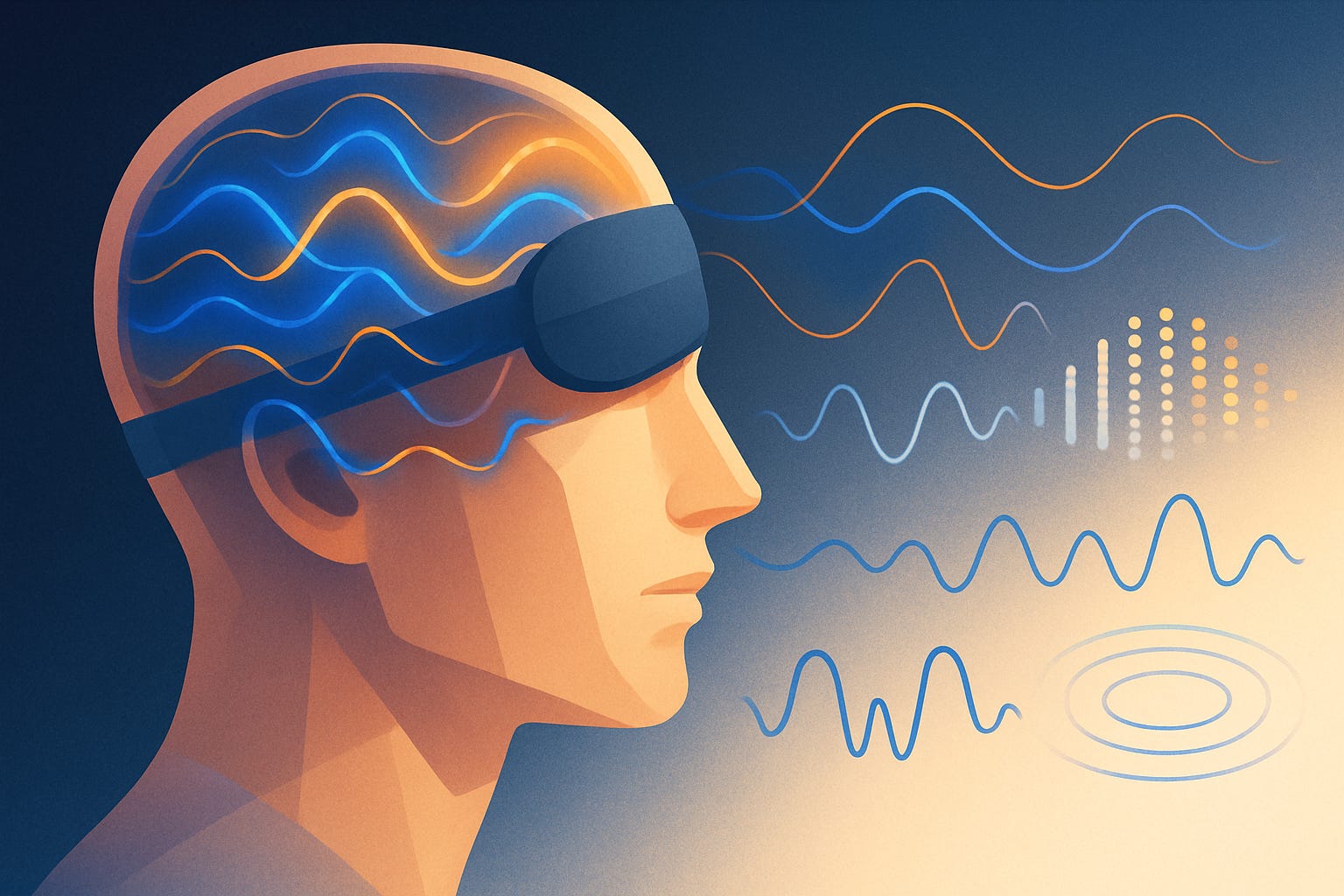
Most sleep wearables never touch your brain. An Oura Ring or a Whoop band infers “deep sleep” from your heart rate, your movement, and some statistical guesswork, which is a perfectly reasonable way to estimate sleep, but it is a proxy, not a measurement. A small category of devices skips the guesswork and puts actual electroencephalography (EEG) electrodes against your scalp overnight. That is a genuinely different kind of data, and it comes with genuinely different rules for how to read it. Here is what your headband is actually recording, how good that recording really is, and what a pro checks before trusting the score on the app’s home screen.
What your headband is actually measuring
Sleep researchers do not eyeball “sleepiness.” They score 30-second chunks of EEG against a fixed set of criteria, first standardized by Allan Rechtschaffen and Anthony Kales in the 1960s and later updated by the American Academy of Sleep Medicine, and every stage has its own electrical signature. Wakefulness with your eyes closed shows alpha waves, a steady rhythm around 8 to 13 Hz. As you drift into light sleep (stage N1), the alpha fades and slower theta waves, 4 to 7 Hz, take over. Stage N2 adds two distinctive bursts: sleep spindles, quick 12 to 14 Hz bursts thought to help lock in memory, and K-complexes, sharp single waves triggered by outside noise or internal processing. Deep sleep, stage N3, is dominated by big, slow delta waves under 4 Hz, the stage most tied to physical recovery. REM sleep looks almost like wakefulness on the EEG, fast and low-voltage, paired with the rapid eye movements and muscle atonia that give the stage its name. None of this requires a full clinical setup to detect in principle, but it does require electrodes in the right place and software that can tell a real spindle from an eyelid twitch.
Here is the part worth sitting with for a second: does your wearable actually see these signatures, or does it infer them statistically from a couple of noisy channels? That distinction is the entire premise of this article. A few reference points before you compare devices, drawn from the scoring standards researchers actually use:
Alpha (8 to 13 Hz): relaxed wakefulness, eyes closed
Theta (4 to 7 Hz): light sleep, stage N1
Sleep spindles (12 to 14 Hz) and K-complexes: the signatures of stage N2
Delta (under 4 Hz): slow-wave, deep sleep, stage N3
Low-voltage mixed frequency plus rapid eye movements: REM sleep
In-lab polysomnography, which records EEG alongside eye movement and muscle activity through dozens of electrodes, remains the reference standard that every wearable gets graded against, and it is worth reading up on how polysomnography actually works before you take any consumer sleep score at face value.
Grading the Muse S Athena against the sleep lab
The best-documented consumer EEG sleep headband right now is the Muse S Athena, which reads brain activity through seven sensors, two on the forehead, two behind the ears, and three references, alongside fNIRS blood-oxygen sensing and a PPG heart rate sensor. What sets it apart from most wellness gadgets is that it has actually been checked against the gold standard in a peer-reviewed study, not just an internal white paper.
Researchers from the Canadian Sleep Research Consortium, the University of Ottawa, and the Royal Ottawa Mental Health Centre ran 56 adults through a single night of simultaneous Muse-S recording and full clinical polysomnography, then had a registered sleep technologist score the lab data blind to the headband’s output. The result, published in the journal Sleep Advances: a full-night Cohen’s Kappa of 0.76, generally considered substantial agreement, with per-stage accuracy ranging from 88 to 96 percent and specificity as high as 99 percent. That is a genuinely strong result for a dry-electrode consumer device worn without a technician in the room.
But here is where reading like a pro actually pays off: the same study found the Muse-S was not unbiased in one particular direction. It overestimated deep sleep (N3) by an average of 15 minutes and total sleep time by 6 minutes, while it underestimated light sleep by 14 minutes compared to the lab recording. That is not a fatal flaw, but it means the single number staring at you every morning, “1 hour 42 minutes of deep sleep,” carries a real margin of error baked into that specific stage. A few habits worth adopting because of this:
Trust week-over-week trends in your own data more than any single night’s absolute minutes
Treat the deep sleep number as directionally useful, not a precise clinical measurement
REM and wake staging are the most reliable outputs, per the near-perfect agreement range in the validation study
Remember this validation applies to the Muse-S specifically, not to every EEG headband on the market
A device with no published PSG comparison at all deserves more skepticism than one with a flawed but documented one
When your headband talks back: closed-loop devices like Elemind
So far, everything above describes wearables that read. A newer category also writes: it senses your brainwaves in real time and immediately responds with a stimulus meant to change them. The clearest example is Elemind, a Cambridge, Massachusetts company founded by MIT researchers, whose headband uses three frontal EEG electrodes to detect alpha-wave activity and a bone-conduction transducer to deliver a precisely timed pink-noise pulse. The idea, per MIT’s own reporting on the technology, is to time the sound to land at a specific phase of your alpha rhythm, nudging it down and easing the transition into sleep, rather than just playing generic white noise all night.
Elemind’s own pilot data reported a sleep-onset-latency reduction of roughly 10.5 minutes, with meaningful variability, in people who started out taking 30 minutes or more to fall asleep. That is a real, measured effect, not marketing fluff, but it is also worth being precise about what it is not: Elemind is explicitly a wellness product, and the company has been upfront that it is not FDA-cleared to diagnose or treat any sleep disorder. Compare that with Dreem 3S, made by Beacon Biosignals, which points its EEG headband squarely at clinical research and decentralized trial use rather than the consumer wellness aisle, a genuinely different business model and a different bar of evidence to ask for.
If you are shopping in this category, ever wonder why one company leads with an FDA-clearance conversation and another very deliberately avoids it? That framing tells you almost as much as the spec sheet. Before trusting a closed-loop device’s claims:
Ask whether the effect was measured against a sham or placebo condition, not just before-and-after
Check the sample size behind any “X percent faster to fall asleep” headline, pilot studies of a few dozen people are a start, not a conclusion
Note whether the company is targeting consumers, clinicians, or researchers, since that shapes what evidence they are required to show
Separate “reads your brainwaves” from “changes your brainwaves,” these are different technical claims with different risk profiles
A wellness label is not a red flag by itself, but it does mean nobody outside the company has reviewed the claims yet
The pro checklist before you trust the score
Here is the blunt version of everything above: right now, no consumer EEG sleep headband holds FDA clearance to diagnose insomnia, sleep apnea, or any other sleep disorder. That is not a knock on the technology, it is just where the regulatory bar sits, and a real diagnosis still means a night hooked up to actual polysomnography in a lab. What these devices are good at is longitudinal, at-home pattern tracking that a one-night lab study can never give you, since nobody sleeps normally with 20 wires glued to their scalp.
If you are evaluating one of these devices, or already own one and want to stop taking its dashboard at face value, ask the same four questions a sleep researcher would ask before citing a new device in a paper:
Has it been validated against polysomnography in a published, peer-reviewed study, and can you find the actual accuracy numbers per sleep stage
Is the sample large enough, and diverse enough in age and health status, to generalize to you
Does the company disclose where its numbers run high or low, the way the Muse-S validation study did for deep and light sleep
If it claims to change your sleep, not just measure it, was that tested against a sham condition
Next time your app tells you that you got 58 minutes of deep sleep, the useful question is not whether that number is exactly right. It is whether tonight’s number is meaningfully different from last week’s, measured by the same device, under the same known biases. That comparison is one your smartwatch nudge on a wristband still cannot offer you.