

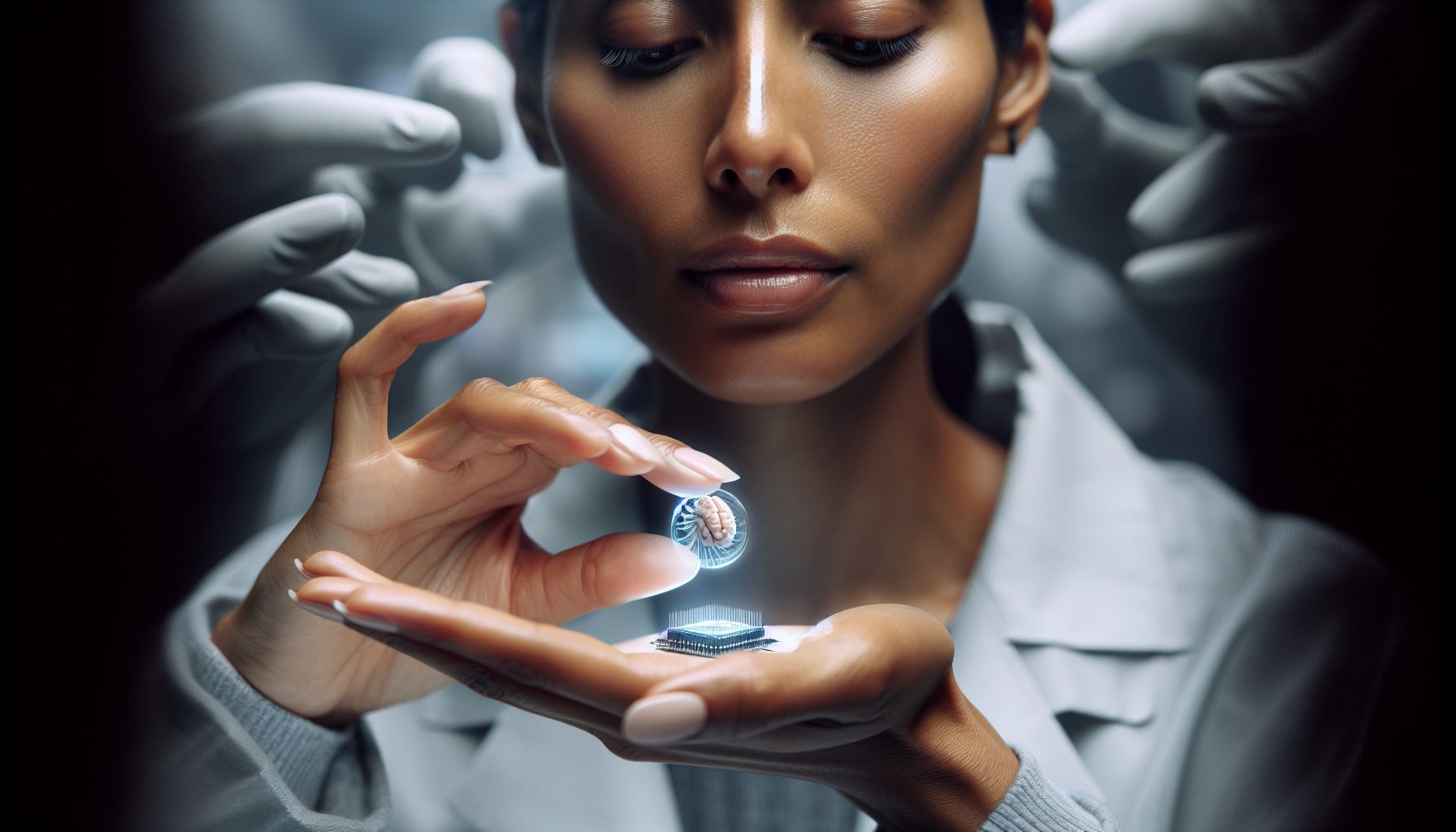
Something happened in April 2026 that most mainstream tech outlets barely covered. A small device — a pea-sized chip carrying 520 recording electrodes — was placed on the surface of a living human brain by Dr. Murat Günel, chair of neurosurgery at Yale Medical School, as part of an early feasibility study run by a company called Science Corporation. The procedure itself was low-drama: the patient was already undergoing brain surgery, and the implant was added without requiring additional incisions or anesthesia time. The chip sat on the cortex, listened, and successfully recorded neural signals.
On paper, that sounds like a modest milestone in a field full of them. It isn’t. What makes this moment different is what the chip is designed to become — and what that says about where the entire brain-computer interface field might be heading.
Science Corp isn’t building a better electrode. It’s trying to build something that is, eventually, no longer really an electrode at all.
Why every current brain implant has the same fundamental flaw
To understand what Science Corp is attempting, you need to understand the problem that every other BCI company is quietly managing rather than solving. Put something made of metal or silicon into the brain, and the brain immediately tries to wall it off. 🔬
The sequence is well-documented. Within hours of implantation, microglia — the brain’s immune cells — detect the foreign object and begin encapsulating it. Within two to three weeks, astrocytes form a compact glial scar around the implant: a tight, insulating sheath that progressively increases the electrical impedance between the electrodes and the neurons they’re trying to record. Signal quality degrades. Over months to years, neurons in the surrounding area begin to die. The foreign body response, as it’s called in the literature, is the main reason most chronically implanted neural devices fail over time.
This isn’t a secret. Researchers have known about it for decades. The standard industry response has been to:
Make electrodes thinner and more flexible to reduce mechanical mismatch with soft brain tissue
Use softer materials, like hydrogels, to minimize the immune response
Design algorithms that compensate for degraded signal as scar tissue accumulates ⚡
Accept that long-term signal fidelity will decline and plan accordingly
Yale’s Dr. Günel has described the problem bluntly: conventional probes “cause brain damage that is likely to undermine device performance over time.” The BCI field has been engineering around that damage for two decades. Science Corp founder Max Hodak — who co-founded Neuralink before departing in 2021 — decided he’d rather solve it instead.
His proposed solution is to stop using electronics as the brain’s primary contact point, and use neurons instead. 🧠
What “biohybrid” actually means, and why it’s genuinely different
The word biohybrid gets used loosely, so it’s worth being precise. Science Corp’s full device concept combines two fundamentally different technologies: semiconductor fabrication and cell biology, with neither one subordinate to the other.
The long-term architecture works like this. A thin-film device sits on the cortical surface, resting on the brain rather than penetrating it. Embedded in the device are lab-grown neurons, derived from stem cells and genetically modified with light-sensitive proteins called channelrhodopsins — the same proteins at the heart of optogenetics research. Micro-LEDs on the chip can fire pulses of light that trigger these neurons to fire. The neurons, meanwhile, grow axons and dendrites outward from the device into the patient’s native brain tissue, forming functional synaptic connections with the circuits underneath. 💡
What you end up with, if it works, is a biological bridge. The electronics talk to the lab-grown neurons via light. The lab-grown neurons talk to the brain via chemistry — the same neurotransmitters, the same synaptic mechanisms the brain has been using for evolution’s entire run. The high-impedance glial scar problem largely disappears because there’s no metal foreign body for the brain to wall off. The neurons are the interface.
The scale potential is genuinely striking. Science Corp’s published thinking, available on the company’s website, notes the key advantages of this approach:
A device volume of under one cubic millimeter could house a million neurons
A million neurons, each forming multiple connections, could generate over a billion synapses
Bidirectional communication — reading and writing neural signals — becomes possible at biological resolution, not electrode-count resolution 🚀
Chemical neurotransmitters allow the interface to speak the brain’s native language, rather than approximating it with electricity
That’s the vision. Alan Mardinly, Science Corp’s chief science officer, has spent years building toward it with a team of about 30 researchers.
Science Corp’s first human — and what it actually demonstrated
The device placed by Dr. Günel in April 2026 is not the full biohybrid system described above. It contains no lab-grown neurons. No optogenetics. No light stimulation. It’s a recording-only platform, and as The Next Web reported, its purpose is specifically to prove that the hardware architecture can safely sit on the brain’s surface and capture meaningful signals before any biological components are introduced.
That’s actually the correct sequencing. Build the foundation. Confirm safety. Then add the biology. What the first human placement did demonstrate is significant: the biohybrid sensor successfully detected cortical activity through its living neuronal layer, validating years of preclinical animal work showing that lab-grown neurons on the device could form functional synapses with host brain tissue in rodent models. 🔬
Hodak was measured about expectations. “This is a first-in-human,” he said in the announcement. “We’re at the very beginning of understanding what this technology can do in people.”
Science Corp’s track record with biology-meets-electronics is not purely theoretical. The company’s PRIMA retinal implant — a device smaller than a grain of rice that pairs with camera-equipped glasses to restore vision in patients with age-related macular degeneration — was tested in 38 patients across 17 sites in five countries. Results published in 2025 showed 80% of patients achieved meaningful improvement in visual acuity, and 84% could read letters, numbers and words at home. Science Corp has submitted a CE mark application to the EU and expects approval by mid-2026, which would make it the first BCI company to have a product commercially available. That context matters for the brain interface work because it shows this is a team that can navigate the gap between interesting biology and regulated medical devices.
The TechCrunch profile of Science Corp’s Yale partnership is worth reading in full if you want a clear-eyed look at what the company is doing and how long it realistically expects to take. Günel’s own timeline estimate — “2027 would be optimistic” for full biohybrid trials — is an honest signal that this is basic science as much as product development.
If you work in neurotech or follow it closely, what aspects of the biohybrid approach do you find most technically credible — and what do you think remains the hardest unsolved problem?
The engineering challenges nobody is downplaying
Science Corp is not pretending this is easy. In fact, Hodak has discussed the challenges with unusual candor in public forums, and they’re worth taking seriously rather than skipping past. 🧠
Cell manufacturing is the first major one. Growing neurons reliably from stem cells, keeping them alive through the implantation process, and ensuring they form the right kinds of connections with native tissue is genuinely hard. Living cells aren’t silicon wafers — quality control operates on a completely different plane from semiconductor fabrication. Neurons are fragile. They need oxygen, glucose, and neurotrophic support. They will die if the process goes wrong, and “wrong” in cell biology can mean something that’s extremely difficult to catch before implantation.
The immune rejection problem is the second. Lab-grown neurons implanted into another person’s brain would normally trigger an immune response. The solutions Science Corp is working toward involve:
Hypoimmunogenic stem cell lines, genetically engineered to be “cloaked” from the immune system — essentially universal donor neurons, compatible with any human patient
Patient-derived neurons (autologous), grown from the patient’s own cells — more compatible, but takes months and currently costs over a million dollars per patient 💊
Immunosuppressive medications during the integration window, as used in organ transplant medicine
The third challenge is the “kill switch.” Hodak has discussed this openly with TIME: if transplanted neurons were to grow uncontrollably, crowding out native cells, the system needs a way to stop them. Science Corp’s current answer is ganciclovir, an antiviral drug that could be used off-label to selectively attack the implanted cells. It’s a reasonable precaution, and the fact that they’ve thought through this failure mode is reassuring. It’s also a reminder that this technology is operating at the edge of what medicine knows how to do safely.
As NeurotechMag explored in the piece on the signals that neurotech is hitting a tipping point, capital is flowing into this field fast enough that ambitious bets are now being made at scale. Science Corp’s $230 million Series C in March 2026, at a $1.5 billion valuation, is a signal that investors believe the biohybrid bet is worth making even with these challenges unsolved.
How this fits into the BCI competitive picture
It’s tempting to treat biohybrid as just another horse in the BCI race. I think that framing undersells what Science Corp is attempting, and also overstates how soon this becomes a race in any practical sense. ⚡
Neuralink has implanted its N1 device in over 20 patients and recently expanded trials to the UK. Synchron has more than 50 patients implanted via its blood-vessel-threading Stentrode approach. Paradromics received FDA investigational device exemption for its Connexus system in late 2025, targeting speech restoration. These are all real milestones. They’re also all variations on the same fundamental architecture: put electronics near neurons, record the electrical field, decode the signal.
What Science Corp is attempting is architecturally different. Not incrementally different. The differences between a purely electronic interface and a biohybrid one are roughly:
Signal source: electronic interfaces record field potentials; biohybrid synapses use chemical neurotransmitters
Integration mechanism: electronics sit near neurons; biohybrid neurons become part of neural circuits
Longevity trajectory: electronic implants degrade as scar tissue forms; biohybrid interfaces may strengthen as neurons integrate
Stimulation physics: electronics apply voltage; biohybrid uses light-triggered neurotransmitter release — far more spatially precise 🔬
MIT’s lab has taken a different but related path. In November 2025, Professor Deblina Sarkar’s group published research in Nature Biotechnology on what they call “circulatronics”: immune cells fused with microscopic photovoltaic electronics, injected intravenously, which navigate autonomously to inflamed brain regions and self-implant, providing neuromodulation with no surgery required. It’s an entirely different application of the same core insight — that biological cells can camouflage electronics and carry them where pure engineering can’t reach.
These two approaches — Science Corp’s cortical biohybrid and MIT’s circulatronics — represent what I think is the most interesting long-term question in the BCI field: not “which electrode design wins,” but “what happens when we stop treating the brain as something electronics must learn to interface with, and start treating it as something electronics can learn to become part of.” That’s a different question. It has a different answer, and probably a different timeline.
For anyone tracking where neurotech is heading, NeurotechMag’s breakdown of the competitive advantages that define this sector is worth revisiting through this lens — because biohybrid technology, if it works at clinical scale, would fundamentally shift which advantages matter most.
Max Hodak has said that Avatar is “a pretty good reference” for how he thinks about biohybrid interfaces. That’s a provocative framing, and probably premature. But when a neurosurgeon at Yale with decades of brain surgery experience describes the concept of using transplanted neurons to protect neural circuits in Parkinson’s disease as “genius,” it’s worth pausing to take the ambition seriously rather than reflexively cycling it through a skepticism filter.
The question that I keep returning to is this: if a biohybrid implant could form a billion functional synaptic connections with a patient’s own motor cortex, would the brain eventually stop distinguishing between its own circuits and the ones that grew in from the device — and if it did, what would that mean for how we think about treating, or enhancing, the brain over a lifetime?