

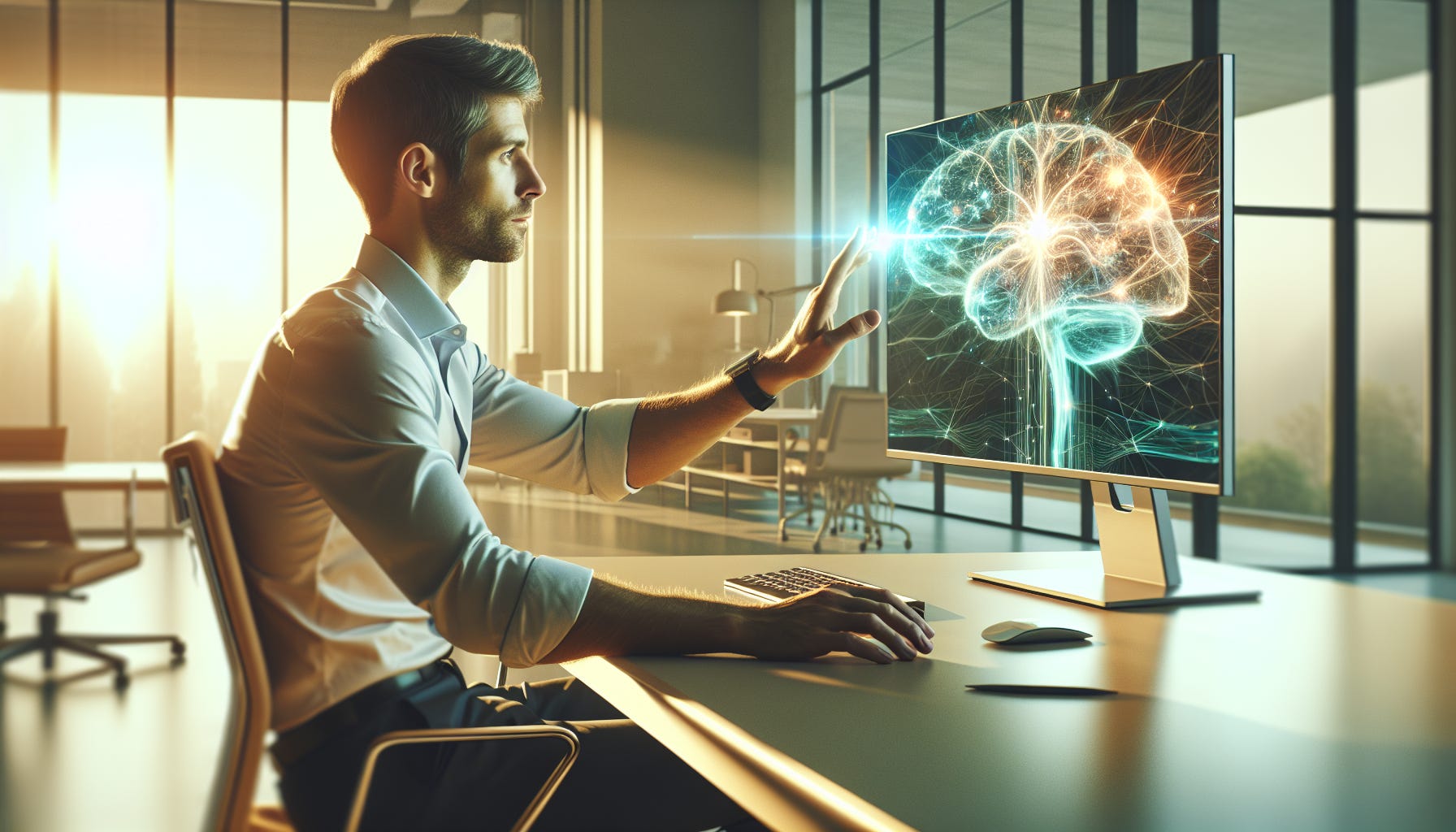
Picture this: you’re paralyzed from the shoulders down, but you’re playing chess online with your thoughts 🧠. Not science fiction anymore — that’s exactly what Noland Arbaugh did in 2024, becoming the first person to receive a Neuralink brain implant. His story isn’t just inspiring; it’s a preview of where neurotechnology is heading.
On March 20, 2024, Neuralink released a livestream showing Arbaugh moving a computer cursor and playing online chess using the implant.
But here’s the thing: brain-computer interfaces aren’t just about Elon Musk’s headline-grabbing company. They’re a rapidly expanding field that’s
about 25 clinical trials of BCI implants are currently underway, and the technology is about to get much more personal.
What exactly is a brain-computer interface? Think of it as a translator between your neural chatter and the digital world.
At its core, a brain–computer interface is a system that measures brain activity and converts it in real time into functionally useful outputs, changing the ongoing interactions between the brain and its external or internal environments. In plainer terms, a BCI translates thought into action.
Whether you’re dealing with paralysis, curious about cognitive enhancement, or just wondering what all the fuss is about, understanding BCIs matters because they’re not staying in research labs.
Society is recognizing: Neurotech isn’t coming — it’s here. This is where innovation meets humanity.
The two flavors of brain reading 🔬
BCIs come in two main varieties, and the difference between them is literally life-changing.
Invasive BCIs require surgery.
Invasive BCIs involve surgical procedures to implant electrodes directly into the brain or on its surface. Although there are inherent risks and potential complications for the user associated with such systems, they offer high-resolution signal acquisition. These are the heavy hitters — Neuralink’s device has threads with more than 1,000 electrodes, giving the device a much higher connectivity rate than most of the BCIs currently being studied in humans.
The payoff? Incredible precision. Neuralink patients can control computer cursors with jaw-dropping accuracy.
Arbaugh, who is quadriplegic, reported being able to control a computer cursor and play games using only his thoughts, saying the device had “given my life back”. But there’s a catch — surgery carries risks, and some patients experience complications like electrode degradation over time.
Non-invasive BCIs are the more user-friendly option.
Non-invasive BCI approaches are particularly common as they can impact a large number of participants safely and at a relatively low cost. Where traditional non-invasive BCIs were used for simple computer cursor tasks, it is now increasingly common for these systems to control robotic devices for complex tasks that may be useful in daily life.
These typically use EEG (electroencephalography) — essentially reading brainwaves through sensors on your scalp. No surgery, no infection risk, and you can take them off when you’re done. The tradeoff? Lower signal quality and less precise control.
Here’s what each approach excels at:
Invasive: High-bandwidth control, precise cursor movement, complex device operation, speech synthesis
Non-invasive: Wellness tracking, meditation training, basic device control, gaming applications
Real applications happening right now ⚡
The applications are moving way beyond “cool tech demo” territory.
This review comprehensively covers BCI applications for neurological conditions such as motor disabilities, speech impairments, cognitive dysfunction, and sensory deficits.
Medical breakthroughs are the most dramatic.
Recent advances in BCIs, particularly those achieved in 2024, have significantly impacted the field of speech restoration, particularly in patients with severe disabilities such as ALS.
We’re seeing paralyzed patients control robotic arms, wheelchair navigation through thought, and communication systems for people who’ve lost their ability to speak.
Consider Brad Smith, the third Neuralink patient.
Brad Smith – an ALS patient who is completely non-verbal, ventilator-dependent, and can only move his eyes – used the implant to narrate and self-edit a YouTube video – essentially with just his thoughts and eyes alone. The video is narrated by a voice digitally recreated from Smith’s audio recordings before he lost the ability to speak. Smith speaks about how the implant works, the impact it has had on his family, and the impact it has had on his ALS journey.
Stroke rehabilitation is another game-changer.
In the domain of stroke rehabilitation, the investigation of BCI technology has achieved substantial advancements. However, several challenges and research gaps remain.
BCIs can help rewire damaged brain connections by providing real-time feedback during therapy sessions 🧠⚡.
Consumer applications are exploding too.
In September 2024, Neurable Inc., a prominent figure in neurotechnology focusing on AI-driven tools, alongside the luxury audio brand Master & Dynamic, unveiled the MW75 Neuro, intelligent headphones that incorporate Neurable’s brain-computer interface (BCI) technology to assist users in gaining profound insights into their cognitive well-being, tackling burnout, and improving everyday performance. The first of their kind, these BCI-enabled consumer headphones are poised to transform our interaction with daily technology.
Gaming is getting weird in the best possible way 🎮. Non-invasive BCIs are enabling mind-controlled gameplay, immersive VR experiences, and even emotion-responsive environments. Early adopters are already playing games with their thoughts, and the experience is surprisingly intuitive.
The AI boost that changes everything 🤖
Here’s where BCIs get really exciting: artificial intelligence is supercharging their capabilities.
Furthermore, the integration of BCI with emerging technologies such as artificial intelligence (AI) and machine learning enhances the precision and adaptability of these interfaces. By learning from users’ brain patterns, BCIs become more intuitive and effective, providing personalized therapy tailored to individual neurological profiles.
Modern BCIs use machine learning to:
Adapt to your brain patterns over time, improving accuracy with use
Filter out noise and focus on the neural signals that matter
Predict your intentions before you fully form the thought
Provide personalized feedback based on your unique neural signatures
Today, the convergence of deep learning with neural data is yielding quite accurate decoders – e.g. speech BCIs infer words from complex brain activity at 99% accuracy and <0.25 second latency. Such feats were unthinkable ten years ago – in 2014, after his self-experiment, Dr. Kennedy was only able to produce about 290 short words. This illustrates how rapidly the technology to interpret brain signals (thanks to advances in AI and electrode design) has accelerated.
The AI integration means BCIs are becoming more like intelligent partners than simple tools. They learn your habits, anticipate your needs, and adapt their responses accordingly. It’s the difference between typing on a basic keyboard and having a smart assistant that finishes your sentences.
The money says it’s real 💰
When serious money starts flowing, you know technology is transitioning from research curiosity to commercial reality.
In 2025 alone, disclosed funding in neurotechnology — across implantable and non-invasive brain-computer interfaces (BCIs), neuromodulation, diagnostics, and more — surpassed $1.3 billion. Investors rarely bet billions on projects that won’t pay off. Capital tells us the smart money believes: neurotech is more than hype — it’s scalable. Put another way: neurotech is attracting serious capital — a core ingredient in hitting a tipping point.
The market projections are staggering.
The global brain computer interface market size is calculated at USD 2.94 billion in 2025 and is predicted to increase from USD 3.33 billion in 2026 to approximately USD 13.86 billion by 2035, expanding at a CAGR of 16.77% from 2026 to 2035.
That’s not gradual growth — that’s explosive expansion.
What’s driving this? A few key factors:
Healthcare applications are proving their worth in clinical trials
Consumer interest in cognitive enhancement and wellness tracking is surging
Government funding is accelerating research and development
Tech giants are making strategic investments in neural interfaces
The investment landscape shows that this isn’t speculative bubble territory.
In December 2024, Precision Neuroscience secured USD 102 million in funding, bringing its total to USD 155 million. This investment aims to advance their AI-powered brain implant designed to enable paralyzed individuals to control computers with their thoughts. The funding round included contributions from General Equity Holdings, B Capital, Stanley F. Druckenmiller’s Duquesne Family Office, and Steadview Capital.
What this means for your future 🚀
Here’s where BCIs get personal. You might not need a brain implant today, but the ripple effects of this technology will likely touch your life sooner than you think.
Short-term (next 2-3 years), expect to see:
More consumer EEG headsets for wellness and gaming
Better assistive technologies for people with disabilities
Clinical BCIs becoming more widely available for specific conditions
Integration with smart home systems and IoT devices
Medium-term (5-7 years), we’re looking at:
Non-invasive BCIs for cognitive enhancement and learning
Mainstream adoption in gaming and entertainment
Workplace applications for focus and productivity monitoring
Advanced prosthetics with natural control
Long-term (10+ years), the possibilities get wild:
Seamless brain-computer communication becoming commonplace
Memory enhancement and cognitive augmentation
Direct brain-to-brain communication networks
Integration with AI systems for unprecedented human-machine collaboration
The key insight?
Neurotechnology has crossed from theoretical potential to realistic, impactful, and broadly relevant tech that affects people’s lives, markets, policy, and consumer experiences. That’s not slow growth. That’s critical mass.
What fascinates me most is how BCIs are democratizing access to technology. For someone like Noland Arbaugh, who gained independence through his neural implant, BCIs represent freedom. For the rest of us, they represent possibility — a new way to interact with our digital world that feels more natural and intuitive than ever before.
The question isn’t whether brain-computer interfaces will impact your life, but how. Are you ready to think your way into the future? 🤔