

Every year, roughly 800,000 Americans have a stroke. Most survive. Many don’t recover. According to the CDC, stroke is a leading cause of serious long-term disability in the United States, and it reduces mobility in more than half of survivors over 65. The standard playbook after a stroke has always been the same: get the patient into acute rehab as fast as possible, squeeze every possible recovery out of the first three to six months, and then brace for the plateau. “What you regain early on is all you can expect,” neurologists told patients for decades. It was a reasonable summary of the science. It was also, apparently, wrong.
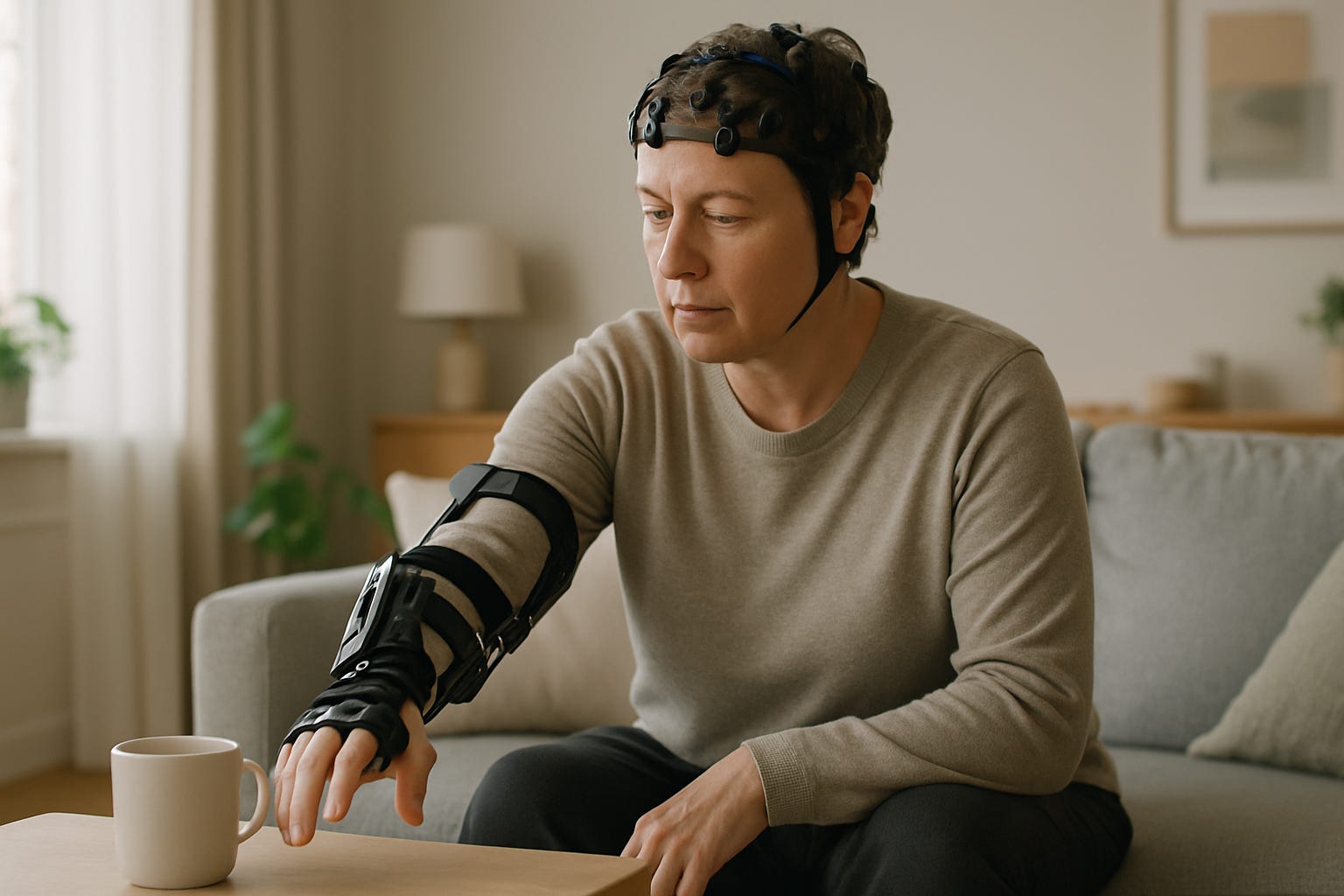
A new category of device is quietly rewriting that script. 🧠 Non-invasive brain-computer interfaces designed for home use are giving chronic stroke survivors — people years or even decades past their event — measurable motor recovery in their own living rooms. No clinic required. No neurosurgeon. No wires through the skull. Just an EEG headset, a robotic exoskeleton on the arm, and the patient’s own brain signals, doing the heavy lifting in ways neurologists didn’t think possible in the chronic phase. The results coming out of 2025 and early 2026 are hard to dismiss. In fact, they’re kind of remarkable.
What “chronic stroke” actually means — and why it matters
Before getting into the devices, it’s worth sitting with the scale of the problem. 🔬 When clinicians talk about chronic stroke, they mean survivors who are more than six months past their event and still living with motor deficits. The arm is physically intact. The muscles work. What’s broken is the communication line between the brain’s motor cortex and the arm itself — the neural pathway that turns “I want to reach for that glass” into an actual reaching motion.
Between 55% and 75% of stroke survivors have lasting motor deficits, and arm function is the hardest to recover. Research compiled from clinical trials shows that 65% of patients at six months are unable to effectively incorporate the paretic hand into daily activities — not because of muscle damage, but because the motor cortex can’t reliably instruct the arm to act. Subjective wellbeing drops sharply one year post-stroke, and the dominant cause is arm impairment, not just general disability.
The rehabilitation gap in this population is stark:
Most insurance-covered rehab ends within the first few months, when recovery velocity is highest
The American Heart Association noted in a July 2025 policy statement that U.S. stroke rehabilitation systems “continue to fall short of the needs of patients”
The economic cost of stroke is projected to increase more than five-fold between 2020 and 2050, from $67 billion to $423 billion — the largest absolute cost increase among any medical condition covered by Medicare
Forty percent of stroke survivors report being physically inactive one year post-event, a figure that suggests the rehab system is losing people well before they’ve exhausted recovery potential
The dominant assumption has always been that the brain’s neuroplasticity — its ability to rewire after injury — essentially expires after the acute phase. BCIs are challenging that assumption with real data, and the mechanism they exploit is something neuroscientists have understood in principle for years. What’s new is packaging it into something a person can use alone, at home, for an hour a day.
The science of Hebbian learning, and why timing is everything
The biological mechanism behind BCI-driven stroke rehabilitation is called Hebbian plasticity, named after the psychologist Donald Hebb, whose 1949 principle is usually summarized as: “neurons that fire together, wire together.” ⚡ The idea is that when two neural events happen in tight temporal coincidence — the brain’s motor intention and the corresponding sensory feedback from an actual limb movement — the synaptic connection between those neurons strengthens. The brain interprets the coincidence as meaning those circuits belong together, and reinforces the pathway.
The problem in chronic stroke is that the motor cortex tries to signal the arm, but the damaged pathway means the arm never moves. There’s no sensory feedback. The loop never closes. The brain eventually stops trying in any meaningful way, and the pathway degrades further.
A BCI breaks this deadlock. Here’s the sequence, as explained in a 2025 review published in Frontiers in Neurology:
The patient wears an EEG headset that reads motor cortex activity
The patient thinks about moving their affected arm or hand — motor imagery, no actual movement needed
The BCI detects the characteristic pattern of motor intent in the EEG signal, specifically the mu-rhythm desynchronization (8–12 Hz) that appears when the motor cortex “fires”
The system immediately triggers functional electrical stimulation (FES) — precisely timed electrical pulses that physically move the patient’s paralyzed arm
The physical movement closes the loop. The brain intended movement, and movement happened. Hebbian plasticity interprets this as the pathway working, and progressively strengthens it. Do this repeatedly, session after session, and the motor cortex gradually recruits intact tissue in the ipsilateral hemisphere — the healthy side — to take over the function that the damaged pathway can no longer handle. Recovery in the chronic phase isn’t about healing the damaged tissue. It’s about rerouting around it. 🔬
Research from a longitudinal BCI-FES study published in Science Research confirmed this at a neurological level, showing two synergistic mechanisms at work: Hebbian plasticity-driven neural remodeling and engagement of intact corticospinal tract fibers, mediated by the closed-loop sensorimotor integration the BCI creates. The EEG biomarkers matched: increased functional connectivity between motor areas in the affected hemisphere correlated directly with functional improvement — which is about as clean a cause-and-effect signal as neuroscience gets.
The key word in all of this is contingent. The feedback only works if it’s locked to the patient’s own motor intention, not delivered randomly or on a timer. Studies comparing active BCI-FES to sham FES — where hardware is identical but stimulation is random — consistently show the active group outperforms sham. Intention is the variable that matters. The BCI is the thing that detects it.
IpsiHand and the RCT that changed the conversation
You can have all the mechanistic elegance in the world and still fail to convince anyone in clinical medicine without a randomized controlled trial. That is what February 2026 delivered. 💊
Kandu, the company that formed from the 2025 merger of Neurolutions and Kandu Health, announced results from the first randomized controlled trial of an FDA-cleared, non-invasive BCI therapy in chronic stroke survivors. The findings were presented by Dr. Eric Leuthardt of Washington University School of Medicine at the International Stroke Conference in New Orleans. The numbers landed well.
Patients using the IpsiHand system — Kandu’s EEG-driven, FDA-cleared home BCI — showed significantly greater improvements in upper extremity motor function than those on a standard home exercise program. The number needed to treat (NNT) was 2.2, meaning that for every 2.2 patients who use IpsiHand instead of standard exercises, one patient achieves a clinically meaningful functional benefit. For a chronic neurological condition that clinicians have considered largely treatment-resistant, an NNT of 2.2 is a striking result.
Kandu CEO Leo Petrossian was blunt about what it means: these data, he said, “fundamentally challenge the longstanding belief that recovery after stroke permanently plateaus after the first few months.”
What makes IpsiHand’s regulatory position particularly interesting is how far along the access pathway it already sits:
FDA clearance: received in 2021 as a Breakthrough-Designated, de novo 510(k) device — the first BCI cleared for stroke rehabilitation
Medicare billing code: in April 2024, CMS created HCPCS code E0738 specifically for IpsiHand, classifying it as Durable Medical Equipment — making it the first BCI with a dedicated Medicare reimbursement code
Veterans Affairs coverage: IpsiHand is also covered through VA, which gives access to a large population of younger, working-age stroke survivors
The therapy protocol involves using the device at home for one hour a day, five days a week. The EEG headset picks up motor intent. The robotic exoskeleton moves the affected arm or hand. The patient’s brain does the neuroplasticity work. A clinical team monitors progress remotely through Kandu’s telehealth platform. No clinic visits. No scheduling conflicts. No transportation barriers. That’s not a trivial convenience — for many chronic stroke survivors, especially older adults in rural areas, access to outpatient rehab facilities is genuinely limited.
One hundred percent of participants in Kandu’s earlier clinical trials showed some improvement in arm or hand function. The newer RCT puts statistical rigor behind that signal. If you’ve been following this space and wondering when the evidence would catch up to the mechanism, this is that moment.
The bigger picture: telerehabilitation and what home-based BCI enables
Let’s zoom out. 📈 IpsiHand is today’s most clinically validated home BCI for stroke, but the field around it is moving fast, and the underlying architecture — EEG-detected motor intent, closed-loop feedback, remote clinical oversight — is being applied in multiple directions simultaneously.
The University of Sheffield’s Tele BCI-FES system, studied in a 2025 clinical trial, delivers BCI therapy entirely over telerehabilitation infrastructure. Eight chronic stroke patients completed nine home-based BCI-FES sessions with real-time remote adjustment from the clinical team. Every patient completed the protocol. The research team flagged the key insight: existing rehabilitation methods focus almost entirely on recovery within the first months post-stroke, leaving the chronic population with minimal options. A telerehabilitation BCI changes the economics of who can access therapy — not just the efficacy of the therapy itself.
Virtual reality is entering this space too. Combining BCI motor intent detection with immersive VR environments makes motor imagery training more engaging and, according to several studies, more accurate. When patients visualize movement in a VR scene that shows the arm moving in response to their neural signals, classification accuracy improves. A randomized crossover trial combining BCI with VR for upper limb stroke rehabilitation began recruiting at the Technical University of Lisbon in January 2026, with completion targeted for 2027.
The broader pattern here deserves attention:
Hebbian feedback quality improves when visual and proprioceptive channels are both engaged — VR provides the visual, FES provides the proprioceptive
AI-driven signal decoding is getting better at generalizing BCI decoders across patients, reducing the calibration time new users need before therapy is effective
Closed-loop adaptive systems are replacing fixed-threshold detectors, meaning the device learns the specific patient’s neural patterns rather than applying a generic template
Remote monitoring allows clinical teams to adjust stimulation parameters, review adherence data, and intervene early if a patient is struggling — without anyone leaving home
None of this is science fiction. Most of it is already in commercial deployment or late-stage trials. What’s missing, still, is scale. Home BCI devices reach a small fraction of the chronic stroke population that might benefit from them, partly because awareness is low, partly because reimbursement pathways are still being established, and partly because neurologists who trained before 2020 were taught that the chronic phase means reduced recovery potential. That teaching needs updating.
Have you or someone you know been told there’s little point in further rehabilitation more than a year after a stroke? Given the IpsiHand RCT results, it might be worth reconsidering that conversation with a neurologist who’s current on BCI-based approaches.
What still needs to work
It would be intellectually dishonest to write about this field without being specific about where the friction points are. The BCI-FES evidence for stroke is genuinely compelling, but it comes with honest caveats. 🔬
The Frontiers in Bioengineering review from 2026 — one of the most comprehensive recent summaries of BCI in severe stroke — notes that “current effect size estimates are limited by small sample sizes, high study heterogeneity, and inherent performance biases.” The RCT from Kandu addresses the rigor concern, but it’s one trial. Replication across more diverse patient populations — different stroke locations, different severity levels, different ages — is still needed.
There’s also a calibration problem that goes underdiscussed: not all stroke survivors produce clean enough motor intent signals for current EEG-based BCIs to reliably decode. Patients with more severe cortical damage, or damage in regions that govern motor imagery itself, may not get the same benefit. The devices currently work best for patients who have some residual motor intent circuitry — the “arm is fine, the connection is broken” population. Patients where the motor cortex itself is substantially damaged face a harder problem.
Insurance coverage is improving but uneven. Medicare and VA coverage exists for IpsiHand, but some major private insurers, including Blue Cross NC as of early 2025, still classify BCI devices as investigational. The RCT data from ISC 2026 will almost certainly accelerate coverage decisions at private payers — this is exactly the kind of evidence coverage reviewers ask for — but there will be a lag.
Finally, adherence over months is different from adherence in a supervised trial. A patient who uses IpsiHand five days a week in a 12-week study with clinical oversight may use it very differently when the trial ends. Kandu’s integration of remote clinical monitoring and its telehealth service model is a deliberate attempt to address this, and the merger with Kandu Health brought in exactly that kind of sustained patient support infrastructure. Whether that translates to real-world adherence comparable to trial performance is something we’ll know more about in 2026 and 2027 as post-market data accumulates.
None of these caveats cancel what the RCT showed. They’re the honest shape of a technology that is real, working, reimbursable, and available — but still early in its commercial lifecycle.
The question worth asking the neurology community right now is sharper than “does BCI rehabilitation work for chronic stroke?” The evidence says it does. The more pressing question is: how many patients who could benefit from this therapy know it exists? If you’re a clinician, a caregiver, or a stroke survivor who has been told recovery has stopped — what would it take to find out whether you’re in the two-thirds who could still meaningfully improve?