

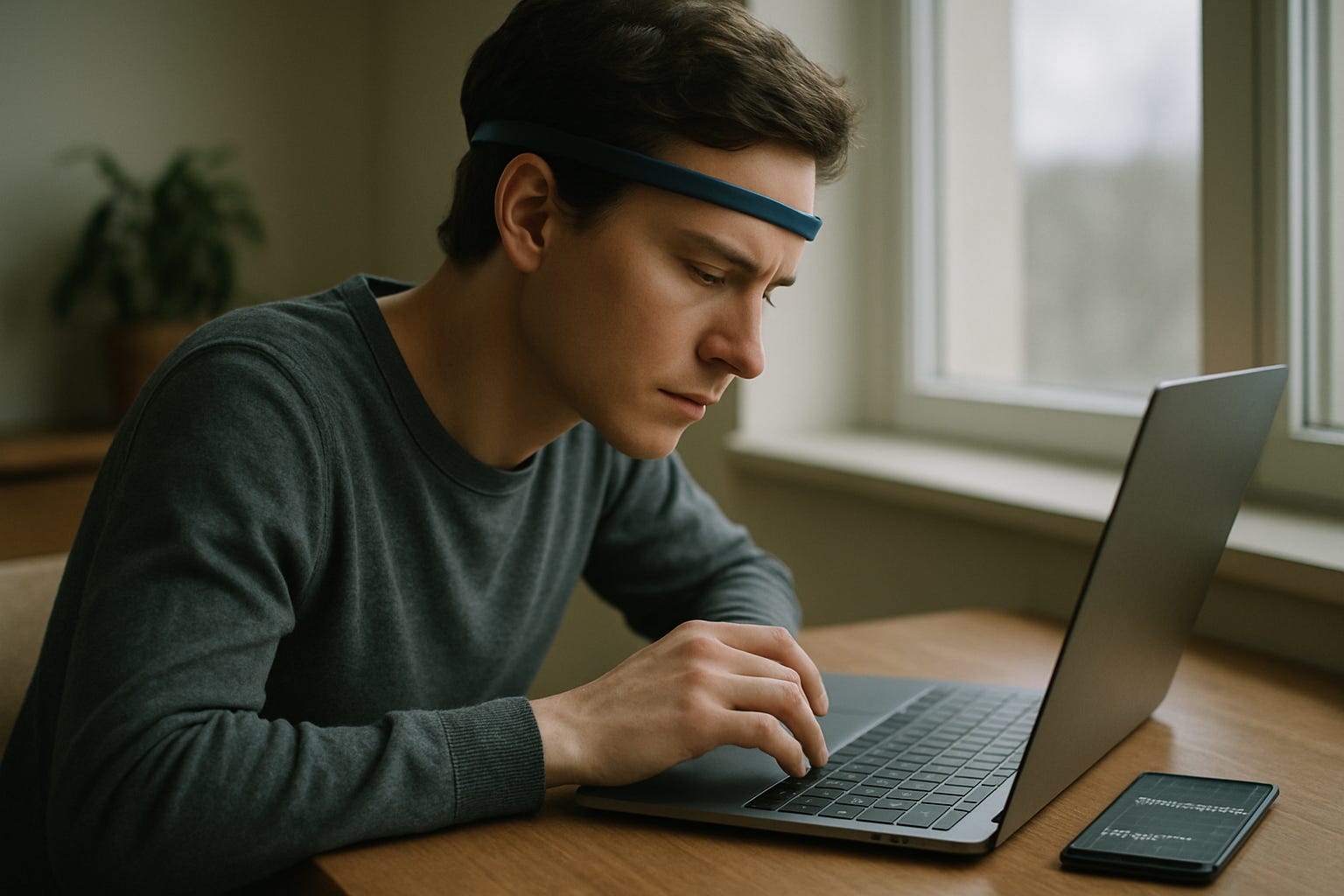
Day one with a consumer EEG headset on your head is an experience. You feel faintly ridiculous. The headband sits across your forehead like a sweatband that wandered into a neuroscience lab. An app on your phone tells you whether your brain is “calm” or “active.” A little graph shows your alpha waves. You sit there, trying to focus, watching yourself try to focus, and wondering if watching yourself try to focus is interfering with the focusing. It probably is.
We ran this experiment across 30 consecutive days with the Muse S Athena, InteraXon’s dual-sensor EEG headband released in March 2025 — the first consumer wearable to combine both EEG (electrical brainwave tracking) and fNIRS (functional near-infrared spectroscopy, which measures blood oxygenation in the prefrontal cortex). The goal was simple and, in retrospect, possibly naive: wear it consistently, do the recommended sessions, track any changes in self-reported focus and productivity, and report back honestly. No control group. No double-blind design. Just one headband, thirty days, and a policy of not lying to ourselves about what we observed. 🧠
How the device actually works — and what it can and can’t measure
The Muse S Athena ($474.99, plus a Muse Premium subscription for full features) gives you four primary EEG channels at positions AF7, AF8, TP9, and TP10, plus fNIRS sensors for prefrontal cortex blood flow tracking. The combination matters: EEG has excellent timing but poor spatial resolution, picking up aggregate electrical chatter across large neural populations. fNIRS adds a slower but more spatially precise hemodynamic signal, tracking which brain regions are working harder. In theory, together they give a more accurate picture of focus states than either alone.
What the app actually shows you:
A calm score from 0-100 that reflects how much alpha wave activity is present relative to high-frequency beta
A focus metric derived from the fNIRS blood-flow data in the prefrontal cortex 🔬
Real-time audio feedback during meditation sessions — birdsong when calm, wind when distracted
Session-by-session trend data and sleep tracking when worn overnight
What it cannot show you: the specific content of your thoughts, the quality of your attention on a complex task, or anything about deeper brain regions. The electrodes sit on your scalp and forehead. They hear the brain through several layers of skull, scalp, and tissue. A 2026 study published in Scientific Reports comparing consumer EEG devices against a research-grade DSI-24 system found that signal quality degrades substantially in real-world conditions versus controlled labs. The problems: motion artifacts from jaw clenching, blinking, and head movements corrupt the signal; electromagnetic interference from phones, routers, and nearby electronics introduces noise; and the dry electrode contact that makes consumer headsets wearable trades off against the gel-based conductivity that makes clinical EEG precise. 💡
That’s not a reason to dismiss the devices. It is a reason to understand what they’re actually measuring. The Muse is good at detecting states — broadly calm versus broadly activated — and at building awareness of those states over time. It is not a precision instrument for detecting whether you’re genuinely focused on a difficult problem versus just sitting quietly.
What actually happened across 30 days
Week one was the hardest, for reasons that had nothing to do with the device. Habit formation is genuinely difficult. Fitting a 10-20 minute session into a morning before the day accelerates requires either discipline or a very flexible schedule. The headset setup is quick — under two minutes to achieve signal lock — but even two minutes becomes a daily friction point when you’re deciding whether to bother.
By day five, we’d established a consistent pre-work session pattern: 15 minutes of eyes-closed focus training using the Muse app’s neurofeedback mode, where the audio feedback responds in real time to your brainwave state. The audio metaphor is clever. Your brain learns remarkably fast that it controls the sound environment. Within a session, the shift from distracted mental chatter to a quieter baseline becomes almost tangible.
Here is what changed, with precision:
Session-to-session calm scores improved from a starting average of around 48 to a consistent 65-72 by week three — a meaningful shift in baseline, though we can’t rule out that we simply got better at the specific game the app rewards
Subjective focus quality during work sessions that followed the morning training felt noticeably better in weeks two and three; by week four, we weren’t sure whether this reflected neural change, the routine of a deliberate morning pause, or confirmation bias from data we were primed to interpret positively 🧬
Sleep tracking data, captured on nights when we wore the headband overnight, showed what the app described as improved sleep quality scores — though we slept well before the experiment and the baseline wasn’t particularly problematic
The most concrete observable change: a reduced tendency to immediately reach for a phone during moments of boredom or cognitive load. This might be neurofeedback. It might be the general effect of spending 15 minutes each morning paying close attention to attention itself
What did not change, or changed in ways we couldn’t verify: deep work endurance on genuinely hard cognitive tasks, working memory capacity, reaction time, or any metric we could objectively measure outside the app’s own ecosystem.
The signal quality problem is real, and you should know about it
This is the part that most consumer EEG coverage glosses over, so we’re not going to.
The Scientific Reports paper from Handong Global University, published in February 2026, assessed four consumer EEG devices — including the Muse 2 — against a research-grade system under controlled conditions. The findings were nuanced: consumer devices can produce signal quality comparable to research-grade systems in controlled lab conditions, but real-world deployment introduces substantial degradation. The difference isn’t primarily the device’s inherent capability. It’s the environment. 📈
In a neuroscience lab, you sit still in an electromagnetically shielded room with gel-based electrodes and trained technicians correcting your posture. At your desk, you have a Wi-Fi router three feet away, a phone on Bluetooth, a tendency to clench your jaw when a message arrives, and a posture that shifts every few minutes. All of that corrupts EEG data in ways the app’s signal quality indicator doesn’t fully flag.
The Neurosity Crown comparison is instructive here. The Crown processes EEG signals locally on its own onboard N3 chipset rather than streaming raw data via Bluetooth to a phone — which reduces latency and Bluetooth packet loss, two known signal fidelity problems in phone-dependent systems like Muse. It costs $1,499 with no subscription and offers eight channels versus Muse’s four. For developers who want raw EEG access and API flexibility, it’s a more serious scientific instrument. For someone who wants a structured consumer experience with guided meditation and sleep tracking, the Muse ecosystem is more complete. ⚡
The fundamental limit that neither device overcomes: four or eight channels on a consumer headset can only see a small part of the brain’s electrical activity. A 64-channel research EEG covers the entire scalp. A 256-channel system maps neural activity with the kind of spatial resolution that lets researchers distinguish between attention networks and memory networks in real time. Consumer devices are working with a much rougher signal, and the apps interpret that rough signal through proprietary algorithms that the companies don’t publish for independent review.
This isn’t a conspiracy. It’s a product tradeoff. But it’s worth knowing exactly what you’re measuring before you build a daily habit around the metrics.
What the 30 days actually taught us about attention
Here is the honest finding, separate from the device’s performance: paying daily, structured attention to your attention does something. Whether that something is neural change, behavioral change, or just the effect of a morning routine that enforces a brief pause before the day’s digital noise begins — we genuinely cannot separate these causes with a one-person, uncontrolled experiment. ⚡
What we can say is that the experience is consistent with how consumer EEG researchers at the Centre for Future Generations describe the category: these devices accelerate the growth of self-awareness around cognitive states. They make abstract mental concepts — calm, distraction, focus — legible as data points. That legibility changes behavior somewhat, even when the underlying signal is imperfect.
The TechCrunch framing from Neurable CEO Ramses Alcaide is accurate: these devices don’t read your thoughts. They detect whether your brain is in a focused or distracted state and give you feedback that lets you notice and respond to that state. That’s a narrower capability than the marketing often implies, and it’s a genuinely useful one.
The questions worth asking before you buy:
Are you looking for a tool to deepen an existing meditation or mindfulness practice? Consumer EEG headsets are probably a useful addition
Are you hoping to objectively measure cognitive performance on complex tasks? The devices aren’t built for that, and the metrics won’t give you what you want 🔬
Do you have the consistency to use it five or more times per week for at least eight weeks? Most meaningful changes in consumer neurofeedback users appear after 8-12 weeks of consistent sessions, not after a few days of novelty use
Are you comfortable with the ambiguity of not knowing exactly how much of your improvement came from the device versus the routine it imposed? Because that ambiguity doesn’t resolve cleanly
As NeurotechMag has covered in previous issues, the consumer EEG market is moving fast enough that these questions will look different in another two years. EEG sensors are already appearing in headphones and earbuds — the HyperX and Neurable collaboration announced at CES 2026 embeds EEG directly into gaming earpads, targeting focus metrics for competitive play. Neurable’s MW75 Neuro headphones hide 12 EEG channels in the earcups and look like regular over-ear headphones. The form factor problem — wearing something that signals “I am measuring my brain” — is being solved by hiding the sensors in things people already wear.
Should you buy one?
Probably, if the price doesn’t hurt, you have realistic expectations, and you’ll actually use it. Mostly definitely not, if you expect it to transform your cognitive performance on its own or you have a history of buying gadgets, using them for a week, and shelving them.
The Muse S Athena at $474.99 is a reasonable entry point for the category — polished app, solid signal for a consumer device, both EEG and fNIRS sensors, good meditation library, and one of the only headsets that doubles as an overnight sleep tracker. The subscription cost (around $130 per year for full features) is a genuine consideration. 💊
The Neurosity Crown at $1,499 makes more sense if you’re a developer, researcher, or someone who wants raw data access and doesn’t need a guided app ecosystem. It’s an 8-channel device with on-device processing, a real SDK, and no ongoing subscription. It demands more from the user but gives more back to users with the technical appetite to use it.
A few practical lessons from 30 days:
Session consistency matters more than session length. Three 10-minute sessions per week beat one 30-minute session whenever the mood strikes
Signal quality improves with setup care. Spending an extra 30 seconds adjusting electrode contact reduces artifact noise measurably, even in a dry-electrode consumer device
The app’s “calm score” is a relative measure, not an absolute one. Track your trend over weeks, not your absolute score on any given day
Don’t wear it during active cognitive work sessions. The EEG artifacts from typing, moving, and shifting posture corrupt the signal enough that the feedback becomes misleading
Thirty days is enough time to form a habit and start seeing trends. It’s not enough time to be certain those trends reflect genuine neural change versus familiarity with the app’s feedback logic. Honest answer: we’d need six months and a much better experimental design to separate the two.
What we know for certain: attention is trainable, and tools that make attention visible tend to accelerate that training. Whether a $475 headband is the right tool for you depends entirely on how you learn, how consistent you are, and whether you can hold the ambiguity without it driving you toward premature conclusions in either direction.
What would make you willing to try something like this — a lower price, stronger clinical evidence, or the device becoming invisible inside something you already wear?