

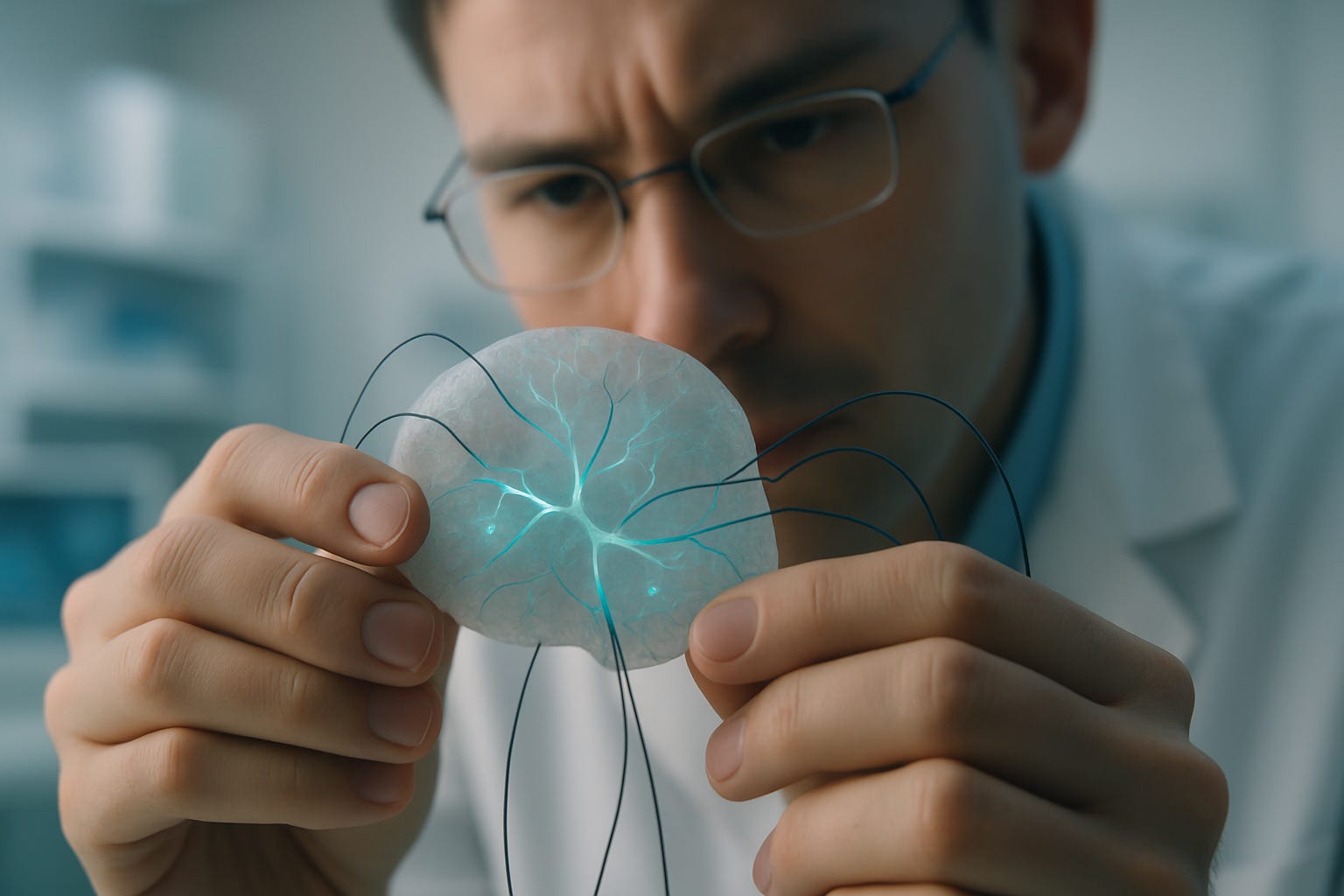
Imagine paying for a state-of-the-art brain-computer interface, having the surgery, recovering, and then watching it gradually go silent over the following months. Not because the hardware broke. Not because the software crashed. But because your own brain, doing exactly what it’s designed to do, decided the device was a foreign invader and began methodically walling it off.
That’s not a hypothetical. It’s one of the central unsolved engineering problems in neurotechnology, and it goes by the name glial scarring. Until researchers crack it, every promising advance in BCIs — from Neuralink’s electrode threads to next-generation speech decoders — runs into the same biological wall.
The strange part is that the brain isn’t malfunctioning when it does this. It’s functioning perfectly. The immune response to implanted devices is exactly the right response to a foreign object — it just happens to be catastrophic for the electronics inside your skull. Understanding why that happens, and what engineers are doing about it, tells you a lot about why brain implants are harder than they look and why the field is closer to a real solution than most people realize. 🧠
The body’s most efficient walling-off machine 🔬
The moment a surgeon inserts a neural probe into brain tissue, a timer starts. Within 30 minutes of implantation, microglia — the brain’s resident immune cells — are already extending processes toward the device. By the two-hour mark, they’ve covered roughly half the probe’s surface. Within about 20 hours, astrocytes join in, swelling and extending their own processes toward the implant. Within days, a dense cellular sheath has begun to form around the electrode.
This process, called the foreign body response, is coordinated in phases:
Acute phase (first hours): microglia detect the implant as a threat, extend toward it, and begin releasing inflammatory cytokines including TNF-α and interleukin-1
Subacute phase (days to weeks): activated astrocytes upregulate a protein called GFAP (glial fibrillary acidic protein), proliferate, and migrate toward the injury site
Chronic phase (weeks to months): the glial scar densifies, neurons near the electrode begin dying or retreating, and a thick insulating sheath of reactive cells permanently encapsulates the device
A 2025 review published in the Journal of Neurochemistry by Paveliev and colleagues captures the timeline in uncomfortable detail: astrocyte morphology changes toward a reactive phenotype within one hour of insertion, and the number of astrocytic processes wrapping toward the probe steadily increases from 6 hours to 7 days post-implantation.
The biological logic is sensible. Your brain is the organ that most needs protection from infection and foreign material — it sits behind the blood-brain barrier for a reason, and when that barrier breaks (as it does when a probe is inserted), the immune response kicks in hard. The problem is that neurons retreat from the scar tissue, increasing the distance between the electrode and the cells it needs to record from. The scar itself is electrically insulating. Signal quality drops. Then it drops more. Then, eventually, the signal is gone. 😔
Why the Neuralink thread problem wasn’t just bad luck ⚡
Neuralink’s first patient, Noland Arbaugh, became the most publicly scrutinized test case for neural electrode longevity in history. The early results were striking: Arbaugh was controlling a computer cursor, playing chess, and eventually learning new languages entirely through thought-based input. Then, about three months post-surgery, reports emerged that approximately 85% of his 1,024 electrodes had retracted from brain tissue, sharply reducing signal capture.
Neuralink traced part of the problem to brain micromotion — the constant, subtle movement of brain tissue inside the skull that turns out to be about three times greater than the company’s engineers had anticipated. When an electrode is stiffer than the surrounding tissue, even tiny movements create mechanical stress at the interface, which the brain reads as ongoing injury and responds to with ongoing inflammation. More inflammation means more scar tissue. More scar tissue means more signal loss.
The company ultimately resolved Arbaugh’s performance degradation through software — recalibrating the decoding algorithm to extract useful signal from the remaining active electrodes — rather than anything biological. Which is clever engineering, but it’s not a fix for the underlying problem. It’s more of a workaround.
This gets at something worth thinking about: the stiffness mismatch between silicon or metal electrodes and brain tissue is enormous. Silicon has a Young’s modulus of roughly 180 GPa. Brain tissue sits somewhere between 1 and 30 kPa — that’s approximately ten billion times softer. Flexible polymer materials like polyimide (1.5–2.5 GPa) are a significant improvement, but even they remain orders of magnitude stiffer than the tissue they’re sitting in.
Does this make you rethink what “biocompatible” really means for neural devices? Because biocompatible in the chemical sense — the material doesn’t leach toxic compounds — turns out to be a much lower bar than biocompatible in the mechanical sense. Your brain doesn’t care if the probe is inert. It cares that there’s something rigid poking through it.
The engineering counter-offensive 💡
The good news is that materials scientists, neuroscientists, and device engineers have been attacking this problem from multiple angles, and several approaches are starting to produce real results.
Soft and flexible probes are probably the most active research front right now. The fundamental idea is to match the mechanical properties of the electrode to those of brain tissue, reducing the micromotion-induced stress that signals ongoing injury. Research on ultraflexible probes — reported in Science Advances — found that drastically reducing bending stiffness could essentially eliminate glial scarring in animal models. Precision Neuroscience’s Layer 7 Cortical Interface, which received FDA clearance in April 2025 as the first wireless BCI device to get that status, takes a different but related approach: rather than penetrating the cortex at all, its 1,024-electrode flexible film sits on the brain’s surface, threading through a cranial micro-slit smaller than 1 mm. No penetration means no initial puncture injury. No initial puncture injury means a much quieter immune response.
Drug-eluting coatings are the second major strategy. The idea is to coat electrodes with materials that slowly release anti-inflammatory compounds directly at the tissue interface, suppressing the immune response locally without systemic effects. One well-studied approach uses PEDOT (poly(3,4-ethylenedioxythiophene)), a conductive polymer that can be loaded with drugs like dexamethasone and triggered to release them electrically. It solves two problems at once: it improves the electrode’s electrical properties by reducing impedance, and it fights the inflammation that would otherwise degrade the interface over time.
A 2024 study in the RSC Journal of Materials Chemistry B described injectable PEDOT-based hydrogel electrodes that can be delivered in liquid form and solidify in place — meaning the electrode conforms perfectly to the brain’s irregular surface rather than pushing against it. The potential implications for reducing mechanical mismatch and therefore inflammation are meaningful.
Lubricant-coated probes are a newer entrant. Research published in ACS Applied Bio Materials in early 2026 described flexible printed circuit board probes with a biocompatible lubricant coating, which showed markedly reduced astrocytic and microglial activation in chronic mouse implants compared to uncoated probes, with stable neural signals maintained for several weeks.
Shrinking the probe itself also helps. MIT researchers have shown that reducing electrode diameter can dramatically reduce scarring, because a smaller probe displaces less tissue during insertion and generates a smaller ongoing mechanical stimulus. About half of standard deep brain stimulation electrodes stop working within the first six months, partly because the constant rubbing of a millimeter-scale electrode generates persistent gliosis. Microscale probes change that calculus. 🔬
The surface vs. penetrating tradeoff
Not everyone agrees that penetrating the cortex is the right approach for long-term chronic recording. This debate is worth paying attention to, because it’s not just a technical disagreement — it’s a fundamentally different hypothesis about where the longevity problem is solvable.
Penetrating electrodes like Neuralink’s threads get very close to individual neurons, which gives you high-resolution single-unit recordings. That’s genuinely valuable. But they also punch through cortical tissue, rupture blood vessels during insertion, and create a chronic micromotion problem that doesn’t go away. The foreign body response for penetrating electrodes is substantially more aggressive than for surface devices.
Surface or subdural electrodes — like Precision Neuroscience’s Layer 7 or classic electrocorticography (ECoG) arrays — avoid the penetration problem entirely. They record from the cortical surface rather than inside the tissue. Signal resolution is lower at the single-neuron level, but the absence of tissue penetration means a much milder immune response, and the Layer 7’s 1,024-electrode density compensates significantly by giving you high spatial resolution across a wide area.
The tradeoffs look roughly like this:
Penetrating cortical electrodes: highest single-neuron resolution, fastest signal degradation, most intense foreign body response, most surgically invasive
Surface cortical arrays (ECoG/Layer 7): lower single-neuron resolution, milder foreign body response, commercially cleared, reversible and modular
Soft/flexible penetrating probes: promising middle ground, reduced mechanical mismatch, still in pre-clinical or early clinical stages for most designs
Drug-eluting coated electrodes: add-on strategy applicable to multiple device types, effectiveness varies by drug, delivery mechanism, and timescale
Precision Neuroscience’s co-founder Benjamin Rapoport, MD, PhD, who previously left Neuralink in part over concerns about the long-term consequences of penetrating electrodes, built Layer 7 explicitly around the reversibility and surface-access philosophy. He’s basically betting that the longevity problem is easier to solve if you stay out of the cortex in the first place.
That might be right. Or it might turn out that the signal resolution you lose by staying on the surface limits what’s therapeutically possible. The field doesn’t have a definitive answer yet, and that ambiguity is probably where the most interesting research is happening right now. 🧬
What “solved” would actually look like 📈
It’s worth being honest about what “solving” the glial scarring problem requires. Eliminating the foreign body response entirely is probably unrealistic — the brain’s immune system is deeply wired to respond to foreign objects, and suppressing it systemically would create serious infection risks. What researchers are hunting for is something more specific: a stable, low-inflammation long-term interface where the scar either stops forming at a level that doesn’t impair signal quality, or is managed close enough to the electrode surface that the electrode still has access to active neurons.
The benchmarks the field is working toward include:
Maintaining useful signal quality for five or more years post-implantation in chronically implanted devices
Reducing astrocyte and microglia activation to levels where nearby neurons don’t die or retreat
Eliminating the acute-insertion trauma that triggers the most intense early inflammatory response
Developing materials that are mechanically indistinguishable from brain tissue, not just electrically inert within it
None of those is fully solved. Some are closer than others. The soft-probe and lubricant-coating work is producing real reductions in scarring in animal models. The surface-access approach of Layer 7 sidesteps the penetration problem in ways that have been validated in 37 clinical study participants. Neuralink’s algorithmic workaround for Arbaugh’s retracted electrodes worked, even if it didn’t address the biology.
What’s actually exciting — and I think this is the underappreciated story here — is that the field is now attacking the problem with a level of materials sophistication and mechanistic understanding that didn’t exist five years ago. Researchers know exactly when microglia start moving (within 30 minutes), when astrocytes activate (within an hour), how the two cell populations coordinate via cytokine signaling, and which mechanical properties of the electrode most predict long-term scarring severity. That mechanistic clarity is what makes better solutions possible.
The brain is extraordinarily good at protecting itself from things that don’t belong inside it. Building something that does belong — or at least convinces the brain it does — is the problem. And given how fast materials science and neural engineering are both moving right now, my guess is it’ll look solved within a decade. At which point the question becomes: what do we actually want these implants to do when they can last a lifetime?
That’s the conversation worth starting now.