

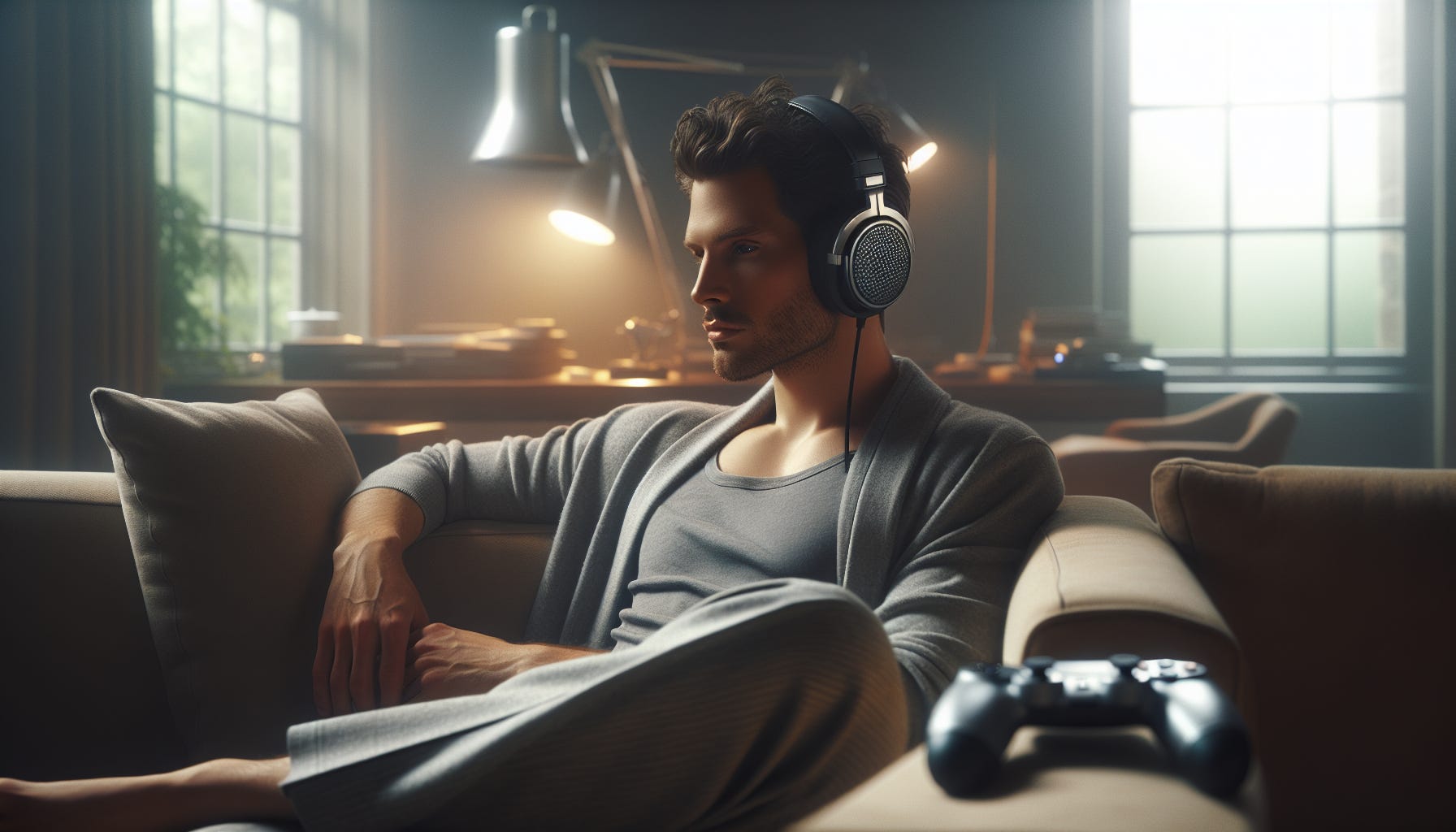
The headline sounds like something from a tech magazine circa 2040. “Control games with your mind.” And yet it’s May 2026, and you genuinely can do this. A pair of headphones with EEG sensors in the ear pads ships to your door for $499. A 19-year-old in Shanghai with a brain implant cleared the opening stages of Black Myth: Wukong using only his thoughts. Noland Arbaugh, who hasn’t been able to move his hands since a diving accident eight years ago, played Mario Kart with his father.
All of that is real. All of it happened recently. And if you’re excited by those three sentences, you should probably read a little further before you reach for your credit card — because “controlling a game with your mind” means something completely different depending on which technology you’re talking about, and most of the consumer-facing version is a lot more modest than the marketing implies. That’s not a reason to dismiss it. But it is a reason to understand what you’re actually buying.
What the consumer version actually does 🧠
Let’s start where most people will start: the devices you can actually buy without a surgeon. The most sophisticated consumer mind-control gaming product available right now is probably the Neurable MW75 Neuro, a collaboration between Neurable AI and Master & Dynamic. The original model costs $699. The newer MW75 Neuro LT, released in September 2025, trimmed about 12% of the weight and dropped to $499 — still not impulse-buy territory, but more realistic than the flagship.
These headphones look nearly identical to standard premium wireless headphones. The difference is in the ear pads: they contain 12 EEG channels made from soft fabric sensors that measure your brain’s electrical activity in real time. Neurable’s AI processes those signals and generates metrics — Focus Level, Calmness, Cognitive Speed, Anxiety Score — updated every second. The SoundGuys review describes the experience of seeing your focus spike as you concentrate on a task and flatten as your mind wanders. One reviewer wore the headset while playing a side-scrolling shooter on a Steam Deck and watched the data trace their learning curve in the first level, then settle as the controls became automatic.
This is real. It’s not pseudoscience, and it’s not fake. Neurable validated the technology in a study with 132 participants, and they’ve done follow-on work with the Mayo Clinic. The headset really does capture meaningful neural signals from an otherwise normal-looking pair of headphones.
Here’s the catch: what it does with those signals is not direct game control. Not yet. The MW75 Neuro tracks your cognitive state — how focused you are, when you’re approaching mental fatigue — and uses that data to suggest brain breaks, show you productivity patterns, and give you a window into how your brain performs through the day. The gaming application is more about self-awareness than mind control. You wear the headset while gaming and see the neural data alongside your session. You don’t move characters with your thoughts.
What consumer EEG gaming actually looks like in 2026:
Passive cognitive monitoring during gameplay — tracking attention states, alertness, and focus as overlays or companion app data
Simple binary control in purpose-built applications — games designed specifically for BCI input, where you “push” with concentration or “pull” with relaxation, a bit like pressing a single button with your brain
Adaptive game environments that adjust difficulty based on your measured mental load — easier when you’re fatigued, harder when you’re locked in
Neurofeedback games where the explicit goal is to practice brain control, training attention regulation rather than playing traditional games
That’s meaningful. That’s actually a category of experience that didn’t exist five years ago. But if you’re imagining yourself steering a car through a Mario Kart track purely by thinking “left” and “right,” you’re picturing something the consumer hardware can’t deliver today. 💡
What the implant version actually feels like ⚡
For the full version — the one where you’re playing a complex video game with your thoughts at something approaching normal speed and accuracy — you need an implant. That’s the honest answer, and I think it’s important to say it plainly rather than let the consumer marketing blur the line.
Noland Arbaugh became the first person to receive Neuralink’s “Telepathy” N1 chip in January 2024. The device sits in his skull, sealed, with ultra-thin electrode threads woven into his motor cortex. Within a month, he was controlling a cursor on his laptop screen by imagining moving a cursor. Then came chess. Then Mario Kart with his father watching. As Arbaugh told Neuralink’s company meeting: “I am so blessed to be part of it. It’s only been a month and I can’t believe how much my life has changed.”
Arbaugh described the experience as imagining moving his hand, even though his hand doesn’t move. The signal that would have driven hand movement is intercepted by the chip before it reaches his paralyzed muscles, decoded by software, and translated into cursor position on screen. It’s not reading thoughts exactly — it’s reading motor intent. The distinction matters, because it means the training process is largely about learning to produce consistent motor imagery, which most people can do once they understand what the system is looking for.
In April 2025, a different story emerged from Shanghai. BrainXBot — a collaboration involving the Tianqiao Brain Science Research Institute and the Shanghai Institute of Microsystems — reported that a 19-year-old epilepsy patient played complex games after receiving their Beinao-1 implant. According to Tom’s Hardware’s reporting, the training process took roughly 20 hours — about three times faster than Arbaugh’s initial Neuralink training — and the patient achieved 4.07 bits per second of cursor control performance, approaching the 4.6 bits per second Arbaugh achieved after 60 hours. He played Black Myth: Wukong and Honor of Kings and also controlled a smart wheelchair and home devices using the same system.
The patient’s pathway to gaming:
Started with basic titles like Pac-Man and Tank Wars to build motor imagery consistency
Graduated to cursor-based internet navigation, app control, and smart home commands
Reached complex action games after approximately 20 hours of brain training
Achieved cursor response speed “approaching the level of normal people using a mouse,” according to the company
The physical sensation of using an implanted BCI is something no reviewer has described in the way you’d describe holding a controller. Arbaugh said it felt natural quickly — that imagining movement became an almost unconscious process after a while, the way you stop thinking about which fingers press which keys when you type. That’s the version of mind-controlled gaming that feels like the science fiction. It’s also the version that currently requires open-skull surgery. 🔬
The gap — and why it’s not as simple as “wait for better technology” 📈
Consumer EEG and implanted BCI aren’t really on the same innovation timeline heading toward the same destination. They’re different tools for different things, and understanding that is more useful than assuming one will eventually become the other.
The limitations of non-invasive EEG for high-fidelity game control are physics problems, not just engineering problems. Your skull scatters electrical signals badly. The sensor sits centimeters from the neurons generating the signal, separated by bone, fluid, and tissue. The result is blurry, low-resolution data compared to what you get from an electrode touching the cortex directly. A 2024 study flagged what researchers call “BCI illiteracy“ — the finding that roughly 20% of potential users simply cannot generate the kind of consistent, distinguishable brain signals that consumer EEG needs to decode intent reliably. That’s not a fixable user error. For some people’s neural architecture, EEG control of complex inputs may never work well.
That’s a specific limitation worth naming. A technology that doesn’t work for one in five people isn’t ready to be everyone’s controller. The honest framing from neuroscientists is that consumer EEG gaming today is best thought of as a layer of information on top of traditional input rather than a replacement for it. You play the game normally; the EEG data enriches the experience or adapts the environment.
Implanted BCIs face a different set of constraints:
Surgical requirement limits the addressable population to people for whom the medical benefit clearly outweighs the risk
Regulatory pathways mean every new application (gaming, communication, vision, emotion) needs its own clinical evidence
Device longevity is still being established — how long do these implants remain functional and safe? Years of data are still being collected
Electrode drift can degrade signal quality over time as tissue gradually reacts to the implant
I find the discourse around this frustrating because it tends to collapse into either “mind control gaming is almost here” hype or “this is dangerous sci-fi” dismissal, when the actual picture is more nuanced. The technology is real and working, it helps real people meaningfully, and the path to mainstream gaming applications involves solving problems that range from practical engineering to regulatory philosophy. That’s worth sitting with rather than skipping past. 💡
Where the hardware is actually heading 🚀
The most instructive recent data point isn’t from Neuralink or BrainXBot. It’s a January 2025 paper in Nature Medicine from a Stanford University team led by researchers working with a participant who has tetraplegia. They developed a finger-based BCI that allows continuous control of three independent finger groups, with the thumb controllable in two dimensions — totaling four degrees of freedom from thought alone. The system achieved an average acquisition rate of 76 targets per minute, with completion times under two seconds. The same system controlled a quadcopter game.
Four degrees of freedom. Seventy-six targets per minute. Those numbers matter because they’re approaching the precision needed for real game control, not just cursor movement. The game controller in your hands has more degrees of freedom than that, but not infinitely more — and the gap is closing faster than most people realize.
The consumer gaming market is moving in parallel. The BCI gaming market was valued at $144 million in 2024 and is projected to reach $927 million by 2034 at a 20.5% annual growth rate, per Polaris Market Research. That trajectory reflects genuine commercial interest, not just optimism. Game developers are starting to design with BCI inputs in mind. The integration of focus-tracking APIs into engines like Unity is already happening at the indie level.
What I think the next three years actually look like, based on the data:
Consumer EEG gets genuinely useful as a gaming companion layer — adaptive difficulty, burnout prevention, focus-state overlays — without ever becoming a primary controller for most games
Hybrid inputs start appearing: a controller you hold, augmented by brain signals that add a fifth or sixth axis of subtle control, like changing camera sensitivity based on your attention state
Clinical BCI gaming expands meaningfully as more patients receive implants through Neuralink, Synchron, and BrainXBot’s growing trial programs
New form factors for non-invasive devices — Merge Labs’ ultrasound approach, if it works, could eventually offer signal quality between today’s EEG and implants, without surgery
As we’ve tracked in our coverage of the signals that neurotech is approaching its tipping point, the field is accelerating. And as we’ve written about the consumer neurotech devices you can actually buy today, some of that technology is already in your living room — it just doesn’t look the way you’d expect.
The version where a healthy person sits down, puts on a light headset, and plays a complex game using only their thoughts — with no degraded controls, no calibration ritual, no 20% failure rate — that version is probably still years away for non-invasive devices. The version where someone with paralysis uses a brain implant to reclaim control of games and their digital life? That’s happening now, quietly, in clinical trial sites in the United States, Australia, and China.
So the question worth asking yourself isn’t “when will mind-controlled gaming be real?” It already is. The real question is: which problem matters more to you, the performance ceiling of consumer devices or the access barrier of clinical ones — and which of those do you think gets solved first? 👇