

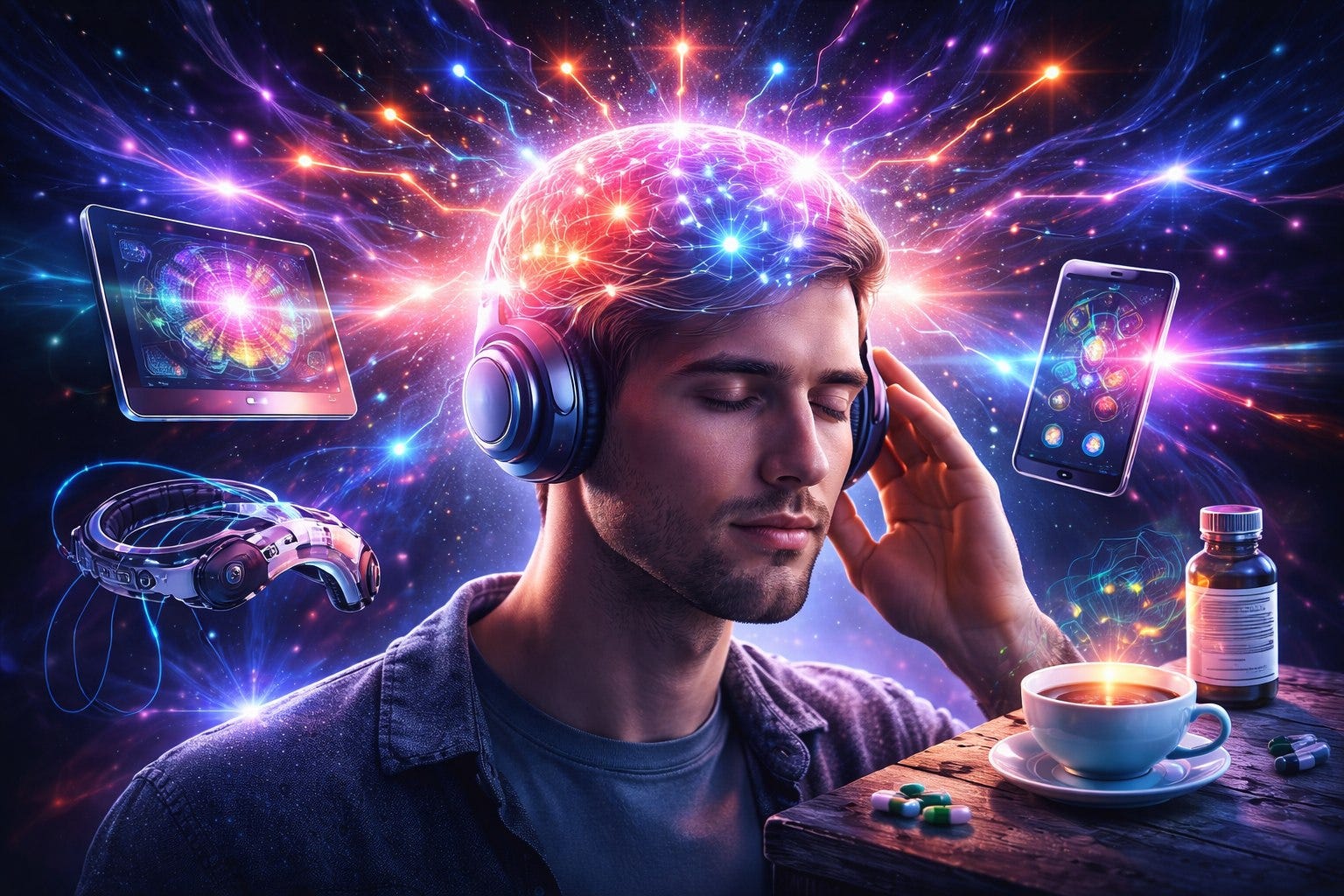
You know the feeling: your brain is a browser with 87 tabs open — and one of them is playing that ad you can’t close. The world is racing forward, but your thoughts are bogged down in 2019 Slack messages and your grocery list. What if I told you there are ways — anchored in neurotechnology — to sharpen attention, boost memory, and fine-tune focus that don’t involve incense, chanting, or becoming one with a retreat cabin in rural Oregon? 😊
Welcome to neurotech brain hacks — not woo-woo, not trendy affirmations, and definitely not another call to breathe deeply. These methods are rooted in neuroscience, emerging tech, and experimental evidence. They range from electrical stimulation to real-time brain training — and they’re not just science fair curiosities. Ready to crack your neural code? Let’s dive in.
1. Transcranial Electrical Stimulation: Joules for Your Neurons ⚡
If you’ve ever thought, “What if I could give my brain a little push?” — this is the closest thing science currently offers. Transcranial electrical stimulation (tES), including tDCS and tRNS, delivers very low electrical currents to specific brain regions via electrodes placed on the scalp. Early research suggests it can modulate cortical excitability, potentially enhancing learning or motor performance.
It’s like whispering to your neurons, “Okay guys, think faster.” Different protocols (random noise stimulation [tRNS] vs. direct current [tDCS]) target distinct brain rhythms. The catch? Outcomes are subtle, context-dependent, and individual results vary — but the mechanism is real and measurable.
Why it matters: This isn’t sci-fi — labs and consumer devices alike are experimenting with electrical nudges to improve focus and task performance. It’s low-intensity, non-invasive, and increasingly accessible (though professional supervision helps).
👉 Think of it as a confidence-boosting booster seat for your neurons.
2. Decoded Neurofeedback: Train Your Brain Without Trying to Think 😵💫
At a high level, neurofeedback lets you see — in real time — how your brain is behaving. But decoded neurofeedback goes a dramatic step further: using functional MRI data, it rewards your brain for patterns associated with specific cognitive states. Over time, participants can unconsciously learn to bring out those brain states more often.
Imagine your favorite video game rewarding you for calm focus — except you are the game. The twist? You don’t need to intend to think differently; your brain learns by reinforcement. This kind of technique has shown promise for visual skills and implicit learning.
Why it matters: It’s a bridge between neuroscience and behavior — real-time feedback shaping neural activity itself.
👉 Your brain becomes the apprentice and the master.
3. EEG Neurofeedback: Surfing the Alpha Waves 🧘♀️📊
Not all neurofeedback requires fMRI machines. EEG neurofeedback uses scalp sensors to track your brainwaves and then gives you feedback — often gamified — that nudges you toward desirable brain states. Studies show potential improvements in attention, memory, and executive function through repeated training.
Think of it like training your brain to “stay in the zone” — with real-time indicators of success. Some protocols aim to boost alpha activity (linked with relaxed alertness) or suppress unhelpful rhythms.
Why it matters: This hack is closer to real-world application, with several consumer systems available and clinical protocols in active research.
👉 It’s like a gym for your brain’s electrical personality.
4. Brainwave Entrainment: Lights, Tones, Focus 🎧✨
Ever heard binaural beats and wondered if anyone actually feels something? Audio-visual entrainment (AVE) takes that idea and puts it on steroids. By exposing your brain to specific frequencies of sound or light pulsing at certain rates, you can “entrain” brain rhythms — steering them toward patterns associated with attention or relaxation.
Early research suggests rhythmic sensory stimulation can influence cortical activity, potentially aiding focus or inducing cognitive states that make learning or creative work easier.
Why it matters: It’s an accessible hack — no electrodes on your head, just sensory rhythms that your brain can align with.
👉 Light and sound as cognitive rudders.
5. Cognitive Training With Adaptive Algorithms 📱🤖
Apps that claim to train your brain — and make you smarter in the real world — are controversial in research. Some meta-analyses show improvements on the trained tasks but limited transfer to entirely new domains.
Still, adaptive training — where the task adjusts in real time to your performance — engages neuroplasticity. Done consistently, it can strengthen working memory and processing speed. The trick is picking evidence-based programs rather than flashy marketing.
👉 Better than Candy Crush, probably.
Why it matters: This hack combines human motivation with machine-level adaptation.
👉 Practice that doesn’t feel like punishment.
6. Nootropics & Nutritional Neurosupport 🍵💊
Not technically a gadget, but definitely part of modern neurotech: supplements and dietary tweaks designed to support cognitive function. From caffeine and L-theanine combos to omega-3s and botanicals, there’s a science to feeding your brain well.
Some of these compounds — dubbed “nootropics” — show modest benefits in alertness and memory under controlled conditions. While they’re not magic pills, they do interact with neurotransmitter systems and metabolic pathways tied to cognition.
Why it matters: If your brain is the engine, consider this premium fuel — with effects that might give you a noticeable edge.
👉 Boost performance without sacrificing sleep.
Also read: 10 Ways Athletes Are Using NeuroTech To Train The Brain-Body Connection
So… Should You Try These? 🤔
Absolutely — if you’re curious, careful, and critical. These six neurotech-backed hacks all have roots in plausible neuroscience and emerging research. But remember: the brain isn’t a machine you can hack once and forget about. It’s more like a garden — tended slowly, measured over time, and influenced by sleep, stress, diet, and habits.
Ask yourself: What is my goal?
Attention? Memory? Creativity? Mood stability?
Answer that first — then pick the tools that align with your brain’s rhythm.