

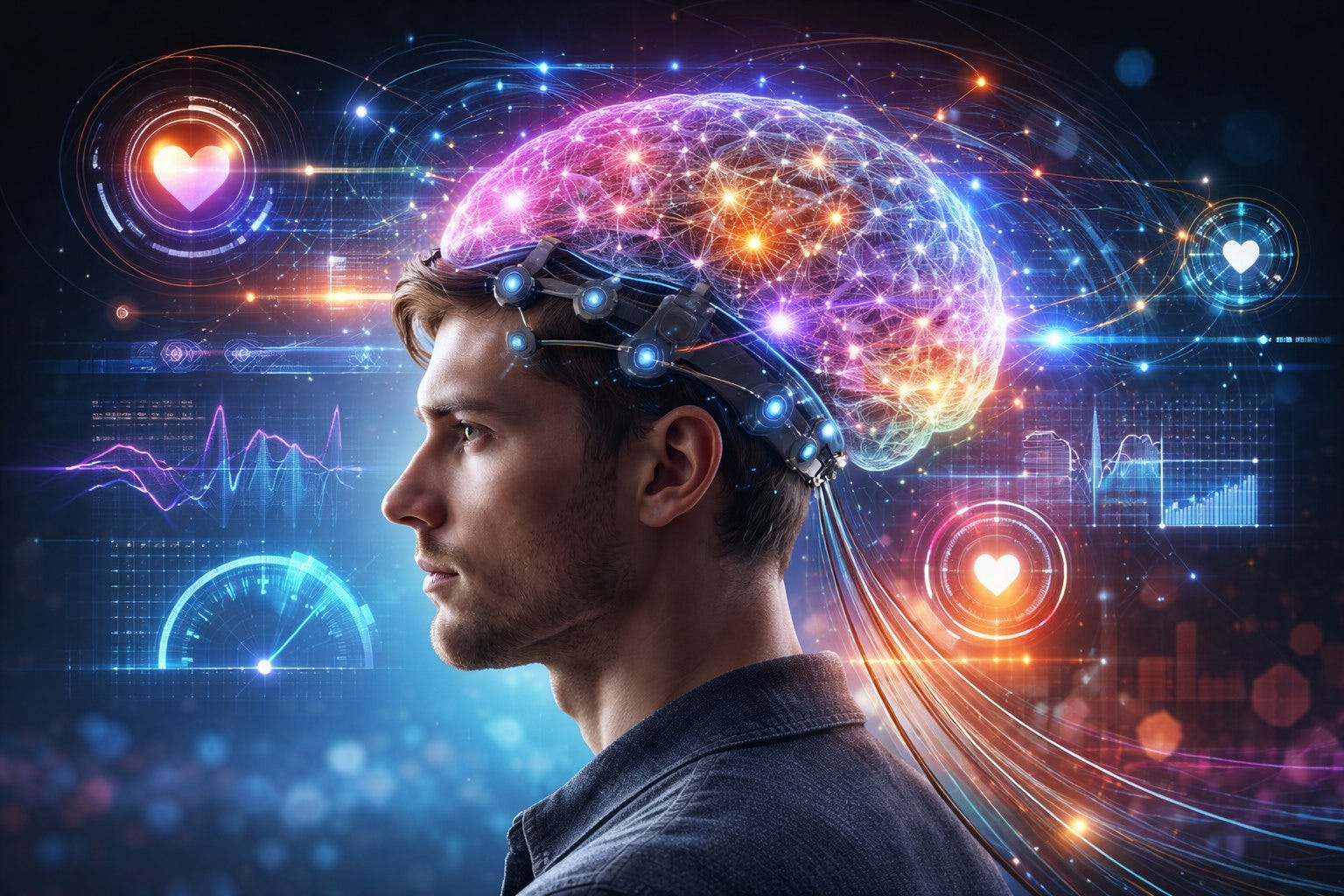
We’ve all grown up hearing about IQ — that elusive number that supposedly tells us how “smart” someone is. But what if I told you that focusing solely on IQ is like judging a book by its cover … in braille? 🤨 Sure, IQ tests tap into some elements of cognitive ability, but they miss so much of what actually drives success, adaptation, creativity, and emotional savvy in the real world.
Today, brain science and neurotechnology are rewriting the playbook. We’re learning that six other metrics — measurable, meaningful, and far more informative — give us a richer picture of human brain power and performance. And thanks to tools like EEG, fMRI, and AI-driven analytics, we can actually see them in action. 🚀
Let’s explore these brain metrics, why they matter more than IQ, and how neurotech measures them.
1. Emotional Intelligence (EQ): The Social Superpower 💡❤️
You might score great on logic puzzles, but can you read a room? Emotional intelligence — the ability to recognize, understand, and manage emotions in yourself and others — consistently predicts leadership success, better decision-making, and stronger relationships. Unlike IQ, which captures reasoning ability, EQ taps into the emotional bedrock that underlies most human interactions.
Neurotech can measure EQ-related brain activity using EEG and fMRI by tracking how the prefrontal cortex and amygdala respond during emotional tasks. These regions light up when we process emotional cues, regulate responses, and empathize with others.
Why this matters: high EQ isn’t just “nice to have” — it’s a predictor of resilience, teamwork, and real-world success. Imagine coaching your brain to be as socially adept as it is intellectually sharp.
2. Working Memory Capacity: The Mind’s Sticky Note 📋🧠
Working memory is what lets you juggle several pieces of information at once — like holding a phone number in your head while someone is still speaking. It’s not IQ, but it underpins complex reasoning, problem solving, and learning new skills.
Researchers tap into working memory with n-back tasks or similar cognitive paradigms while recording brain signals. Single-channel EEG features (like theta power changes) scale with how hard the brain works during memory load.
Here’s the twist: some people with middling IQ scores shine on working memory tasks — and that ability often translates to better multitasking and flexible thinking. It’s the brain’s operating workspace — not its filing cabinet.
3. Processing Speed: Fast Isn’t Just Faster ⚡📊
Processing speed is how quickly your brain turns input into output — think of it as the CPU clock speed of your nervous system. It’s the difference between deliberating forever and gliding through mental tasks effortlessly.
Neurotech measures this using reaction time tests and brain biomarkers like ERPs (event-related potentials) in EEG. Shorter latencies often signal more “neural efficiency” — that is, your brain is doing more with less.
So yes — speed matters. Not because slow thinkers are dumb, but because speed amplifies everything else you do in cognition.
4. Neural Connectivity: The Brain’s Social Network 🕸️🔗
If IQ reflects brain content, connectivity reflects brain conversation. Neural networks are how different brain regions coordinate — and stronger, more flexible connections often predict better performance across many domains, including creativity and cognitive control.
Tools like resting-state fMRI and advanced EEG capture how information flows across networks — and these patterns matter far more than sheer brain size.
Think of it like this: intelligence isn’t about one big brain hub … it’s about how well each corner of the mind can talk to every other. That’s deep integration — not just volume.
5. Cognitive Flexibility: Mental Gymnastics 🤸♂️🧠
You know that friend who switches tasks effortlessly? That’s cognitive flexibility — the ability to shift gears when the situation changes. IQ tests don’t measure this well, but real-world success demands it.
Neurotech tracks flexibility by analyzing changes in brain activation during shifting tasks, particularly in frontal and parietal networks. Individuals with stronger flexibility show different activation patterns compared to those stuck in rigid thinking.
This metric predicts adaptability — a crucial skill in today’s fast-changing world.
6. Socio-Emotional Signal Variability: The Brain’s Rhythm 🎼🧠
This one’s wild: scientists are now investigating how variability in resting brain signals correlates with socio-emotional outcomes like self-efficacy and life satisfaction. Research shows that individuals with greater resting state BOLD signal variability often report higher socio-emotional scores — even if their fluid cognition isn’t top-tier.
In plain English: a brain that’s dynamic and variable at rest may be more adaptable and socially tuned than one that’s stable but rigid.
Neurotech records this via fMRI scans and complex signal analysis — giving us another lens into the brain’s “mood and mindset.”
Also read: 6 Ways Neurotech Is Changing How High Performers Train Their Brains
Why This Changes Everything (Yes, Really)
Here’s the bottom line: the brain is not a single dial you can set to “smart.” It’s a symphony — a dynamic, adaptive, context-sensitive network where emotion, memory, speed, and connectivity all play their part. Intelligence isn’t one score. It’s six — or more.
Neurotechnology isn’t just about fancy gadgets. It’s about clarifying what matters most in human cognition and behavior. These metrics reflect real capabilities — ones that shape how we learn, lead, relate, and innovate.
💥 So here’s a challenge: Instead of asking “What’s my IQ?” ask “Where do my strengths really lie — statistically and neurologically?” Because that’s where the magic happens.