

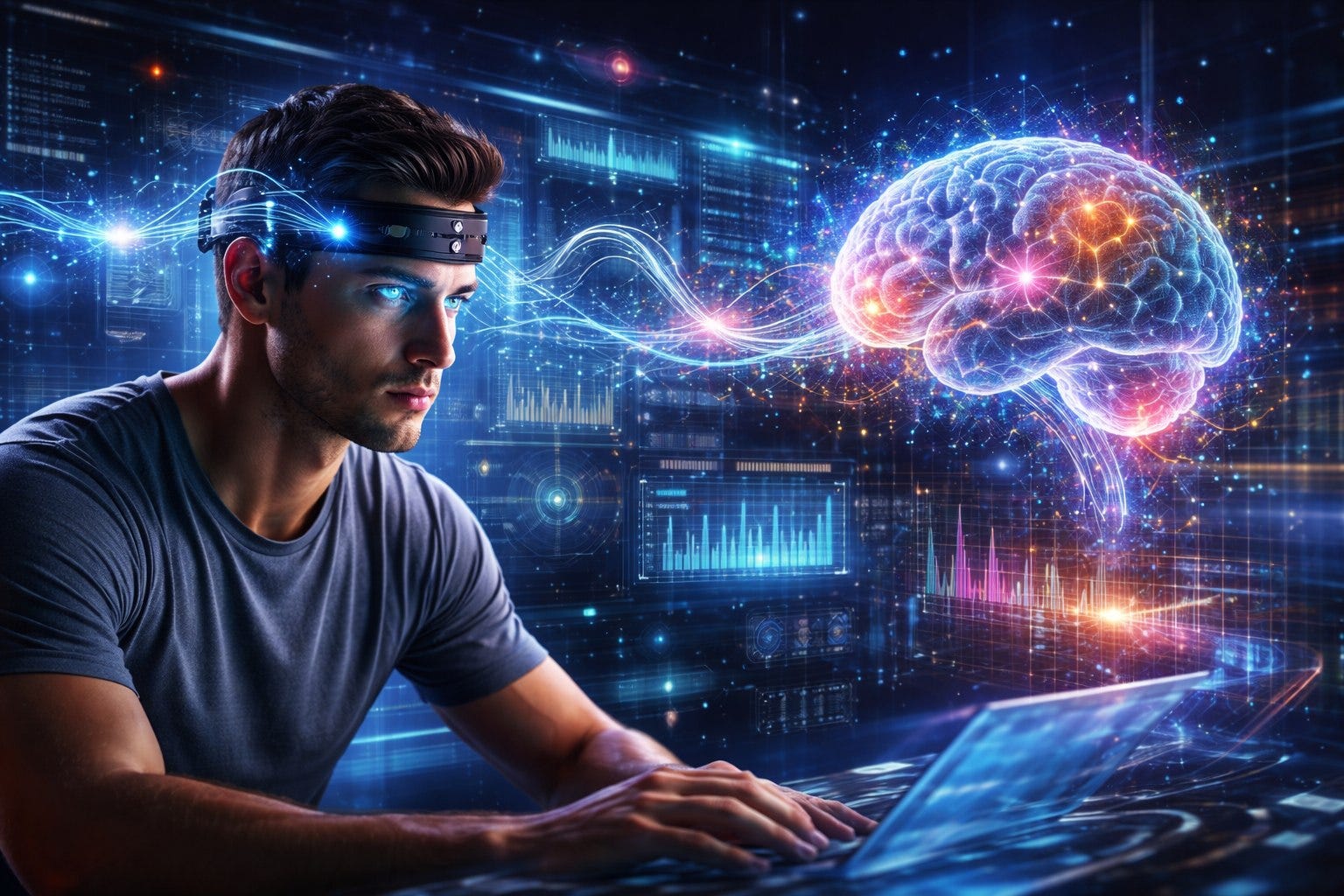
Imagine this: a world where training the brain isn’t just meditation apps and crossword puzzles — it’s science, data, feedback loops, and measurable cognitive gains. Where reaction time, focus, memory, and decision-making aren’t vague goals, but measurable outcomes you train like an athlete trains speed or strength.
That world isn’t tomorrow. It’s now. Neurotechnology — once the stuff of sci-fi — is reshaping how top performers train their brains. From athletes and executives to creatives and gamers, devices and systems now give real insights into cognitive states and even nudge neural patterns toward peak performance. 🧠💥
Let’s dive into six transformative ways neurotech is turning hard-wired human brains into finely tuned performance engines.
1. Neurofeedback: The Brain’s Training Mirror 🪞
High performers have long used feedback — from heart rate to split times — to improve. Neurofeedback does the same for the brain.
Using electroencephalography (EEG) or other sensors, neurofeedback systems measure brainwave activity and provide real-time feedback, guiding the brain toward desired states like deep focus or calm resilience.
For example, athletes use neurofeedback to trim reaction times. A review showed EEG-based neurofeedback significantly improved visual attention — a core skill in competitive sports and high-stakes environments.
The magic here isn’t just data — it’s learning. Users gradually reshape brain networks via practice, reinforcing patterns tied to performance, attention, and emotional control. For those who train consistently, it’s like weightlifting for neural circuits: gradual, measurable gains. 💪🧠
Curious where your mind falters most — at deep focus or high pressure? Neurofeedback shows you.
2. Wearable Neurotech: Brain Training On the Go 📡
Gone are the days when brain tech lived only in labs. Today’s wearable neurotech devices place neuroscience into headbands, earbuds, and even glasses — turning everyday moments into performance training opportunities.
These devices track brainwaves and deliver feedback so you can refine focus, memory, or creativity. By influencing optimal brainwave patterns (like boosting beta waves for concentration or alpha waves for calm focus), some systems help reshape neural activity in real time.
Here’s what wearable neurotech unlocks:
🧠 Enhanced attention and flow state training
💤 Sleep and recovery optimization
📈 Memory and learning improvements
📊 Personalized cognitive insights
Think of it like a fitness tracker for the mind — but rather than steps or heart rate, it’s training focus, awareness, and cognitive agility. For high performers, this means less guesswork and more data-driven improvement.
3. Cognitive Training Platforms: Brain Workouts That Work 🧩
Before neurotech, “brain training” was relegated to apps promising vague improvements. Now, data-driven platforms use immersive tasks backed by research to strengthen specific cognitive capacities.
Take programs that simulate real decision-making under pressure: they challenge working memory, pattern recognition, anticipation, and rapid problem solving — the mental muscle groups that matter most in competitive contexts.
Unlike generic puzzles, these technologies adapt to your performance and push you just beyond your comfort zone. I think that’s a huge moment — because true training requires challenge. Not busywork.
Whether you’re an athlete anticipating plays, a CEO juggling priorities, or a creative solving puzzles, these platforms offer structured brain workouts that align with performance goals.
4. Neurostimulation: Directly Shaping Neural Activity ⚡
For those seeking cutting-edge approaches, non-invasive neurostimulation techniques (like transcranial direct current stimulation) are emerging tools that complement training. These methods subtly nudge electrical activity in targeted brain regions, potentially speeding up learning or improving focus in short bursts.
Academic studies have shown that neurostimulation, paired with training, can enhance skill acquisition — though results vary and sustained gains need consistent practice. The key idea isn’t magical brain control. It’s gentle assistance at the margins, helping the brain settle into optimal functional patterns faster.
While this space has controversy and requires thoughtful use, it’s undeniably fascinating. Think of neurostimulation as advanced coaching rather than a cheat code — even elite athletes approach it with care. 🧠⚙️
5. Data-Driven Cognitive Assessment 🧠📊
If you don’t measure, you can’t improve. Simple as that.
Tools like computer-based cognitive assessment systems provide high performers with real metrics: reaction time, memory span, decision speed, attention variability, processing efficiency. These metrics aren’t guesses — they’re numerical markers you can track over time.
Some platforms even allow repeated evaluation, giving a dashboard of strengths and growth areas. For a professional in peak training, this turns the abstract — “I feel sharp today” — into the concrete — “my reaction time improved by 12ms.”
This isn’t just geeky precision. It’s strategic advantage. Knowing your baseline and progress helps refine training choices with laser focus.
6. Mental Resilience & Stress Management 🧘♂️💡
It’s tempting to think of performance purely in terms of cognition — memory, focus, speed — but the best performers win by mastering their minds, too. Neurotracking and related systems help users not just think better, but stay calm under pressure.
Modern neuroscience shows that training brain patterns tied to emotional regulation enhances resilience, flow state, and stress response. Techniques like neurofeedback and focused mental training help users learn to dial their nervous systems into performance mode — even when stakes are high.
This is huge. In arenas where pressure wrecks outcomes — athletics, trading floors, startups pitching in front of investors — mental resilience becomes a competitive edge.
Also read: 6 NeuroTech Terms Every Future Founder Should Know
What Does This All Mean for You? 🚀
Neurotech isn’t just hype. It’s the next frontier of performance training — where subjective improvements meet objective measurement. The smartest performers aren’t just training harder — they’re training smarter:
Using real data.
Measuring before improving.
Tailoring feedback to personal cognitive profiles.
Treating the brain as a muscle, network, and dynamic system. 🧠🔥
But be clear: this is performance augmentation, not performance magic. Training takes time. Gains aren’t immediate. And high performers still need sleep, nutrition, disciplined habits, and real-world practice.
So here’s my question to you:
👉 Are you training your brain the way top performers do — with data, feedback, and intentional neural optimization?
If not… what’s stopping you?
Neurotech might just be the edge you didn’t know you needed. 👀