

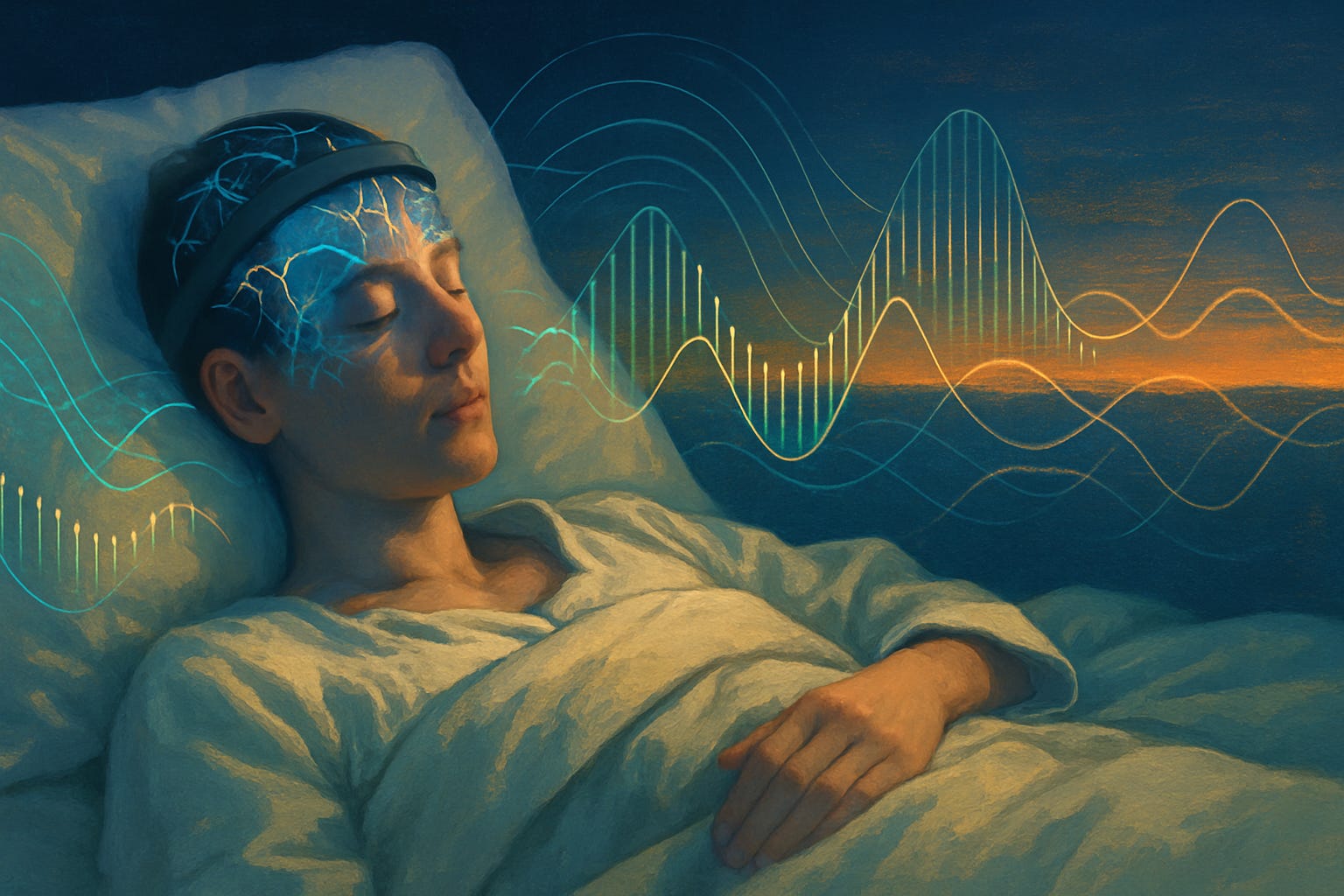
It’s 2 a.m., you’ve counted every sheep in the pasture, and the bottle of zolpidem on your nightstand is starting to look tempting despite the grogginess and dependence risk that come with it. 😴 Insomnia is stubborn, and the pharmaceutical options have real downsides. That gap is exactly where a wave of neurotech companies has planted its flag, promising sleep help that works with your brain’s own electrical activity instead of sedating it into submission.
Some of this tech is legitimately FDA-cleared. Some of it is a CES demo with a small pilot study behind it. And some of it is a device the Department of Defense is funding because insomnia rates double after military deployment. Here are six real approaches, sorted by what stage they’re actually at, not what the marketing copy claims.
closed-loop sound that’s timed to your own brainwaves
This is the category with the most peer-reviewed backing right now. Instead of playing generic white noise, these devices read your EEG in real time and fire a sound pulse at the exact moment your brain is most receptive to it. 🎧
Elemind, a Cambridge, Massachusetts, company spun out of MIT, makes a headband called the ENMod with three EEG channels positioned roughly at Fp1, Fp2, and Fpz on the forehead. It tracks the phase of your alpha waves (the 7.5 to 12.5 Hz rhythm associated with relaxed wakefulness) and delivers a soft acoustic pulse timed to arrive out of phase with that rhythm, which appears to hasten the transition into sleep. A randomized, sham-controlled crossover trial published via PMC found meaningful reductions in sleep onset latency compared to a silent sham week. Worth noting: Elemind is sold as a general wellness product, and Sleep Review reported plainly that it isn’t FDA-cleared to diagnose or treat any sleep disorder, even with a published trial behind it.
Two competitors showed up at CES 2026 doing something similar. NextSense’s Smartbuds pack six in-ear EEG sensors sampling at 1,000 Hz and pulse audio timed to slow-wave sleep rather than sleep onset. LumiMind’s LumiSleep headband, built by Stonehill Tech, claims millisecond-level responsiveness as it guides users toward sleep, a device we spotted in our own rundown of neurotech’s tipping-point moment at CES 2026.
Elemind ENMod: 3-channel EEG, targets alpha phase at sleep onset, wellness-classified
NextSense Smartbuds: 6-channel in-ear EEG, 1,000 Hz sampling, targets slow-wave sleep
LumiSleep: EEG-guided adaptive sound, CES 2026 debut, sleep-onset focused
All three: non-invasive, no prescription, none FDA-cleared as a treatment
Have you tried a closed-loop sleep headband, or does strapping sensors to your forehead before bed sound like the opposite of relaxing? 👇
a gentle current, aimed at the vagus nerve in your neck
Vagus nerve stimulation, or VNS, isn’t new. Implanted VNS devices have been FDA-approved for years to treat epilepsy, treatment-resistant depression, and stroke recovery, the kind of clinical history we covered in how neurotech is quietly replacing antidepressants for some patients. What’s new is a wave of transcutaneous versions, delivered through the skin with no surgery at all.
WillSleep, built by Seoul-based NeuroTx and a CES 2026 Innovation Award honoree, is a small device that adheres to the side of your neck with hydrogel patches and delivers electrical stimulation for 15 to 30 minutes before bed. According to the device’s CES Innovation Awards listing, a 5-week company-run clinical study reported substantial improvements in both sleep quality and insomnia severity scores, with the AI-driven system personalizing stimulation using biometric data. Reviewers at CES were openly skeptical about whether transcutaneous VNS produces a real physiological effect versus a strong placebo response, and that skepticism is fair: this is a consumer wellness device, not an FDA-cleared insomnia treatment, and the supporting data so far comes from the company itself rather than an independent trial.
Implanted VNS: FDA-approved for epilepsy, depression, and stroke rehab, not insomnia
WillSleep and similar neck-worn nVNS devices: consumer wellness category, no FDA clearance
Mechanism: claims to promote GABA, serotonin, and norepinephrine release via vagal stimulation
Independent, peer-reviewed validation for the sleep-specific consumer devices is still thin
an electrical current aimed at slow-wave sleep, funded by the military
This one probably isn’t showing up in stores anytime soon, and that’s precisely why it’s interesting. Researchers at Walter Reed National Military Medical Center and the Uniformed Services University are running a placebo-controlled, double-blind crossover trial of a headband called Teledyne PeakSleep, which delivers under 14 minutes of frontal transcranial electrical stimulation over a 30-minute pre-sleep window, targeting the slow-wave brain rhythms tied to deep sleep. 🪖
Why the military funding? Because, as the study protocol published via PMC notes, insomnia risk roughly doubles among service members after deployment, and it’s a problem the Department of Defense has a direct stake in solving without relying on sedatives that could impair alertness. This device sits firmly in the lab demo and early trial category. It isn’t FDA-cleared, it isn’t available to buy, and its entire purpose right now is generating the safety and efficacy data that would justify moving forward. That’s a meaningfully different stage than a headband already sitting in a CES booth.
Stage: active placebo-controlled clinical trial, not commercially available
Sponsor: Walter Reed National Military Medical Center and Uniformed Services University
Target population: initially service members with elevated insomnia risk post-deployment
Mechanism: frontal short-duration repetitive transcranial electrical stimulation, under 14 minutes per session
in-ear EEG that finally shows a doctor what’s happening all night
Here’s a distinction that matters and gets blurred constantly: a device that measures your brain activity accurately is not the same as a device that treats insomnia. This category is squarely about measurement, and it just hit a real regulatory milestone.
In January 2026, French company Naox Technologies received FDA 510(k) clearance for Naox Link, a single-channel, in-ear EEG system built into a wired earbud, making it, according to Fierce Biotech’s coverage of the clearance, the first ear-worn EEG device cleared for clinical use in both home and hospital settings. It’s approved for patients age six and up, and it explicitly does not generate automated diagnostic conclusions. A licensed clinician still has to read the data. One of its three intended use cases is sleep medicine: overnight EEG recording at home, without the 20-plus scalp electrodes and conductive gel of a traditional polysomnography setup.
Cleared use case: long-duration, ambulatory EEG monitoring, including overnight sleep recording
What it is: a monitoring tool that feeds data to a clinician
What it isn’t: an insomnia treatment, and it makes no automated diagnostic claims
Why it matters: it’s the first FDA-cleared device in this specific form factor, a real regulatory first rather than a CES buzzword
an at-home sleep lab that catches what’s actually wrong
Sometimes what looks like insomnia is really undiagnosed sleep apnea, restless leg syndrome, or another condition entirely, and treating the wrong problem wastes months. That’s the gap a new class of multi-sensor patches is trying to close.
Tedream, made by Wis Medical, is a gel-free, adhesive-free wireless patch worn on the forehead, chest, and forearm that simultaneously records EEG, ECG, EMG, blood oxygen (SpO2), heart rate, respiration rate, snoring, and body position, essentially the full sensor suite of an in-lab polysomnography study. Per coverage from CES 2026’s sleep tech floor, the company markets it as delivering medical-grade signal fidelity for at-home apnea testing, though that specific claim isn’t yet FDA-approved. I’d treat this one as promising but unverified: the sensor list is genuinely comprehensive, and if it holds up under independent scrutiny, it could meaningfully shorten the path to a correct diagnosis instead of months of trial-and-error with insomnia remedies aimed at the wrong problem.
Sensors: EEG, ECG, EMG, SpO2, heart rate, respiration, snoring, posture, all in one patch
Application: forehead, chest, and forearm, no gel or adhesive prep required
Claimed use: at-home sleep apnea testing comparable to an in-lab study
Regulatory status: not yet FDA-approved, company claims unverified by independent review
consumer headbands that train your brain to wind down
The most accessible tier is the consumer neurofeedback headband, and it’s worth being honest about what it does and doesn’t do. These devices don’t stimulate your brain the way tDCS or VNS does. They measure your brain state and respond with adaptive audio, treating sleep less like a switch to flip and more like a skill to practice. 🧘
Muse S Athena, from Canadian company InteraXon, uses seven EEG sensors plus fNIRS (which tracks blood oxygen in the prefrontal cortex) to monitor delta wave activity during deep sleep, alongside heart rate, breathing, and movement. Its Sleep Assist feature plays a soundscape that gradually fades as your brain signals show you’re drifting off. Sleep Foundation’s hands-on review confirms the EEG-based sleep staging gives a more detailed picture than movement-only trackers, while noting it’s a wellness tool, not a diagnostic one. Earable Neuroscience’s FRENZ Brainband, which recently joined the National Sleep Foundation’s SleepTech Network, takes a similar EEG-plus-audio approach at a $680 price point. We rounded up more of this consumer tier, including EEG headsets built for focus rather than sleep, in 5 neurotech devices you can actually buy today.
Muse S Athena: 7 EEG sensors + fNIRS, delta-wave sleep tracking, adaptive Sleep Assist audio
FRENZ Brainband: EEG-based sleep tracking, National Sleep Foundation SleepTech Network member
Category-wide caveat: general wellness devices, not medical devices, no FDA review required
Best fit: people who want data and gentle nudges toward better habits, not a clinical fix
None of these six replace a conversation with a sleep doctor if your insomnia is severe or persistent, and it’s worth saying plainly: a wellness label on the box means the FDA hasn’t checked the science, whatever the app’s marketing claims. But if you’re the kind of person who wants to see the brainwave data behind a bad night instead of just guessing, this is probably the most genuinely useful cluster of devices neurotech has shipped yet. Which one would you actually trust to sit on your nightstand?