

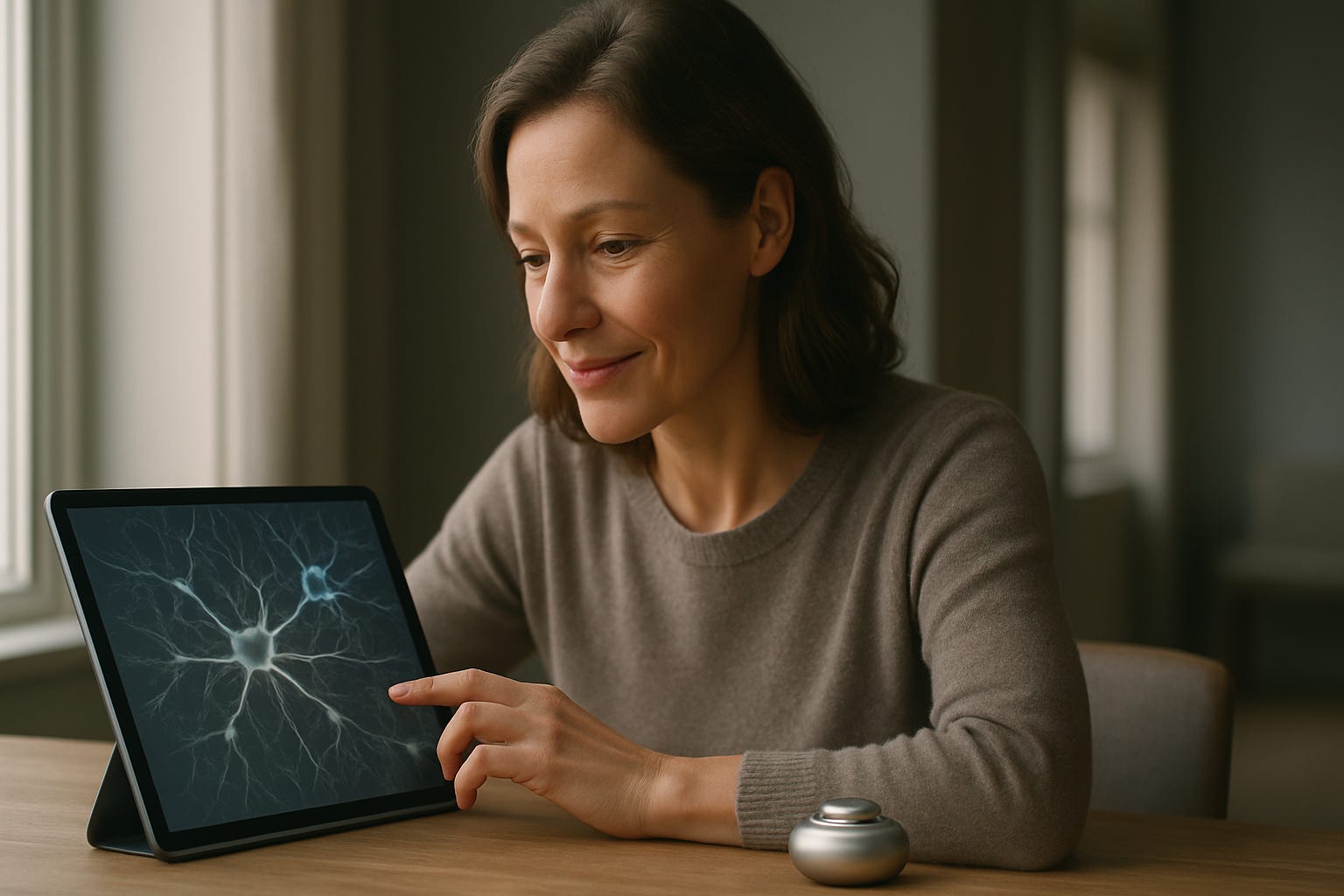
The psychiatrist’s standard playbook for severe depression looks roughly like this: try one antidepressant, wait six weeks, try another, adjust the dose, add a second drug, wait some more, wonder if anything is working. Somewhere between 30% and 40% of everyone treated with antidepressants never gets adequate relief. That’s not a rounding error. That’s tens of millions of people stuck in a loop that medicine hasn’t broken in decades.
What if the answer isn’t a pill at all? What if it’s a blueberry-sized gadget sitting quietly in the bone above your brain, sending electrical pulses to the exact network that’s gone dark? That’s not science fiction anymore. It’s the premise of at least two active clinical trials in the United States right now, with a third just receiving FDA clearance to begin. The neurotech field is betting, seriously and with significant institutional money, that treatment-resistant depression (TRD) is not a psychiatric puzzle but a circuit problem, and circuit problems can be fixed with the right hardware.
I think we’re at an inflection point. Not the breathless, “cure is imminent” kind, but the kind where the evidence is finally mature enough to run proper randomized trials, and the engineering has shrunk enough to make implants feel less like sci-fi horror and more like routine cardiology. Here’s where things actually stand.
The scale of the problem nobody talks about enough
Depression is the leading cause of disability worldwide, according to the World Health Organization, but the version that makes headlines is rarely the most severe form. Treatment-resistant depression, defined as failing to improve after at least two separate courses of antidepressants, affects approximately 3 million Americans each year, and that number almost certainly undercounts the true burden.
The economics are brutal. The total annual healthcare burden of TRD in the United States is estimated at $43.8 billion. And the human cost is harder to quantify. Data from the UK’s National Health Service suggests that close to half of all people with major depressive disorder may develop treatment-resistant depression, a finding that, if it holds up, would be a major reframing of how common TRD really is. Most people think of it as a rare edge case. It isn’t.
The failure modes of standard treatment are worth knowing:
SSRIs and SNRIs work well for many, but roughly one in three patients gets inadequate relief even at appropriate doses and duration
Up to two thirds of patients will not respond to the first antidepressant prescribed, which means the second, third, and fourth tries are grinding through diminishing returns
By the fourth failed medication trial, as many as 83% of patients relapse — a statistic that should make anyone uncomfortable
The condition carries elevated rates of anxiety disorders, self-harm, and suicidality compared with non-resistant depression
This is the patient population that neurostimulation researchers have been quietly targeting for years. The logic is straightforward: advances in neuroscience have made it clear that major depressive disorder involves identifiable structural and functional changes in the brain, just like Parkinson’s disease does. And Parkinson’s, notably, is already treated with implanted electrical devices in tens of thousands of patients. Why should depression be any different? 🔬
The two approaches making the most noise right now
The two big strategies in clinical development are deep brain stimulation (DBS) and a newer category of minimally invasive over-brain stimulation, and they work quite differently.
DBS is the older, better-understood approach. It works like a pacemaker for the brain: a surgeon implants thin wire electrodes deep into a targeted brain structure, connects them to a pulse generator under the skin in the chest, and the device delivers continuous or adjustable electrical impulses to modulate abnormal activity. Previous open-label studies demonstrated at least a 50% sustained improvement in depression symptoms for three out of four patients over a period of two to eight years, which is, frankly, a remarkable result for a condition that had exhausted every other option. The problem is that those were open-label studies, meaning patients and doctors both knew treatment was occurring, which always inflates outcomes.
That’s why the TRANSCEND trial, run by medical device giant Abbott, matters so much. The TRANSCEND (Treatment ResistAnt DepressioN Subcallosal CingulatE Network DBS) study is a double-blinded, randomized, multi-site trial investigating Abbott’s DBS system specifically in people who have failed at least four antidepressant treatments. Half the participants won’t receive any active stimulation for the first 12 months — a sham-control design that eliminates placebo effects. Emory University joined as one of 25 participating sites nationwide, with enrollment actively ongoing. Mount Sinai was the first site to perform the DBS implantation procedure under the trial in March 2025, following years of preclinical and regulatory groundwork.
The Motif Neurotech approach is structurally different and arguably more interesting from an engineering standpoint. Their device, called DOT (Digitally Programmable Over-brain Therapeutic), is roughly the size of a blueberry. It sits in the bone above the brain rather than inside it, doesn’t touch brain tissue directly, and is implanted in a 20-minute outpatient procedure. It’s wirelessly powered. You walk in, you walk out, and you go home with something that can deliver brain stimulation daily without ever needing a clinic visit. In late April 2026, the FDA cleared Motif’s RESONATE trial — the company’s first-in-human study, which will initially enroll around 10 participants over 12 months.
The key distinctions between the two approaches: 🧠
DBS targets deep brain structures (specifically the subcallosal cingulate cortex), requires more invasive surgery, delivers stronger stimulation, and has a longer evidence base
DOT/Motif sits above the brain, targets the same cortical network as transcranial magnetic stimulation (TMS), is minimally invasive, and is designed for completely unsupervised at-home use
Both are aimed squarely at the roughly 3 million Americans for whom nothing else has worked
Both carry FDA Breakthrough Device designations, meaning the agency agrees the unmet need is severe enough to warrant accelerated review
Jacob Robinson, Motif’s CEO, has framed the long-term vision memorably: the goal is that this technology would be the “mental health equivalent of a continuous glucose monitor for diabetes.” That’s an ambitious analogy. But given where the science is heading, it might not be as far-fetched as it sounds. 💡
Closed-loop systems: the real paradigm shift
Here’s the part of this story that I find genuinely fascinating, and that most mainstream coverage completely misses. Both current trials deliver what’s called open-loop stimulation — the device runs on a fixed schedule, regardless of the patient’s actual brain state at any given moment. That’s like dosing insulin at fixed times regardless of blood sugar levels. It works, but it’s blunt.
The next generation is closed-loop, or adaptive, neurostimulation. Rather than continuous stimulation, closed-loop therapy aims to deliver short, intermittent stimulation only when the patient’s brain signals indicate they are in a depressive state, using neural biomarkers detected in real time to trigger the device. Think of it as a thermostat for your mood circuitry. When the relevant biomarker signal drops, the implant fires. When things normalize, it stops.
A landmark proof-of-concept published in Nature Medicine showed that this personalized biomarker-driven approach can produce rapid and sustained improvement in a patient with severe depression. Early results from an ongoing closed-loop DBS trial suggest that the total stimulation time needed to achieve a clinical effect may be under two hours a day — a stark contrast to the 24/7 continuous stimulation used in traditional DBS. That’s a huge deal, because it may reduce risks like hypomania (an unintended mood elevation that’s been a known side effect of DBS) and prevent the brain from adapting and becoming habituated to the signal.
This approach got a commercial foothold in a related indication: in February 2025, the FDA approved Medtronic’s Percept RC neurostimulator with BrainSense, the world’s first commercially available adaptive DBS system — though initially cleared for Parkinson’s disease, not depression. The infrastructure, the sensing, the algorithmic approach — it’s all being developed. Translating it to psychiatric conditions is the next logical step. 🔬
But there’s a catch. Biomarkers for depressive states can differ significantly across individuals due to neurocircuit heterogeneity, which means a “one-size-fits-all” biomarker almost certainly won’t work. Truly personalized closed-loop therapy requires mapping each patient’s unique neural activity patterns before treatment can be calibrated. That’s workable, but it adds complexity, time, and cost to an already resource-intensive intervention.
What the trials can and can’t tell us yet
Let’s be honest about what we don’t know, because the gap between promising trial results and an approved therapy is wider than most coverage implies.
A UK-China study of DBS for treatment-resistant depression reported clinical improvements in roughly half of participants in an open-label trial, and researchers identified neural activity signatures that predicted individual patient response — which is genuinely useful for targeting future treatment. But a double-blind randomized controlled trial from the same group is still pending publication. Results from Abbott’s TRANSCEND trial aren’t expected for years. Motif’s RESONATE study is just beginning. This is early. Very early.
The ethical questions are also non-trivial and deserve more airtime than they usually get. A major scoping review of the past decade’s neuroethical literature found that concepts of changes in patient identity and personality after deep brain stimulation were extensively discussed, with DBS being considered both the riskiest and highest-efficacy option. Mood, personality, and sense of self are not incidental byproducts of a functioning brain — they are the brain. Stimulating specific circuits that regulate affect raises real questions about what, exactly, is being altered.
Issues of data privacy, user autonomy, equitable access, and long-term safety remain unresolved in the BCI space broadly, with researchers noting the risk that commercial pressures could overshadow patient welfare. That risk is particularly acute in psychiatry, where patients may be in severe distress, may have limited capacity to evaluate experimental options, and may feel that an implant is their last resort. Desperation is not the same as informed consent.
There’s also the access problem. DBS surgery costs tens of thousands of dollars. Even if Abbott’s TRANSCEND trial proves efficacy, the path from “it works in a clinical trial” to “your insurance covers it” in the United States is long and ugly. Motif’s minimally invasive design is explicitly aimed at reducing that barrier — a 20-minute outpatient procedure is orders of magnitude cheaper than open brain surgery — but we’re still talking about an implantable device, not a $40 prescription. 💊
Questions worth sitting with:
Who gets access first, and how do we prevent neuro-implant therapy from becoming another luxury treatment available only to the wealthy?
What happens if a patient’s personality changes in ways they — or their family — didn’t anticipate?
When a device is removed or stops working, what are the psychological consequences?
If a closed-loop device is reading your neural biomarkers continuously, who owns that data?
What comes next, and why this moment matters
The honest answer to the headline question — can a brain implant treat depression? — is probably yes, for some patients, under specific conditions we don’t yet fully understand. That’s less satisfying than a binary answer, but it’s more accurate.
What we do know is that the neuromodulation approach to depression has cleared a significant credibility hurdle. The FDA’s Breakthrough Device designations for both Abbott’s DBS system and Motif’s DOT device signal institutional recognition that pharmacological treatment alone isn’t enough for millions of patients. The randomized, double-blind trial designs being used now are specifically designed to answer the placebo question that earlier studies couldn’t. And the shift toward closed-loop, personalized systems represents a genuine conceptual advance over the blunt-instrument stimulation of previous decades.
For a broader view of how consumer and clinical neurotech is converging on mental health, the NeurotechMag piece How Neurotech Is Quietly Replacing Antidepressants for Some Patients tracks how the whole field is moving at once — from surgical implants down to at-home headsets — and why the pace is accelerating.
The short-term markers to watch: 🚀
TRANSCEND trial readout: Abbott’s pivotal DBS data, expected in the late 2020s, will likely determine whether the FDA approves an indication specifically for depression, which would be a watershed moment for psychiatric neuromodulation
Motif RESONATE safety data: The 12-month safety and early-efficacy results will tell us whether minimally invasive over-brain stimulation is viable at human scale
Closed-loop biomarker research: The race to identify reliable, individualizable neural signatures of depressive states is probably the key scientific bottleneck — whoever cracks it accelerates everything else
Insurance and reimbursement policy: The clinical pipeline is ahead of the coverage pipeline. That gap will define whether any of this reaches the patients who need it most
I keep thinking about something Brian Kopell, the lead neurosurgery investigator for TRANSCEND, said: that it is not surprising DBS is showing promise for depression, given how clearly we can now see the structural and functional brain changes that define this condition. Once you reframe depression as a brain circuit disorder rather than a mysterious mood state, the neurostimulation approach stops sounding radical and starts sounding like neurology catching up with itself.
The real question isn’t whether electrical stimulation can treat depression — the early evidence says it can, at least for some people. The question is whether we can deliver it safely, personalize it effectively, make it available equitably, and do all of that before another decade passes for the millions of people for whom the pill bottle has already failed.
So I’ll leave you with this: if you were in the position of having failed four antidepressant treatments and someone offered you a 20-minute outpatient procedure to place a blueberry-sized device in your skull — would you do it? And what would need to be true about the evidence before you said yes?