

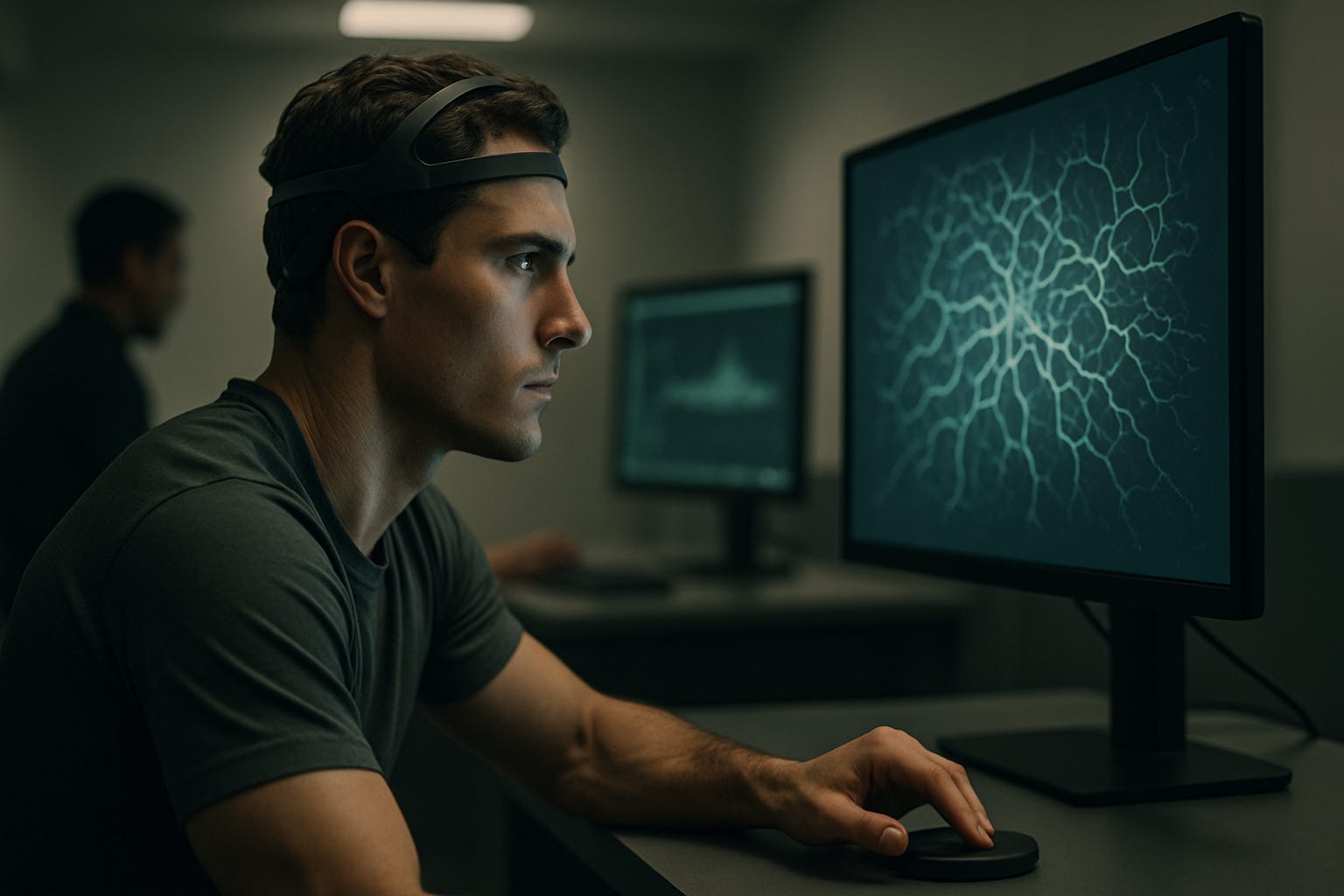
Milliseconds decide careers. In sprinting, the difference between a gold medal and fifth place is often measured in hundredths of a second. In baseball, a batter has roughly 450 milliseconds from the moment a pitch leaves the pitcher’s hand to decide whether to swing — and most of that time is consumed by the nervous system’s signal routing, not the swing itself. In soccer penalty shootouts, a goalkeeper has to choose a direction before the kick even happens, because the ball moves too fast to react to. At this level of competition, where bodies are already optimized beyond what normal training can produce, coaches are turning to an unlikely intervention: training the brain directly, with real-time EEG and neurofeedback.
This isn’t a new idea, but it’s arriving at a new level of credibility. The science behind it has accumulated enough peer-reviewed weight to move from fringe biohack to legitimate performance tool — used, with varying degrees of openness, by professional athletes in the NFL, NBA, MLB, Olympic programs, and Premier League football clubs. The 2006 Italian national soccer team used what they called “the Mind Room” — a brain training facility run by sports scientist Bruno De Michelis, head of the sports science lab for AC Milan — in the months before winning the FIFA World Cup, with players wired to biofeedback systems, watching screens display how their brains responded to pressure. They won. Correlation isn’t causation, but the story stuck.
What’s different now is the research base — and the hardware. The tools have become portable, affordable, and sophisticated enough to deploy outside a Milan laboratory. And the data from multiple meta-analyses is pointing in a consistent direction.
The science: what neurofeedback actually does to reaction time 🧠
Before getting into who’s using it and how, the mechanism deserves a clear explanation. Because “brain training” gets applied to everything from Lumosity apps to actual EEG-based neurofeedback, and these are not the same thing. Not even close.
EEG neurofeedback works by placing electrodes on the scalp, reading the electrical patterns your brain produces in real time, and feeding that data back to you as an audio or visual signal. The athlete’s job is to modulate their brainwave activity — specifically to increase certain frequency bands while suppressing others. The most studied target for athletic performance is SMR, or sensorimotor rhythm, which oscillates in the 12–15 Hz range and is associated with motor control, attention maintenance, and the calm-but-alert cognitive state that precision athletes describe when they’re performing at their peak. 🔬
The neurological case for why SMR training shortens reaction time came into sharper focus with a double-blind, sham-controlled study published in December 2024 in Imaging Neuroscience by researchers at Keio University in Japan. The study involved 24 participants and found that neurofeedback-trained SMR desynchronization reduced simple reaction times and, critically, reduced pre-movement cortical inhibition in the motor cortex — the suppressive “brake” that slows down motor commands. Training the brain to release that brake faster, even fractionally, is exactly what an elite athlete needs.
The cumulative research picture is compelling:
A *2022 meta-analysis published in Frontiers in Human Neuroscience reviewed seven randomized controlled trials covering 173 athletes and found a standardized mean difference (SMD) of -1.08* for reaction time improvement in neurofeedback groups versus controls (p = 0.0009), which constitutes a large effect by statistical convention
A separate 2025 systematic review and meta-analysis published in Scandinavian Journal of Medicine & Science in Sports examined 24 studies from 2000 to March 2025 and reported a pooled SMD of 1.26, indicating a large effect of EEG neurofeedback training on athletic cognitive and motor outcomes
A 2025 study published in Scientific Reports found that SMR neurofeedback training in 30 professional shooters over four weeks significantly improved both simple and choice reaction times and shooting accuracy compared to sham-feedback controls, with improvements maintained at a four-week follow-up
I should be clear-eyed here: the total sample sizes across all these trials are modest. Most studies involve dozens of athletes, not hundreds. Methodological consistency is still a problem the field is working through, as noted by the 2025 review’s authors themselves. But large effect sizes across multiple independent labs are harder to dismiss than a single headline study, and that’s what the neurofeedback-reaction time literature is starting to produce. What’s your take — does an SMD of 1.26 move this from “promising” to “practice-ready”?
Who’s actually doing this — and with what 🚀
The names attached to brain training in professional sports are no longer just anecdotes. Kirk Cousins, the NFL quarterback, used neurofeedback with Myndlift and Neuropeak Pro while being filmed for the Netflix series Quarterback, describing the process as watching video while a headband tracks whether his brain is maintaining optimal states — and the feedback rewards or withdraws based on that. The beauty of it, he said, is that the training happens while you just let the brain do its work.
Lucas Giolito, the MLB pitcher who went from last among starters to American League All-Star, publicly credited neurofeedback as a meaningful part of his offseason improvement at the 2019 All-Star Game in Cleveland, describing the process as “brain-training where they hook you up and read your brain waves and you do focus exercises, guided visualization.” Chris Kaman, the NBA center, started brain training in 2008 and averaged 17.9 points per game that season, attributing his improved ability to read defensive intentions in real time to the focus gains from neurofeedback. Correlation again — but these aren’t isolated anecdotes any more.
At the team level, there are multiple reported instances of brain training integration:
The NFL’s Seattle Seahawks reportedly incorporated neurofeedback into their sleep optimization program, with performance and injury rate improvements noted alongside it
Canadian athletes at the 2010 Vancouver Olympics participated in an NFB program that improved their stress control under competition conditions
Italian national soccer built the “Mind Room” into pre-World Cup preparation — a protocol combining EEG feedback, heart rate coherence training, and alpha-state conditioning
Manchester United has reportedly used EEG headsets during training to measure and improve players’ mental focus, according to multiple sports brain training reports
The U.S. Olympic Ski Team and beach volleyball gold medalist Kerri Walsh Jennings have been noted users of neurofeedback systems in Olympic preparation
The broader shift is from individual athletes using brain training as a private edge to teams institutionalizing it as part of standard performance infrastructure. As NeurotechMag has covered elsewhere in its mapping of the sector, when the smart money in sports science moves, it usually signals something more than a trend.
The hardware athletes are actually using 💡
The most widely mentioned platform in professional athlete circles is Myndlift, a remote neurofeedback system that pairs with a Bluetooth EEG headband and delivers supervised brain training via a smartphone app. It uses clinician oversight alongside at-home sessions, allowing athletes to do their training between sessions without needing to travel to a clinic. Kirk Cousins used it while watching TV — which sounds casual until you remember that operant conditioning works precisely because the training happens during low-interference states.
On the research side, the OpenBCI platform continues to show up in academic studies for good reason: it provides raw EEG access that lets sports neuroscientists design their own feedback protocols rather than relying on commercial software ecosystems. For precision sports research, this flexibility matters, because the SMR training protocols that show the strongest reaction time effects need careful customization.
At the consumer end, the Neurable MW75 Neuro LT, released in September 2025 at $499, deserves mention. It integrates 12-channel EEG sensors into premium headphones built with Master & Dynamic, and tracks focus, cognitive strain, mental fatigue, and a weekly “Brain Age” metric. Neurable tested its Brain Break prompting feature in partnership with the Mayo Clinic, finding participants preferred cognitively-timed breaks to scheduled ones and reported improved wellbeing. The MW75 LT won’t run SMR neurofeedback protocols designed for precision athletes — it’s positioned for knowledge workers and people who want to track their cognitive state during the day — but it represents the form factor direction that athletic EEG training is heading: devices that disappear into things you already wear. ⚡
The sports-specific systems still in common clinical use include:
Neurofeedback clinics using QEEG brain mapping to build individualized training protocols, particularly popular among individual sport athletes in archery, shooting, golf, and combat sports
Muse-based research setups — multiple peer-reviewed studies have used the Muse headband as their recording platform, including work from Prof. Michela Balconi’s lab at the Catholic University of Milan showing faster response times in complex reaction tasks after Muse-guided neurofeedback sessions
In-lab theta/SMR training systems used by sports psychology departments at universities and national training centers
What this means for “neuro-doping” — and where the field’s limits are 🔬
The research community isn’t uniformly enthusiastic. The 2025 meta-analysis in the Bjørk Human Kinetics publication explicitly noted that “methodological variability highlights the need for standardized protocols and further replication.” Small samples, inconsistent feedback protocols, varying session lengths (4 to 45 minutes across studies), and different sham-control designs make direct comparison difficult.
There’s also the transfer problem. Neurofeedback demonstrably improves performance on specific tasks — and the reaction time gains shown in laboratory conditions are real. Whether those gains transfer to complex, dynamic sport situations is a harder question. A shooter showing faster choice reaction time on a button press after neurofeedback training is not automatically a better shot under pressure in competition. The science of brain stimulation and performance makes clear that interventions that work in controlled settings don’t always replicate in live environments, and sports neuroscience researchers are honest about this gap.
The ethics question is also arriving. Patrick Ragert, head of a brain stimulation study at the Max Planck Institute for Human Cognitive and Brain Sciences, raised the concept of “neuro-doping” — whether cognitive enhancement via brain stimulation or neurofeedback should be regulated the same way performance-enhancing drugs are. Currently, no major sporting body prohibits neurofeedback or EEG-based training. But as the technology becomes more powerful and the effects more measurable, that conversation is likely to start in earnest.
What’s not in dispute is the direction of travel. At the 2025 review’s level of analysis, covering 24 studies across two decades and multiple elite sport disciplines, EEG neurofeedback consistently moves the needle on attention, reaction time, motor control, and anxiety regulation in elite athletes. As NeurotechMag has noted in its analysis of how the brain communicates signals that neurotech learns to decode, the frequency bands targeted by sports neurofeedback — particularly SMR and theta — are among the most reliably readable and trainable in the EEG spectrum.
The interesting question for the next five years is whether this moves from a specialized edge held by individual athletes and a few forward-thinking programs to a standard part of high-performance training infrastructure. The technology trajectory suggests it will. The regulatory and ethical conversation will trail it. And somewhere in that gap is where the next generation of elite sport is quietly being won — one brainwave at a time. Which sport do you think will mainstream brain training first?