

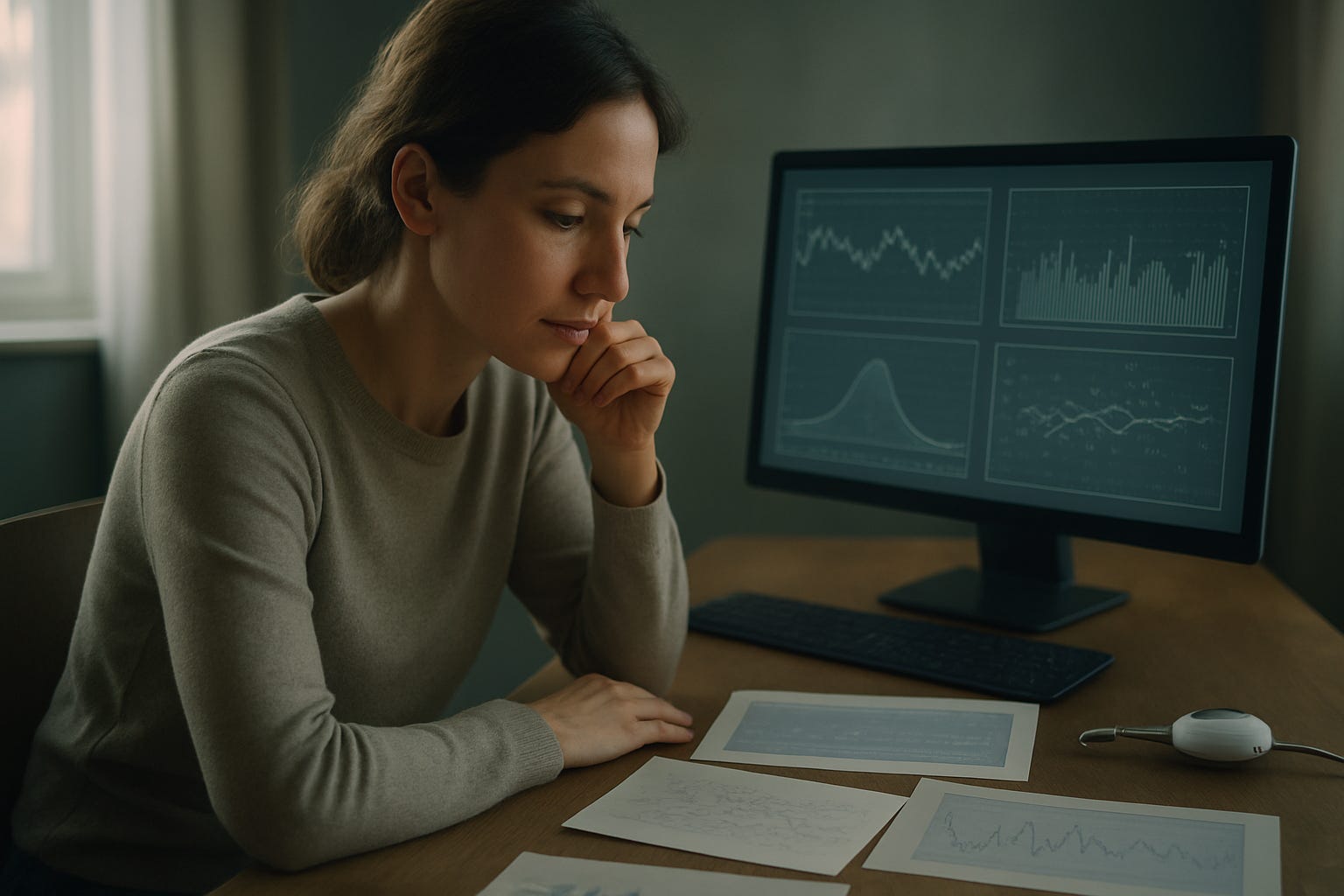
Your neurofeedback app just told you your focus score dropped twelve points. Did your attention actually crater, or did you shift in your chair, clench your jaw, or blink twice in a row? Honestly, with most consumer EEG gear, there’s no way to tell just by looking at the number. That gap between what a device reports and what your brain actually did is the single most important thing to understand before you take any brainwave reading seriously. 🧠
Alpha, beta, and theta waves are real, well-documented, and genuinely useful. They’re also easy to misread, because the electrical signal an EEG electrode picks up is a messy mix of brain activity and everything else happening near your scalp. Sorting one from the other is the whole game.
What alpha, beta, and theta actually track
EEG electrodes pick up voltage fluctuations from thousands of neurons firing together, and researchers sort those fluctuations into frequency bands:
Delta (0.5-4 Hz): deep sleep, largely absent while you’re awake and alert
Theta (4-8 Hz): drowsiness, deep meditation, and internally focused states
Alpha (8-13 Hz): relaxed wakefulness, typically strongest with eyes closed
Beta (13-30 Hz): active thinking, problem-solving, motor planning
Gamma (30 Hz and up): brief bursts tied to peak focus and sensory binding
Here’s the part that gets glossed over: these bands are statistical averages, not clean switches. Your brain runs several of them simultaneously, at different strengths, and your personal baseline alpha peak might sit at 9 Hz while your friend’s sits at 11 Hz. Neither is wrong. NeurotechMag’s own piece on seven signals your brain is giving you covers this same idea from the neuroscience side, and it’s worth a read if you want the deeper mechanics. If you want the full technical rundown of how the electrodes and the measurement itself work, the Wikipedia entry on EEG is thorough and reasonably current. 📊
The upshot: a single alpha or beta reading tells you almost nothing on its own. Context, baseline, and repetition matter more than any individual number.
The artifact problem: your face is louder than your brain
Here’s an uncomfortable fact about EEG: your eye muscles and jaw generate electrical signals that are far bigger than your brain’s. Eye blinks produce voltage spikes in the hundreds of microvolts, while genuine brain activity usually runs in the tens. Frontal electrodes, which sit closest to your eyes, catch the worst of it. According to Bitbrain’s rundown on EEG artifacts, blink and eye-movement artifacts are dominant in the low frequencies, meaning they can look almost identical to genuine delta and theta activity if nobody filters them out. 👁️
Muscle activity is just as bad. Clenching your jaw, frowning, or even swallowing throws high-frequency electrical noise directly into the beta and gamma ranges, exactly where “focus” and “peak concentration” scores live.
Eye blinks and saccades: contaminate delta and theta bands, strongest at frontal electrodes
Jaw clenching, chewing, talking: contaminate beta and gamma bands, broadband noise
Power-line interference (50/60 Hz): shows up as a sharp, consistent spike unrelated to any mental state
Movement and sweat: introduce slow drifts that can mimic changes in low-frequency bands
Cardiac signal: a small, regular pulse that occasionally bleeds into nearby electrodes
This isn’t a hypothetical problem. Frontal alpha asymmetry, a widely cited EEG marker used for decades to study emotion and motivation, took a real hit when a large 2021 reliability study in Brain Structure and Function recorded 370 people eight times each. Once researchers properly controlled for eye-movement artifacts, a chunk of the classic leftward asymmetry effect simply disappeared. Years of research had likely been picking up eyeballs moving, not moods shifting. That’s a genuinely humbling result for a field that’s built entire theories on this measure. 😬
Why one weird reading doesn’t mean anything
Your brain’s electrical output shifts with sleep quality, caffeine, hydration, stress, and time of day, none of which have anything to do with whatever app score you’re staring at. A single session that looks unusual is far more likely to reflect one of those mundane factors, or an artifact, than a real shift in cognitive function.
This is where individual variability makes everything harder. Skull thickness, scalp conductivity, and even specific gene variants change how strongly a person’s brain signal reaches the surface electrodes in the first place. NeurotechMag has covered this exact issue in the brain stimulation context, noting in can you actually boost your IQ with brain stimulation that BDNF and COMT gene variants, among other factors, shape how strongly someone responds to a given intervention. The same variability applies to reading brainwaves, not just stimulating them. 🧬
So what actually counts as a meaningful change?
It shows up consistently across multiple sessions, not just once
It’s bigger than your own day-to-day baseline swings, which you only learn by tracking over time
It correlates with something you’d notice independently, like sleep quality or a task you actually performed better on
It holds up when you repeat the measurement under similar conditions
It’s not perfectly timed with a blink, a yawn, or a shift in posture
Ever notice your “focus score” tank right after you yawned or reached for your coffee? That’s usually the artifact talking, not your attention span. ☕
What the skeptics get right
Not everyone in neuroscience is sold on consumer neurofeedback, and it’s worth hearing them out. Researcher Robert Thibault has raised pointed doubts about the whole category, as detailed in IEEE Pulse. His skepticism breaks into a few specific claims:
Doubt that consumer devices reliably record actual brain signals rather than eye and facial muscle activity
Doubt that the measured signal causes the behavior or mental state a company claims it reflects
A broader field concern, echoed in multiple reviews, about whether any trained change holds up once the feedback stops
A 2019 critical review by Wexler and Thibault, cited in later systematic reviews of low-cost EEG headsets, found these devices could reasonably detect something as basic as drowsiness but lacked reliable evidence for identifying more specific mental states. That’s a meaningfully lower bar than what most marketing copy implies. 🔍
None of this means neurofeedback is fake or useless. Clinical-grade systems used under professional supervision, with proper artifact rejection and validated protocols, are a different animal from a $200 headband and an app. The skepticism is really aimed at the gap between consumer marketing claims and what the underlying signal can actually support.
A practical checklist for reading your own brainwave data
If you already own a neurofeedback headband or are considering one, treat every individual reading the way you’d treat a single blood pressure check taken right after climbing stairs: informative, but not the whole story.
Look at trends across weeks, not single sessions
Discard or discount readings taken right after movement, talking, or intense facial expression
Cross-check any big shift against something you can independently verify, like how rested you feel
Be skeptical of any claim resting on one small study rather than repeated, independent replication
Treat the device as a rough trend line for your own patterns, not a clinical diagnostic tool
NeurotechMag’s guide to neurotech devices you can actually buy today is a good place to compare which consumer options at least attempt decent signal processing before you commit to one. 🎧
So next time your headband flashes a dramatic number at you, ask the more useful question: did something actually change in my brain, or did I just move my face?