

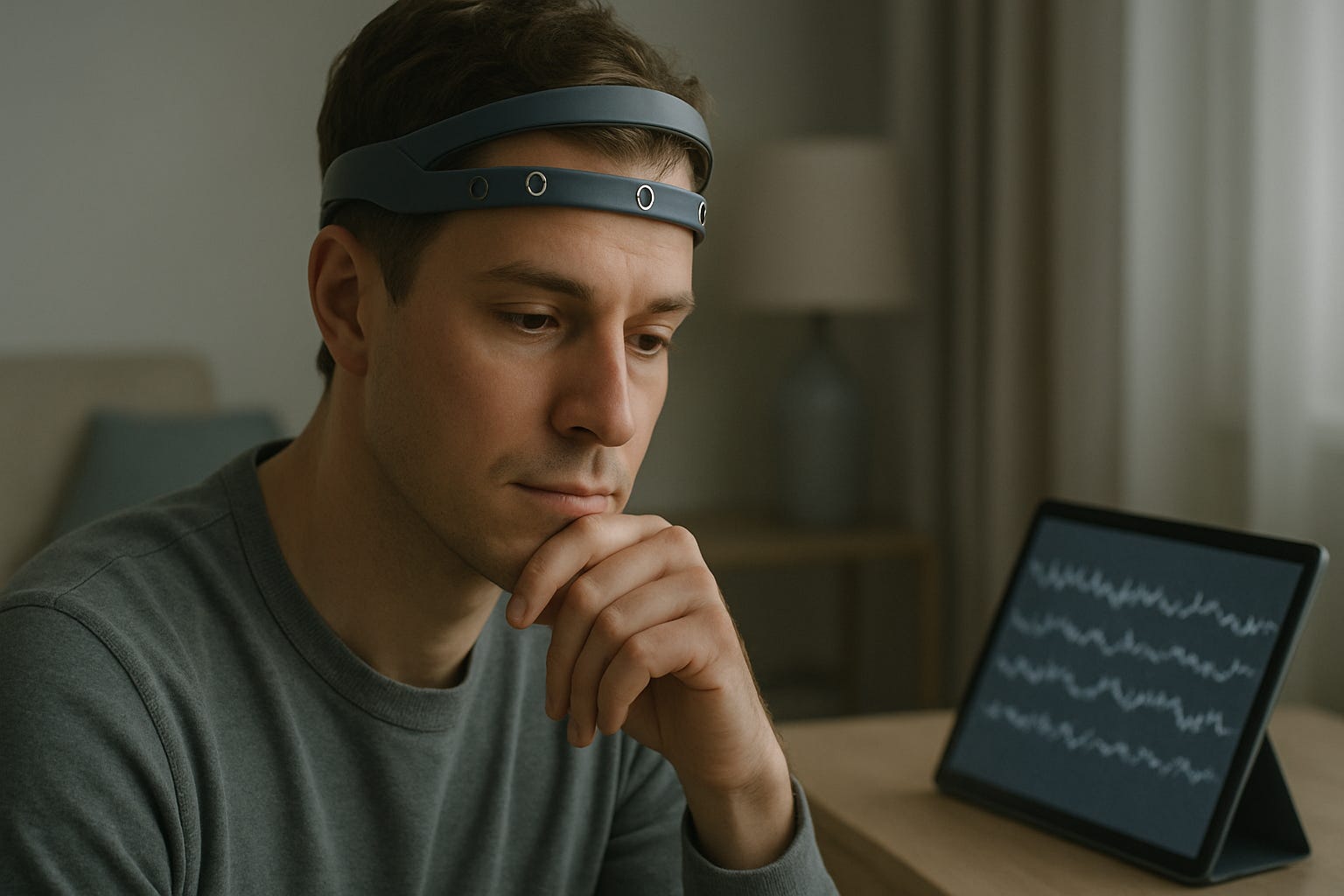
For years, “brain hacking” meant sketchy wellness gadgets and forum threads full of people strapping 9-volt batteries to their foreheads. That reputation is starting to crack. Over the past few months, the FDA has cleared a prescription depression headset for home use, kept expanding what counts as a legitimate video-game treatment, and continued quietly clearing individual EEG platforms for clinical use. None of this is hype. It’s regulatory paperwork, which is honestly the most convincing kind of validation neurotech can get. 🧠
Three technologies are driving this shift: transcranial direct current stimulation (tDCS), EEG biofeedback (also called neurofeedback), and prescription digital therapeutics like EndeavorRx. They work in completely different ways and answer to completely different levels of regulatory scrutiny. Worth sorting out before you buy into any of them.
tDCS finally gets its FDA moment
tDCS sends a weak, steady electrical current through the scalp to nudge activity in a targeted brain region. It’s been around since the early 2000s, mostly as a research tool and a slightly fringe biohacking trend. That changed on December 8, 2025, when the FDA cleared Flow Neuroscience’s FL-100, the first at-home tDCS device authorized for moderate to severe major depressive disorder in adults.
The numbers behind the clearance are genuinely solid:
A 10-week, randomized, sham-controlled trial in Nature Medicine enrolled 174 adults with moderate to severe depression
Active tDCS produced a mean symptom-score improvement of 9.41 points, versus 7.14 for the sham group
58% of active-treatment patients reached remission by week 10, compared with 29% on placebo
More than 55,000 people had already used the device in Europe, with 77% reporting improvement within three weeks
That’s a meaningfully bigger effect than sham-controlled brain stimulation trials usually produce. 📈 I’ll admit I expected another underwhelming “statistically significant but clinically shrug-worthy” result, and instead got a device that’s now competing on cost with transcranial magnetic stimulation (TMS), which runs $6,000 to $12,000 per treatment course versus Flow’s expected $500 to $800 price tag.
None of that erases the field’s messier history, though. A 2023 Lancet trial found tDCS performed no better than placebo for depression, and even researchers who like the technology stay cautious. Robert Reinhart, an associate professor at Boston University uninvolved with the Flow trial, told Scientific American that “tDCS has been studied for more than two decades, and the evidence base is mixed.” That’s a fair summary. One good trial doesn’t erase two decades of inconsistent results, and I’d treat the FDA clearance as a floor, not a verdict. ⚡
EEG biofeedback grows up, unevenly
EEG biofeedback, or neurofeedback, works on a different principle. A cap of electrodes reads your brainwaves, software translates the pattern into something you can see or hear, and you learn, through repetition, to nudge your own brain toward a target state. It’s been used experimentally for ADHD, anxiety, and PTSD for decades, but the regulatory picture is a patchwork rather than a clean approval.
Here’s roughly how it breaks down:
Consumer headbands like Muse and Flowtime are wellness products, not FDA-cleared treatments, and are marketed for relaxation rather than diagnosis or therapy
The Discovery 24 EEG amplifier holds 510(k) clearance, but only to record and display brain signals, not to treat anything
NEBA System earned FDA clearance back in 2013 as a diagnostic aid for ADHD, meaning it helps confirm a diagnosis rather than treat one
Prism, built by GrayMatters Health, is FDA-cleared as an actual PTSD treatment, targeting a specific amygdala-to-prefrontal-cortex circuit
Neurosteer‘s single-channel EEG platform picked up fresh FDA clearance in March 2026 for multipurpose clinical brain monitoring 🔬
Prism is the one worth lingering on. Its 15-session protocol trains users to strengthen a neural circuit originally identified through fMRI research by Talma Hendler at Tel Aviv University, then translates that target into real-time EEG feedback patients can actually act on during a session. GrayMatters CEO Oded Kraft told Psychiatric News that “our objective is not to go around the psychiatrist or therapist,” positioning it as a supplement to talk therapy rather than a replacement.
Ever tried a consumer neurofeedback headband and wondered if it was doing anything beyond draining your phone battery? You’re not alone, and NeurotechMag’s own look at seven signals your brain is giving you digs into exactly why raw brainwave data is so easy to oversell and so hard to validate clinically. 🎧
EndeavorRx and the rise of prescription video games
If tDCS and neurofeedback sound clinical, EndeavorRx sounds like a joke that turned out to be real medicine. On June 15, 2020, the FDA cleared it as the first video game ever authorized to treat a medical condition, specifically attention deficits in children ages 8 to 12 with inattentive or combined-type ADHD.
The game descends from NeuroRacer, a prototype built by neuroscientist Adam Gazzaley at UC San Francisco, and it works by layering sensory distractions and motor challenges that force the brain’s attention systems to work harder than they would in an ordinary game. Akili Interactive, the company behind it, backed the clearance with five clinical studies covering more than 600 children, including a randomized controlled trial in The Lancet Digital Health. After four weeks of play, roughly a third of children no longer showed a measurable attention deficit on at least one objective test, and about half of parents reported a clinically meaningful change in daily functioning. You can read the full regulatory history on EndeavorRx’s Wikipedia page if you want the granular timeline. 🎮
Akili didn’t stop at kids. EndeavorOTC, an over-the-counter version for adults with ADHD, followed in 2024 and now sells for $24.99 a month with no prescription required. That’s a meaningful shift: a therapy that started as a tightly controlled pediatric prescription is now a consumer subscription, sitting right next to the wellness-grade neurofeedback headbands covered in NeurotechMag’s guide to neurotech devices you can actually buy today. The line between “medical device” and “app you download” keeps getting blurrier. 📱
Why regulators are warming up to brain-based treatment
None of these clearances happened in a vacuum. Depression rates in the US have climbed roughly 60% over the past decade, and a third of patients don’t respond well to standard antidepressants or quit them over side effects like weight gain and sexual dysfunction. That gap is exactly what’s pulling the FDA toward alternatives that don’t come in pill form.
A few forces line up here:
Side-effect profiles for tDCS and neurofeedback tend to be mild, think scalp irritation or transient headaches, compared with the broader risk list for SSRIs or antipsychotics
At-home devices cut the cost and logistics of weekly clinic visits, which matter enormously for TMS-style treatments requiring dozens of sessions
Digital therapeutics can be updated with software patches instead of new manufacturing runs, which speeds iteration
Regulatory pathways like FDA’s de novo process reward genuinely novel mechanisms, which is exactly the box EndeavorRx and Flow both checked
I find this genuinely encouraging, though I’d push back on any narrative that these tools are replacing medication outright. NeurotechMag’s earlier reporting on how neurotech is quietly replacing antidepressants for some patients makes the more accurate case: these are additions to the toolkit, not wholesale substitutes, and insurance coverage for most of them is still catching up to the science. 💊
What would actually change your mind about trying one of these, insurance covering it, a longer track record, or a doctor recommending it directly?
What to watch next
Expect this list to keep growing. Flow’s US launch lands in the second half of 2026, Neurosteer’s clearance opens the door to more single-channel EEG monitoring products, and Akili has said it plans to study EndeavorRx-style mechanics for conditions beyond ADHD. Disclosed neurotech funding topped $1.3 billion in 2025, and companies chasing FDA clearance now have real proof that the agency will say yes to non-drug, brain-based treatments when the trial data holds up. 🚀
The honest open question isn’t whether more of these devices will get cleared. It’s whether insurers, employers, and clinicians build the infrastructure to actually prescribe and pay for them at scale, the same infrastructure problem that’s already slowing Flow’s rollout. So here’s the real question worth sitting with: if your doctor offered you a headset instead of a prescription pad tomorrow, would you take it?