

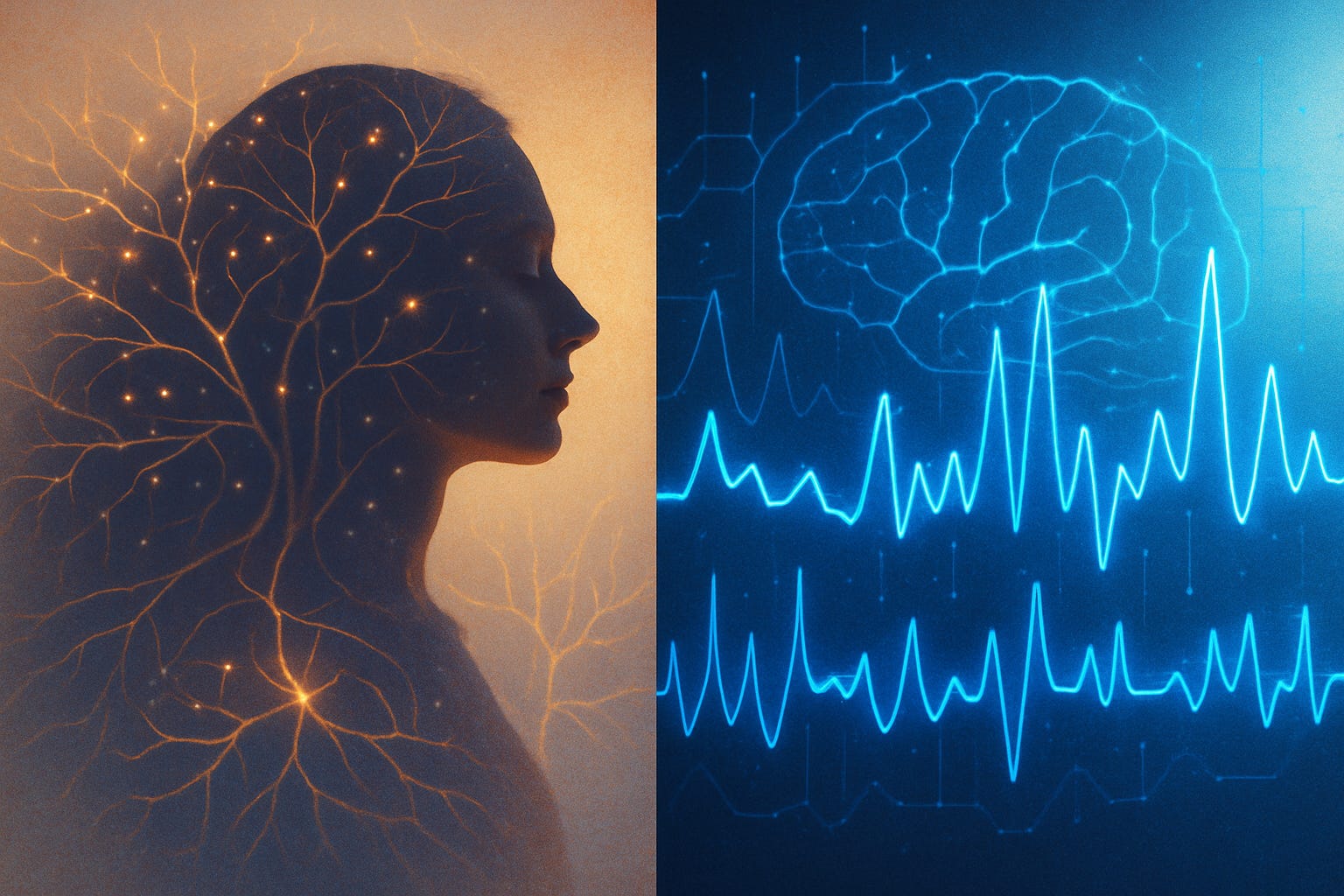
I’ve spent years half-convinced that meditation apps and EEG headbands were selling the same promise with different packaging. They’re not. One trains attention from the inside and asks for patience measured in years. The other shows you your own brain activity in real time and asks for a screen. 🧠 After digging through the actual research, comparing decades-old monk studies to this year’s clinical trials, I think the honest answer is less “which one wins” and more “these are different tools solving different problems,” which is a less exciting headline but a more useful one.
What meditation actually does to a brain, and how long it takes
The most famous data point here comes from Richard Davidson’s lab at the University of Wisconsin-Madison, where Tibetan Buddhist monks with 10,000 to 50,000 hours of lifetime meditation practice sat for EEG recordings back in 2004. Their brains produced gamma brainwaves at amplitudes 25 to 30 times greater than a control group given just a week of meditation instruction. That’s not a subtle effect. But look at the input required to get it: decades of sustained, disciplined practice, some of it during years spent in solitary retreat.
That’s the core tradeoff with meditation. It works, but slowly, and the gains scale with time invested:
Changes appear to be cumulative and progressive rather than triggered by any single session
Classic EEG studies of Zen practitioners found increased alpha activity and eventual theta waves at frontal locations, but only after years of practice
A 2020 controlled study found eight sessions of neurofeedback-assisted meditation improved theta power and cognitive performance versus unassisted practice
Mindfulness training tends to show stronger results for reducing psychological distress than for boosting raw cognitive performance
There’s no shortcut hiding in the data. If you want a longer look at what your brain’s electrical rhythms actually mean, alpha, beta, theta, and how they map to attention and relaxation, we broke that down in 7 signals your brain is giving you. Meditation, at bottom, is a slow negotiation with those same rhythms. ⏳
How neurofeedback flips the process around
Neurofeedback attacks the problem from the opposite direction. Instead of training attention and hoping brainwave changes follow, it targets the brainwave pattern directly and lets you watch it shift in real time, then rewards you, usually with sound or a visual cue, when it moves the right way. The concept traces back to a genuinely strange discovery: UCLA researcher Barry Sterman found in the late 1960s that training a specific 12-15 Hz rhythm over the motor cortex, called the sensorimotor rhythm, produced measurable behavioral effects.
Speed is where neurofeedback has a real edge. A study in Frontiers in Human Neuroscience compared eight weeks of mindfulness training against just 15 sessions of alpha-theta neurofeedback and found the neurofeedback group reached comparable brainwave shifts faster. Consumer devices have leaned hard into this speed advantage, and a few worth knowing:
Muse and Mendi focus on guided relaxation feedback for meditation beginners
Neurosity Crown, which we covered in neurotech devices you can actually buy today, targets focus and cognitive load tracking for work sessions rather than pure relaxation
Myndlift offers qEEG-based assessment with protocols adjusted by human clinicians, putting it closer to clinical-grade training
Clinical fMRI neurofeedback, used in research settings, can target specific regions like the posterior cingulate cortex with far more precision than any consumer headset
The catch, and it’s a real one, is that a lot of this evidence base is thinner than the marketing suggests. 📉
Why the research is messier than either camp admits
Here’s where I have to play the skeptic. A systematic review published in Imaging Neuroscience looked specifically at mindfulness-based neurofeedback studies and found most of them lacked blinded, sham-controlled conditions, meaning participants often knew whether they were getting real feedback or fake feedback. That’s a serious design flaw. Without a proper control group, it’s hard to tell whether reported gains come from the neurofeedback itself or from the placebo effect of sitting quietly and paying attention to a screen.
A few more caveats worth sitting with before you buy a headband:
Most reviewed studies reported a single outcome measure rather than tracking brain target engagement comprehensively over time
Few studies preregistered their hypotheses or followed open science practices, which makes cherry-picked positive results more likely to get published
Neurofeedback can show that a brain region is involved in a process, but that’s different from proving it causes the meditative state researchers are trying to train
Consumer-grade EEG headsets read a noisier, scalp-level signal compared to the clinical fMRI setups used in the strongest research
None of this means neurofeedback doesn’t work. It means the confident marketing claims outrun the evidence more than either side wants to admit, a pattern we’ve run into before, including when we fact-checked whether brain stimulation gadgets can actually boost your IQ.
The combination might beat either one alone
The most interesting finding across the research isn’t a winner, it’s a pairing. A study out of the University of Melbourne tested high-precision, fMRI-guided neurofeedback specifically to help novice meditators recognize and disengage from mental chatter during practice, the exact skill beginners usually struggle with most. The idea is that neurofeedback can act as training wheels, giving new meditators objective, real-time proof that their practice is actually changing their brain state, rather than asking them to take it on faith for years before results show up.
That’s probably the honest takeaway here. Neurofeedback gives you speed and objective feedback loops. Meditation gives you the deep, durable changes that seem to require sustained practice, no gadget shortcuts it. If you’ve got the patience, meditation alone still has the strongest long-term track record. If you want something that shows measurable movement in weeks rather than years, pairing a neurofeedback device with a meditation practice looks like the better bet than picking one and ignoring the other. 🎯
Have you tried either one, or both together? I’m curious whether the real-time feedback actually kept you consistent, or whether it just became one more gadget gathering dust after week two.