

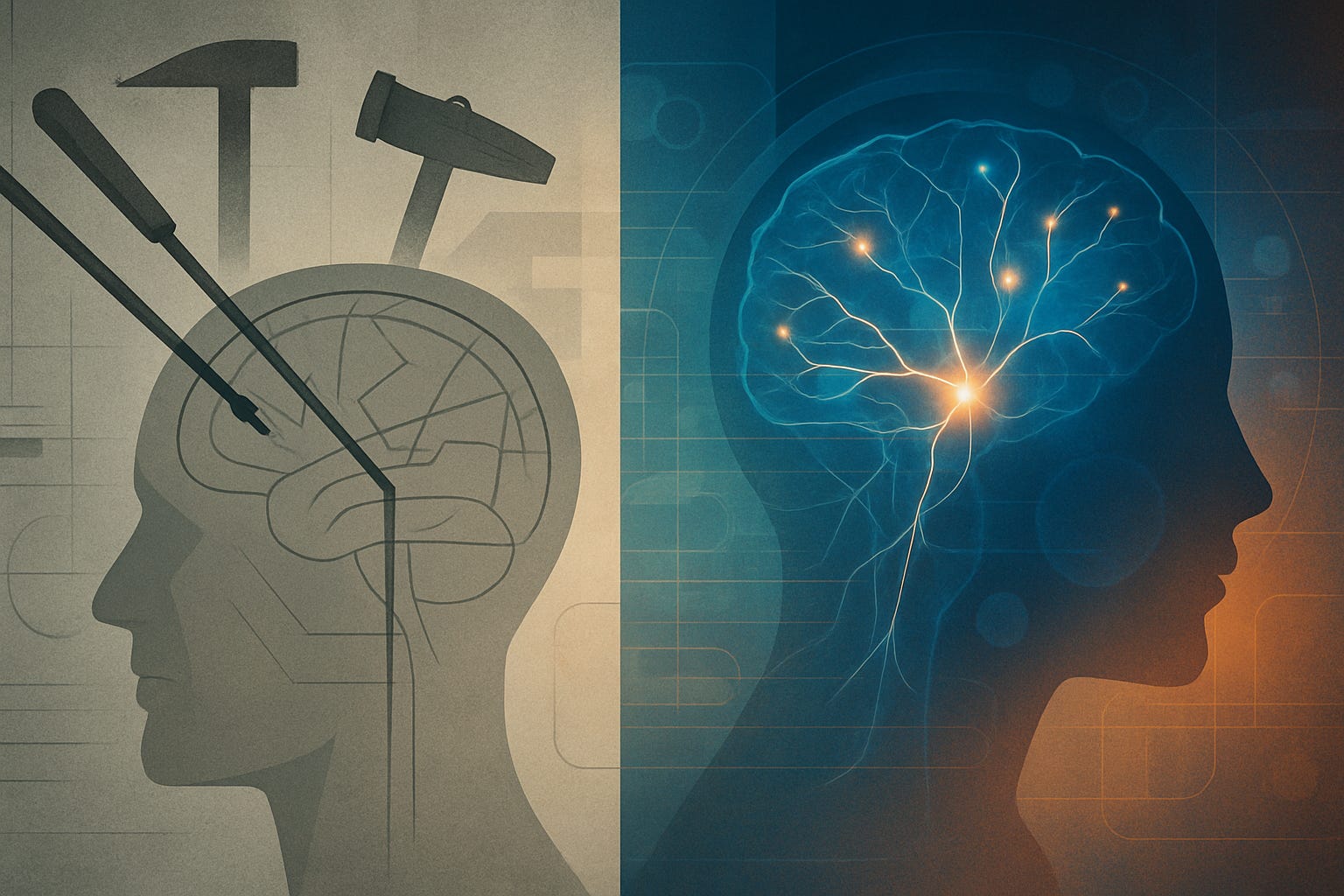
In 1946, a Washington, D.C. doctor named Walter Freeman slid a sharpened ice pick under a patient’s eyelid, tapped it through the thin bone behind her eye socket with a mallet, and wiggled it back and forth to sever connections in her frontal lobe. The whole procedure took about ten minutes, and he sometimes performed it in his own office with no anesthesiologist in sight. Eighty years later, a paralyzed man named Noland Arbaugh sat in a lab wearing nothing but a coin-sized implant under his scalp and moved a computer cursor just by thinking about it. Same organ, wildly different century. 🧠
This is the short version of how brain tech got from butchery to breakthrough, and honestly, it’s messier than the glossy press releases let on.
A cure that was mostly a mutilation
The story starts in Lisbon in 1935, when Portuguese neurologist Egas Moniz drilled holes into a patient’s skull and injected alcohol into her frontal lobe, hoping to calm her anxiety and paranoia. He called it a leucotomy, and in 1949 he won the Nobel Prize for it, honored for what the committee called “the therapeutic value of leucotomy in certain psychoses”. It remains one of the most debated prizes the committee ever handed out.
An American neurologist, Walter Freeman, adopted the idea, renamed it the lobotomy, and eventually ditched the operating room entirely. His transorbital version used an instrument that looked, and functioned, exactly like an ice pick. No surgeon required, no hospital stay, just an office visit and a mallet. 😬 The numbers from that era are hard to sit with:
By 1951, roughly 20,000 lobotomies had been performed in the US alone
Freeman personally carried out an estimated 3,500 procedures over his career
In July 1952, he performed 228 transorbital lobotomies in West Virginia in a single two-week stretch, a spree newspapers later dubbed “Operation Ice Pick”
Patients frequently ended up apathetic, flattened, or permanently impaired rather than cured
The era collapsed almost overnight once chlorpromazine (Thorazine) hit the market in the mid-1950s. Suddenly there was a pill that calmed psychotic symptoms without an ice pick, and lobotomy went from miracle to cautionary tale in about five years. It’s a rough starting point for a field that now promises to restore speech and movement, but it’s the honest one. ⚡
Learning to listen before we learned to talk back
While Freeman was touring the country with his van (yes, really, patients called it the lobotomobile), a quieter and far more useful branch of brain science was taking shape: reading the brain instead of cutting it. That thread actually predates the lobotomy era. In 1924, German psychiatrist Hans Berger recorded the first human EEG, picking up the brain’s electrical chatter through the scalp with nothing more invasive than a few electrodes and a lot of patience.
That single idea, that the brain broadcasts a signal you can capture from outside the skull, became the foundation for almost everything that followed:
Deep brain stimulation, now a standard treatment for Parkinson’s tremors 🩺
Transcranial magnetic stimulation, which can treat depression in days instead of the weeks antidepressants typically require, as we covered in how neurotech is quietly replacing antidepressants for some patients
Cochlear implants, which translate sound into signals the auditory nerve can use
The P300 speller, an early proof that a computer could detect what letter you’re staring at just from your brainwaves
None of this made headlines the way a chip in Elon Musk’s hands does today, but it’s the quiet plumbing that made everything after it possible. 💡
Teaching paralyzed hands to move again
By the 2000s, researchers had moved past reading brainwaves through the scalp and started implanting electrodes directly onto the brain’s surface. The BrainGate consortium, running out of Brown University and Massachusetts General Hospital, became the proving ground. In one of the field’s most-cited moments, a woman named Jan Scheuermann, paralyzed by spinocerebellar degeneration, used two 96-electrode arrays to control a robotic arm with seven degrees of freedom well enough to feed herself a piece of chocolate for the first time in years.
That same period saw the field split in two directions:
Clinical, invasive systems like BrainGate, aimed squarely at restoring function for people with paralysis or ALS
Consumer, non-invasive headsets from companies like Emotiv and NeuroSky, aimed at gaming and meditation, which is where a lot of tech enthusiasts first encountered the words “brain-computer interface”
If you want the deeper mechanics of how a headset or an implant actually decodes intention from electrical noise, we broke it down in 7 signals your brain is giving you, and how neurotech decodes them. Worth a read if the how keeps you up at night the way it does me. 🔬
Musk, chips, and a race that got real fast
Neuralink was founded in 2016 with a blunt mission: build a high-bandwidth implant that connects a human brain to a computer. For years it was mostly monkey videos and keynote promises. Then, in January 2024, Noland Arbaugh became the first human to receive the N1 implant, a device roughly the size of a quarter packed with up to 3,072 electrodes. By June 2026 that number had grown to 26 implanted patients, with trials now running across the US, Canada, the UK, and the UAE, and the company reaching that milestone in roughly two and a half years. Neuralink has also picked up FDA Breakthrough Device status for a speech-restoration project and for Blindsight, its attempt at restoring vision.
Neuralink isn’t the only game in town, and honestly the rival approach is the one I find more interesting. Synchron skips open-skull surgery entirely. Its Stentrode device is a small mesh stent threaded up through the jugular vein, like a cardiac stent, and parked against a blood vessel wall in the motor cortex. It reads far fewer signals than Neuralink’s implant, but it also requires no craniotomy and comes with a recovery measured in days. After a $200 million Series D round in November 2025, Synchron is now gearing up for a pivotal trial aimed at the first FDA approval ever granted to an implanted BCI.
Would you rather have a device that reads more of your brain but requires brain surgery, or one that reads less but slides in through a blood vessel? I genuinely don’t know which trade-off I’d take, and I don’t think there’s a clean answer yet. 👇
What nobody’s fully solved yet
Money is pouring into this field. Disclosed neurotech funding topped $1.3 billion in 2025 alone, and analysts expect the broader market to climb from roughly $15 to 17 billion today to well over $47 billion by 2035, numbers we dug into in 6 signals that neurotech is reaching a tipping point. China has published a five-year roadmap aiming to become a global BCI leader by 2030. Regulators are starting to catch up too. In November 2025, UNESCO adopted its first global framework on neurotechnology ethics, pushing member states to protect mental privacy and prevent employers or insurers from getting anywhere near someone’s neural data.
None of that answers the questions that actually keep me up at night, though:
Who owns the data your implant generates once it leaves your skull?
What happens to a paralyzed patient’s device when the company that made it runs out of funding?
Will restoring speech and movement stay the goal, or will “cognitive enhancement” quietly become the product?
We went from an ice pick through the eye socket to a robot-assisted implant that lets someone with ALS text their family, in under a century. That’s not a small jump. So here’s the real question worth sitting with: now that we can read the brain instead of just cutting it, what should we actually be allowed to do with what we hear? 🧠