

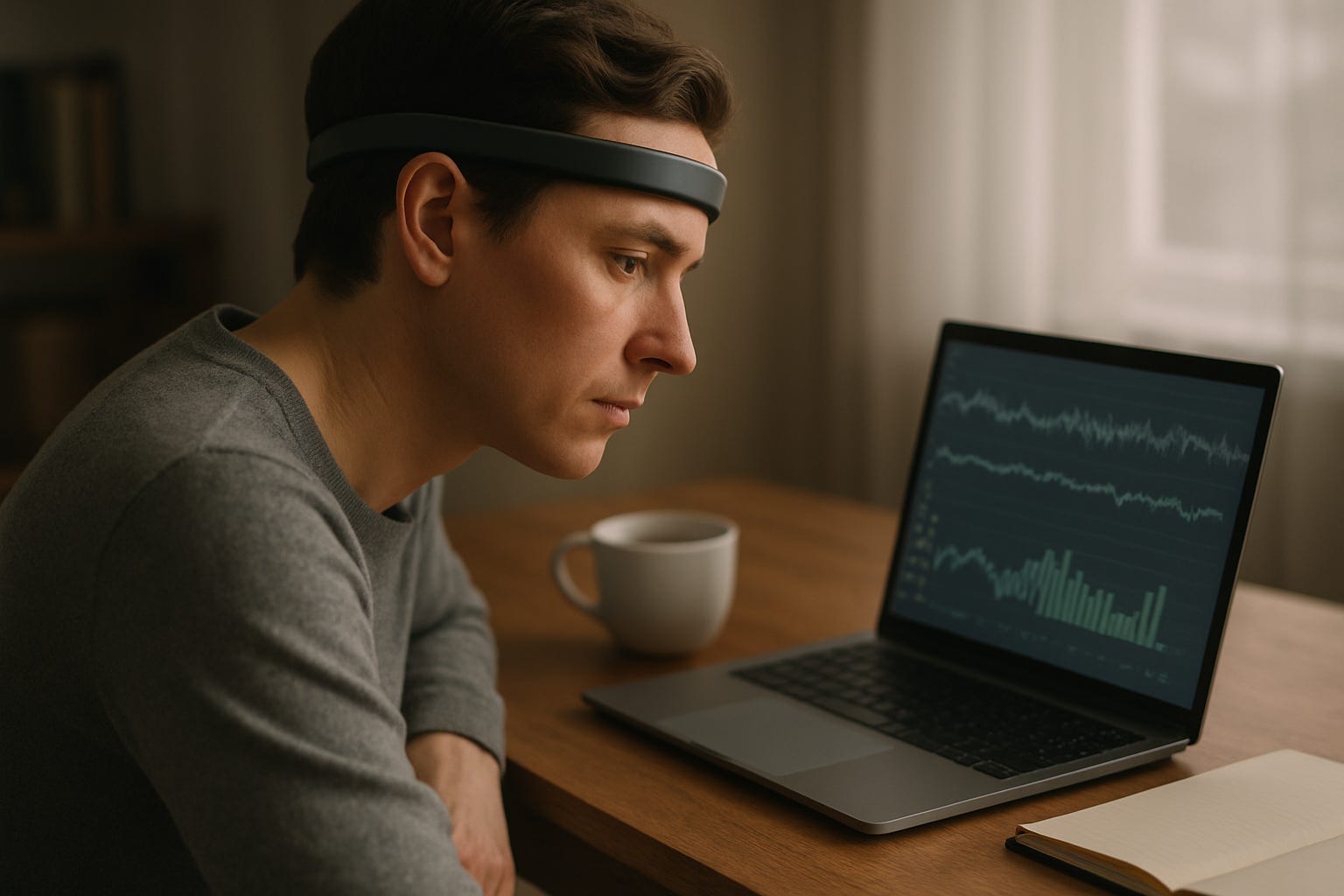
So you bought a brainwave headband. Maybe it’s a Muse, maybe it’s an Emotiv, maybe it’s a pair of earbuds that quietly moonlight as an EEG rig. Whatever it is, it’s now feeding you a stream of numbers, graphs, and little cartoon flames that supposedly represent your “focus.” The hardware part is easy. The hard part, the part nobody explains, is figuring out what any of it actually means and where the marketing stops and the neuroscience starts. Let’s fix that. 🧠
What your headband is actually measuring
Every consumer EEG device is reading the same basic thing: the summed electrical activity of thousands of neurons firing near the surface of your brain, picked up through your scalp (or, increasingly, your ear canal). It sorts that raw signal into frequency bands, and each band correlates loosely with a mental state. This is worth memorizing because it’s the foundation for reading literally any brainwave app you’ll ever use.
Delta (below 4 Hz): deep, dreamless sleep
Theta (4-8 Hz): drowsiness, light meditation, some memory processing
Alpha (8-12 Hz): relaxed wakefulness, especially with your eyes closed; alpha drops when you focus
Beta (13-30 Hz): active thinking, alertness, problem-solving
Gamma (above 30 Hz): high-level processing tied to attention and perception
NeurotechMag went deeper into these categories in 7 signals your brain is giving you, and it’s a good companion read if you want the underlying neuroscience instead of just the app’s summary screen. The key thing to internalize here: your headband isn’t reading thoughts. It’s reading rhythms, and it’s making an educated statistical guess about what those rhythms probably mean, based on population-level research, not a scan of your specific brain. That gap between “probably means” and “definitely means” is where most of the overselling in this space happens. 📊
The hardware landscape, and what it’s actually good for
Not all headbands are chasing the same goal, and picking one without understanding that leads to disappointment fast. The 2026 lineup roughly splits into a few camps.
Meditation and sleep tools, like the Muse S Athena, which pairs EEG with fNIRS (a blood-oxygenation signal) and is built around guided audio feedback rather than raw data exploration
Productivity and attention trackers, like the Neurosity Crown, which uses eight EEG channels to nudge you with adaptive audio when your focus appears to drift during work
Developer and research-grade kits, like Emotiv’s EPOC line and OpenBCI’s boards, which expose raw data and let you build your own analysis pipeline instead of trusting a black-box app
Ear-EEG, a newer category from companies like NextSense and IDUN Technologies, tucking electrodes into earbuds so you can wear the thing on a commute without looking like you’re heading into an fMRI machine
Here’s the practical distinction that actually matters when you’re choosing: does the device give you raw data access, or does it just hand you a proprietary “focus score”? Neurosity and Emotiv generally let serious users export raw signal. Muse and most of the meditation-first devices keep that layer locked behind their own app and, often, a subscription. If you actually want to read your brainwave data yourself rather than trust someone else’s interpretation of it, raw export isn’t optional. It’s the whole point. ⚡
Reading the data without fooling yourself
This is the part where most biohackers go wrong, not because the hardware lies, but because raw EEG is an absolute mess of noise, and it’s tempting to see meaning in what’s actually an artifact.
A few things worth knowing before you trust a spike on your dashboard:
Eye blinks and jaw clenches produce electrical signals far larger than most brain activity, and they routinely get misread as gamma or beta spikes on cheaper single-channel devices
Dry electrodes (used in most consumer headbands, for comfort) give a noisier signal than the wet, gel-based electrodes used in clinical EEG, so expect more variance session to session
Your own baseline matters more than any absolute number. A “focus score” of 62 means nothing in isolation. What matters is whether your 62 today is higher or lower than your typical range
Placebo effects are real and well-documented in this exact category. Simply watching a number and believing you’re influencing it can change behavior and self-report, independent of whether the device is measuring anything precisely
That last point deserves a beat of honesty most product pages skip entirely. NeurotechMag dug into a closely related problem, why brain stimulation devices produce such wildly inconsistent individual results, in can you actually boost your IQ with brain stimulation. The same lesson applies here: the brain is not a simple dial, and neither is the device reading it. If you’re tracking your own data over weeks and months rather than chasing a single session’s number, you’re doing it right. If you’re comparing your Tuesday afternoon score to your Wednesday morning score and drawing conclusions, you’re mostly reading noise. 🔬
Know what the data legally can and can’t claim
Here’s something worth sitting with: no consumer EEG headband on the market is FDA-cleared as a medical device. Every single one, Muse, Emotiv, Neurosity, the ear-EEG startups, all of them operate under the FDA’s general wellness policy, a framework that lets low-risk products make lifestyle claims (”supports focus,” “may help you relax”) without the clinical trial process a medical device requires. That’s not a criticism of the hardware. It’s a fact about what the label on the box legally means, and it’s worth knowing before you interpret a “stress score” as a diagnosis of anything.
That distinction matters even more given how fast the category is moving. NeurotechMag covered the broader momentum building behind consumer neurotech in 6 signals that neurotech is reaching a tipping point, and one thing that piece gets right: capital and attention are pouring into this space faster than regulation or independent validation can keep pace with. That’s exciting if you’re a biohacker who likes being early. It’s also a reason to hold every claim on every app’s dashboard a little more loosely than the app itself would like you to.
A quick gut check before you act on anything your headband tells you:
Is this a trend over weeks, or a single reading?
Could this spike be a blink, a clench, or bad electrode contact instead of a real brain state?
Is the app claiming to treat something, or just reflect something? Only one of those claims requires real trial data
Would I trust this number if a friend, not an app, told it to me with the same level of confidence?
Your own brainwave data is genuinely interesting, and tracking it over time can teach you real things about your sleep, your stress patterns, and your attention. Just read it the way you’d read any self-tracked metric: useful in aggregate, unreliable in isolation, and never a substitute for a clinician when something actually feels wrong. What’s the first pattern you’re hoping to find in your own data, and are you ready to be patient enough to actually see it? 🚀