

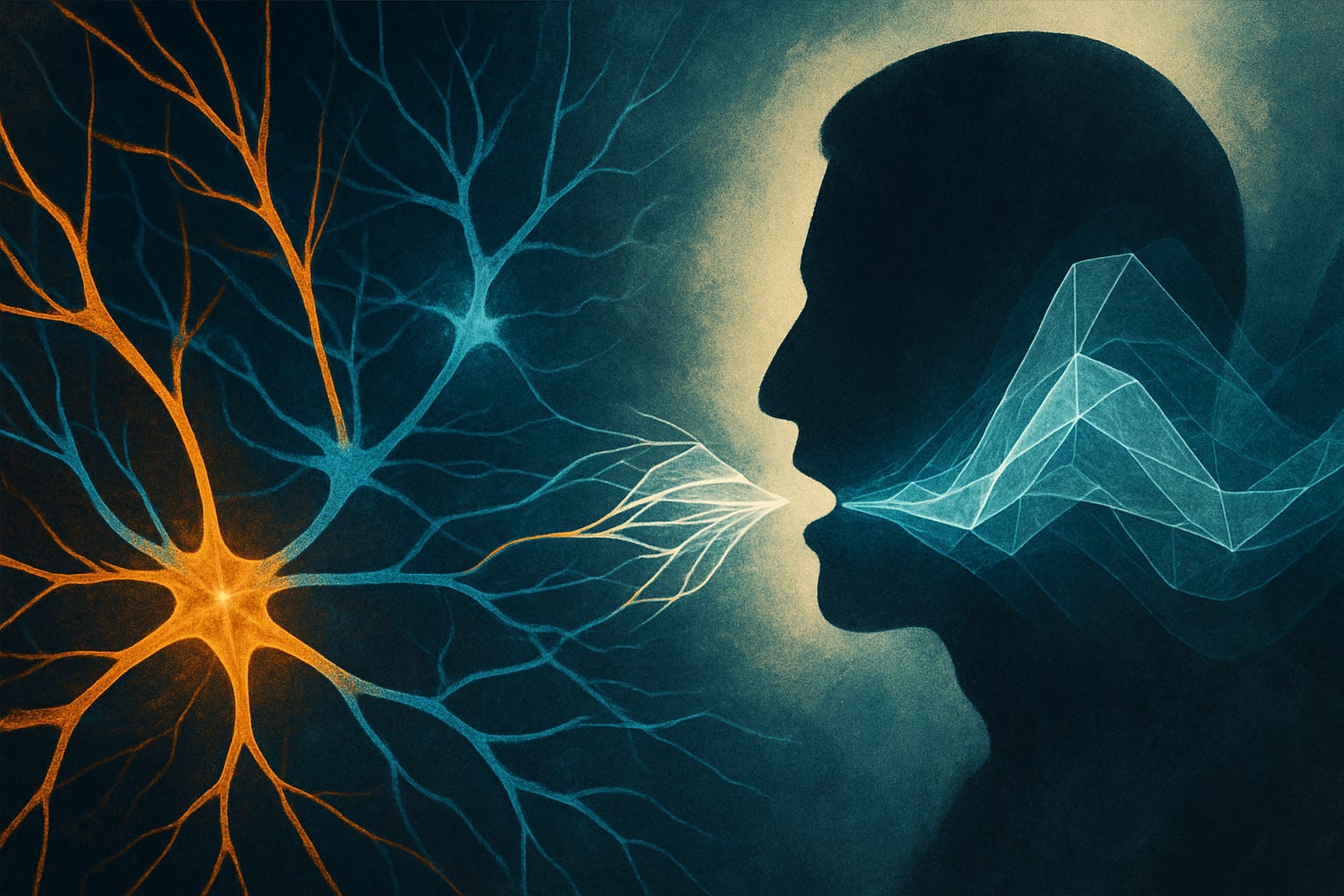
A man who hasn’t spoken clearly in five years asks his home care team to hook him up, then goes to work. Not metaphorically. He clocks in, joins meetings, and talks with his daughter, who has never once heard the sound of his real voice. This isn’t a demo reel moment staged for cameras. It’s an ordinary Tuesday for a brain-computer interface (BCI) patient in an ongoing clinical study, and it’s probably the clearest sign yet that speech-restoring neurotech has crossed from lab curiosity into something people can actually live with. 🎙️ I went digging through the recent trial data to figure out how far this technology has really come, and the numbers are more impressive than I expected.
How a silent brain becomes a spoken sentence
Speech starts in the brain’s motor cortex, in a strip of tissue called the precentral gyrus that coordinates the muscle movements behind talking. In people with ALS, paralysis, or brainstem strokes, that region often still fires normally. The signal just can’t get past a damaged spinal cord or damaged nerve pathways to reach the muscles. A speech BCI intercepts the signal at the source.
The basic setup, across most current systems, looks like this:
Tiny microelectrode arrays, smaller than a baby aspirin, get surgically placed on the brain’s surface layer
The arrays record neural activity as the patient attempts to speak, even though no sound comes out
A computer algorithm, trained with machine learning, decodes those patterns into intended words
A screen displays the predicted text, and text-to-speech software reads it aloud, sometimes in a voice cloned from recordings of the patient’s own pre-illness speech
Researchers at Stanford, led by neurosurgery professor Frank Willett, have described inner speech decoding research that pushes this even further, exploring whether brain regions tied to language and hearing might eventually decode speech a patient only imagines, without any attempt at physical articulation. That’s still early, but it points at where this is headed. 🧠
The accuracy numbers that actually surprised me
I’m generally skeptical of neurotech accuracy claims because the field has a habit of rounding up. This one held up. A team at UC Davis, led by Nicholas Card, Sergey Stavisky, and David Brandman, implanted four arrays of 64 microelectrodes each into a 45-year-old ALS patient’s precentral gyrus. According to NIH’s coverage of the trial, the system was switched on just 25 days after implantation, calibrated for only 30 minutes, and then decoded more than 99 percent of words correctly using a 50-word vocabulary.
That’s a real jump. Older systems needed far more calibration time and still landed around 75 percent accuracy, roughly one in four words wrong, which sounds fine on paper until you try to have an actual conversation that way. For comparison, a separate BrainGate study reported in IEEE Spectrum’s writeup on BCI speech synthesis found that human listeners could understand a patient’s near-instant synthesized speech about 56 percent of the time, up from roughly 3 percent without the device. Researchers Maitreyee Wairagkar and Carrina Iacobacci were careful to call it a proof of concept, not a finished product, and I appreciate that honesty. Progress here isn’t linear, and it depends heavily on vocabulary size, calibration time, and how close the electrodes sit to the right patch of cortex.
From lab trial to full-time job
The most striking recent case involves a patient named Harrell, whose BCI use was documented in The Register’s report on his return to full-time work. A few details stood out to me:
He’s logged more than 3,800 hours on the device, averaging roughly five hours a day
His home care team can operate the system themselves, no researchers required on-site
Earlier BCI systems demanded either constant lab supervision or trips to a research facility, neither realistic for daily life
He’s held meaningful conversations with a daughter who has never heard his unassisted voice
Brandman put it simply: the point isn’t the technology’s cleverness, it’s that a guy who wants to talk can now talk. 💬 That’s a low bar in theory and an enormous one in practice, and it’s the difference between a headline and something a family actually depends on.
What still stands between the lab and everyday life
I don’t want to oversell this. These are still small studies with individual patients, not FDA-approved commercial products, and the field knows that. The P300 spellers and motor-imagery systems we covered in 7 signals your brain is giving you are one branch of this same decoding family, and even those established methods still face real limits:
Vocabulary sizes remain small in the highest-accuracy demos, scaling to natural, unrestricted conversation is the next hard problem
Surgical implantation carries genuine risk, and long-term tissue effects need more years of data
Non-invasive alternatives, like the neuromagnetic voice-detection work happening in academic labs, lag well behind implanted systems on accuracy
Insurance coverage and regulatory approval for speech-restoring BCIs specifically remain unresolved
It’s worth reading this alongside our look at how neurotech is already changing depression treatment, because the pattern is the same across the field: the science is real, the results are earned, and the honest timeline to your neighborhood clinic is still measured in years, not months.
Would you trust a synthesized version of your own voice, built from old recordings, to speak for you every day? I’d love to know where you land on that, and whether the answer changes if it’s someone you love who needs it.